
The military escalation between Russia and Ukraine is no longer confined to widening the scope of attacks and an exchange of long-range strikes; it now also reflects a growing divergence between Moscow and Washington over the path to ending the war. While the American administration believes that increasing military pressure on Russia may create conditions for negotiation, the Kremlin insists that this approach will only prolong the fighting — even as mutual strikes on energy facilities and military infrastructure continue, and signals mount that President Vladimir Putin is intent on pressing ahead with military operations in the current phase.
In the latest statements, Kremlin spokesman Dmitry Peskov said yesterday that the American administration is committing a "miscalculation" by believing that escalation and military pressure can pave the way to a peaceful settlement, stressing that "measures that lead to further escalation will not contribute in any way to advancing the peace process."
He added that the continuation of Ukrainian attacks inside Russian territory would force Moscow to "expand the security zone or buffer zone," arguing that any fresh escalation could extend the duration of the special military operation.
Peskov's remarks came in response to positions announced by US President Donald Trump and Secretary of State Marco Rubio during the NATO summit in Ankara, where Trump said that escalating Ukrainian strikes "could help bring the conflict to an end," while Rubio argued that the difficulties Russia faces in protecting its airspace could create better conditions for entering into negotiations.
At the same time, Peskov affirmed that President Putin remains open to dialogue with the American president, noting that the United States — unlike a number of European countries — still shows a desire to contribute to peace efforts. He expressed Moscow's hope for a resumption of American mediation once Washington's preoccupation with the Middle East file subsides.
On the question of American military support, Peskov said Moscow has no doubt that US arms supplies to Ukraine are continuing, following Trump's announcement that he had granted Kyiv a licence to produce Patriot missile system missiles outside the United States, adding that Russia "will do whatever is necessary to protect its interests."
In another indication of Russia's hardening stance, Reuters reported yesterday, citing 3 sources close to the Kremlin, that Putin does not believe current conditions are suitable for negotiations with Kyiv, and that recent Ukrainian attacks on Russian oil refineries and ports have reinforced his conviction that the war must continue.
2 of the sources added that the Russian president is likely to escalate operations in the coming months, with one source describing the probability of escalation as "strong."
This political dispute unfolded alongside continued battlefield escalation between the two sides.
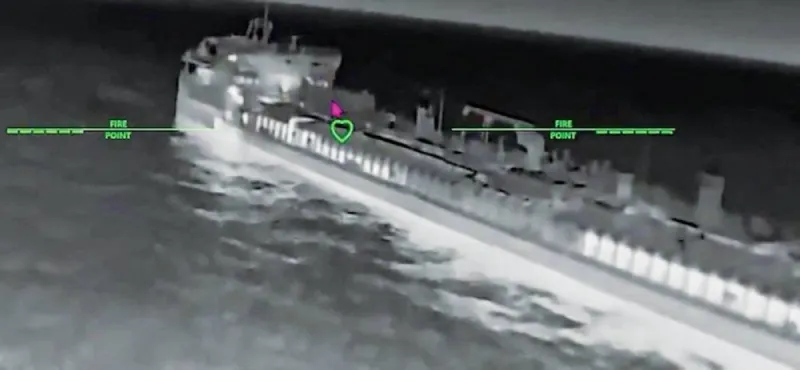
Ukrainian President Volodymyr Zelensky announced yesterday that Ukrainian forces had targeted oil facilities in Stavropol and Tver, an oil pumping station in the city of Ufa, a strategic fuel depot, and an oil loading terminal in the Rostov region. He confirmed that these strikes fall within what he described as a "long-range sanctions" policy aimed at raising the cost of the war for Russia. Ukraine's General Staff also announced the targeting of 12 Russian tankers in the Sea of Azov, which it said were being used to supply the Russian army with fuel and transport petroleum products, in addition to striking a tugboat and a cargo vessel.
In response, Russia's Ministry of Defence announced that its forces had carried out strikes over the past 24 hours on energy, fuel and transport facilities, logistics centres, drone warehouses, and Ukrainian troop deployment sites across 142 areas. Ukrainian authorities announced that 2 people were killed in a Russian drone attack that targeted a vehicle in the city of Kherson.
In the aerial war, Russia's Ministry of Defence announced the downing of 73 Ukrainian drones the night before last over several Russian regions, the Crimean Peninsula, and the Sea of Azov, while the Ukrainian Air Force announced that 72 out of 94 drones launched by Russia had been shot down or disabled.