
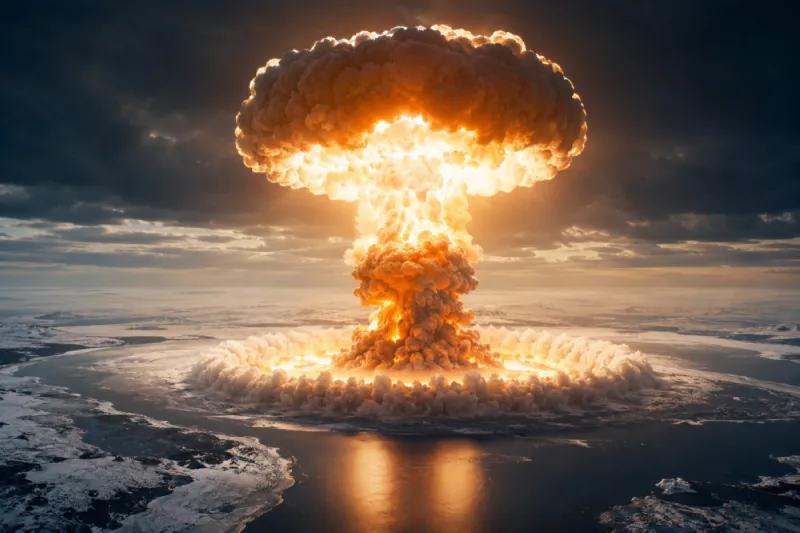
On the morning of 30 October 1961, the largest explosion ever created by man thundered over Severny Island in the Novaya Zemlya archipelago in northern Russia, after the Soviet Union detonated the "Tsar Bomba" — the most powerful nuclear weapon ever tested in history, in an experiment that still represents the peak of destructive force ever achieved by humankind.
The Tsar Bomba had a yield of more than 50 megatons, equivalent to 50 million tonnes of conventional explosives. That is ten times the combined power of all munitions used during the Second World War, and more than 1,500 times the power of the atomic bombs dropped on Hiroshima and Nagasaki combined.
The bomb carried the official designation RDS-220, but became known worldwide as the "Tsar Bomba" — a name that literally means "King of Bombs" — in reference to its status as the most powerful nuclear bomb ever detonated. It was also known by several other names and nicknames, including "Big Ivan", "Project 7000", and "JOE 111", as well as "Kuzka's Mother" (Kuzka's Mother), a Russian expression used to denote delivering a devastating blow or harsh lesson, a label attached to the bomb because of its immense destructive power.
The bomb was designed by a team led by Soviet physicist Andrei Sakharov, who was later nicknamed the "Soviet Oppenheimer". Yet the man who helped develop the most powerful nuclear bomb in history went on to become one of the most prominent opponents of the nuclear arms race, and was awarded the Nobel Peace Prize in 1975.
In 2020, the Russian state atomic energy corporation Rosatom released unprecedented video footage of the test, though the video was later removed from YouTube.
The bomb was dropped over the northern tip of Severny Island in the Novaya Zemlya archipelago in northern Russia. Its power was so immense that it had to be released from an aircraft fitted with a parachute to give the crew sufficient time to survive the blast. Even so, it was not certain the crew would make it.
The impact of the Tsar Bomba
In a flash of white light, the bomb produced a fireball 8 kilometres (5 miles) wide, ultimately peaking in a mushroom cloud that rose 64 kilometres (40 miles) into the sky.
One of the Soviet cameramen who witnessed the test described the moment of the explosion as appearing to be a scene beyond reality, saying that an enormous white flash illuminated the clouds and the entire horizon, and that everything below the aircraft turned into a sea of light, with the clouds appearing to glow and become transparent.
He added that when the aircraft emerged from between two layers of cloud, a gigantic orange fireball appeared below, rising slowly and steadily before piercing through the clouds and continuing to expand, until it seemed to him as though it were swallowing the entire earth.
He concluded his account by saying: "It was a majestic, surreal, and almost supernatural sight."
Incredibly, the bomb was dropped just 54 kilometres (34 miles) from the town of Severny, which was presumed to be inhabited. It was reported that all wooden and brick buildings in the town were instantly levelled. No casualty figures were disclosed. Reports even emerged of windows shattering in Norway and Finland. Nevertheless, despite the force of the explosion, the bomb left surprisingly little radioactive fallout thanks to its design.
The Tsar Bomba was far too large and impractical to ever be of operational use. Indeed, the sheer scale of the explosion is often cited as one of the principal motivations behind the Partial Nuclear Test Ban Treaty of 1963, in which the United States and the Soviet Union agreed to halt atomic bomb tests in the atmosphere, outer space, and underwater, according to IFLScience.
Unfortunately, these lethal weapons continue to be stockpiled around the world. The total number of nuclear warheads in the world stood at approximately 12,700 as of July 2026. Nearly 90% of them are held by two countries — the United States and Russia — while the remaining approximately 1,200 are shared among the United Kingdom, France, China, India, Pakistan, Israel, and North Korea.