
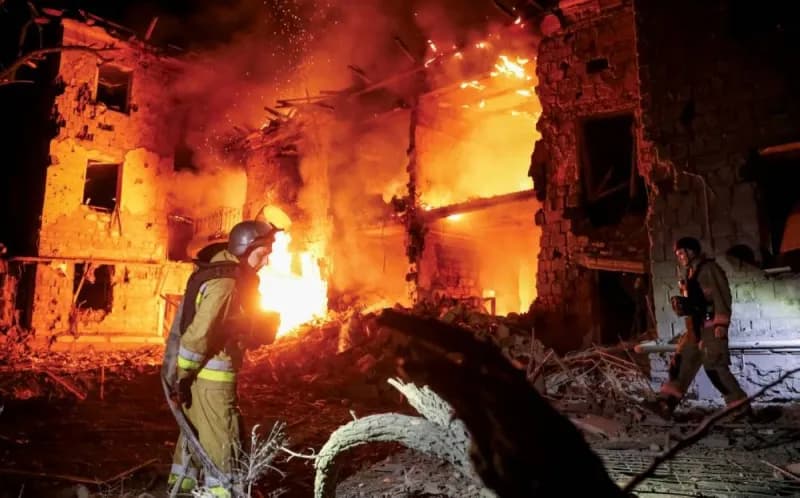
Relations between Russia and Europe have reached an historically unprecedented level of tension and near-total rupture since the start of the war in Ukraine, with all sides exchanging continuous warnings about the possibility of direct escalation, amid a widening defence gap and European states' drive to reinforce their security.
The language of escalation dominates both the political and battlefield dimensions of the Ukraine crisis, amid explicit Russian warnings that the conflict could broaden into a direct confrontation with Western states, with Moscow cautioning Europe that a spark could change everything.
Russia's permanent representative to the Organisation for Security and Cooperation in Europe, Dmitry Polyansky, stated yesterday that European states "are not aware of how dangerous the current level of escalation in relations with Russia is."
Polyansky said: "It seems to me that in Europe they do not understand that we are now passing through an extremely dangerous zone."
The Russian diplomat explained that the matter concerns, in particular, strikes carried out through the airspace of Baltic states, the deployment of weapons production facilities — including drones targeting Russian territory — as well as other actions that already fall within a "grey zone," where military personnel can interpret the course of events in differing ways.
Moscow's warning about a "grey zone" with Europe reflects the most dangerous stage of escalation: when war is not declared yet becomes ignitable by a single mistake. Between Baltic drones and arms factories, Europe and NATO are shifting in Russia's eyes from supporters of Ukraine to parties approaching the line of direct confrontation.
As mutual warnings escalate between Moscow and Western capitals, Europe appears to stand before Russia with a less than fully cohesive front, one marked by historical divergences and differing policy approaches toward the nature of the threat and how to address it.
While European leaders speak with growing boldness about confronting Russia, the continent still lacks many of the capabilities required to wage a large-scale war without United States participation — particularly as military recruitment faces difficulties, defence industries remain fragmented, and "strategic autonomy" remains closer to aspiration than reality.
These developments coincide with intensive European efforts to compensate for the gradual decline in American engagement in the Ukraine war. Kyiv received the first tranche of military assistance — worth 3.9 billion euros ($4.4 billion) — from the support loan approved by the European Union for Kyiv, with a total value of 90 billion euros.
The European Union approved the loan earlier this year; it comprises 60 billion euros in military assistance and 30 billion euros in budgetary support for Ukraine during 2026 and 2027. The European Commission announced that the tranche is earmarked for the purchase of drones.
Meanwhile, two European officials and documents reviewed by Reuters reported that a secret Chinese military training exercise for Russian forces, conducted last year, took place with the direct approval of Russian Defence Minister Andrei Belousov and with the participation of senior generals from both sides.
According to the sources, the training — conducted within the framework of military cooperation between Moscow and Beijing — involved the participation of at least 4 Russian and Chinese generals, a step that, according to European assessments, reflects the growing importance both states attach to developing their defence partnership in the context of the war in Ukraine.
China's Ministry of Foreign Affairs denied the veracity of these allegations, affirming that Beijing's position on the war in Ukraine has not changed.
The ministry said in a statement that "the relevant claims are completely without foundation," characterising them as part of smear campaigns.
Beijing had previously denied similar reports about the training of hundreds of Russian soldiers on its territory, while Moscow refrained from commenting and described such reports as "disinformation."
Against this backdrop, European Union member states are closely monitoring the growing cooperation between Russia and China. Moscow has been regarded as "the greatest security threat" to Europe since the outbreak of the war in Ukraine in 2022, while China remains a key economic partner of the European Union.
Discussions are under way within EU institutions about the possibility of taking additional measures toward Beijing, despite a careful balancing act between political and security considerations on the one hand and economic relations on the other.
On the military front, Ukrainian President Volodymyr Zelensky said yesterday that Ukrainian forces struck an oil refinery in the Russian city of Ufa — more than 1,300 kilometres from the front line — for the second time.
Zelensky indicated that a strike had been carried out on what he described as a "strategic facility" in Penza region, which manufactures components for missiles used by Moscow in its attacks on Ukraine.
He wrote in a post on X: "The distance to the target is approximately 600 kilometres from the front line."