
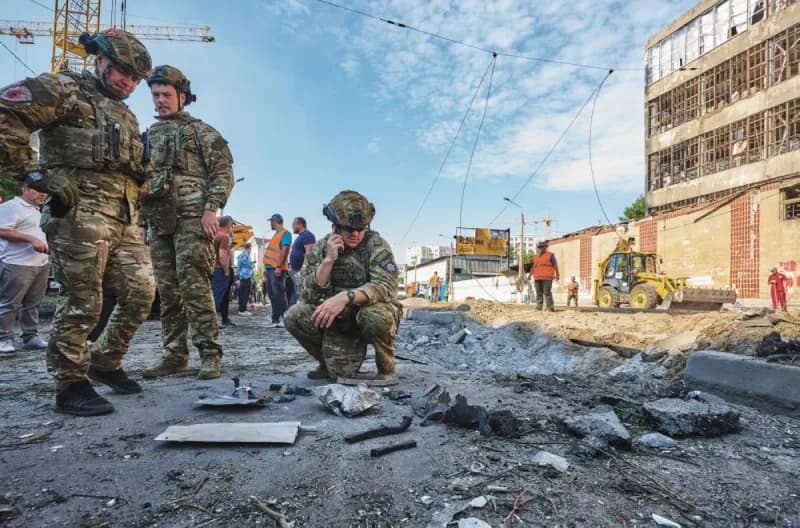
The Ukrainian crisis is witnessing continuous escalation that is overshadowing diplomatic solutions, as a war of attrition rages on the ground alongside a drone war, amid a deadlock in political settlement efforts. The parties are edging toward the brink, with any imminent rapprochement ruled out.
The Russia-Ukraine war entered a new phase of unprecedented escalation during the past month of June, after mutual strikes expanded deep into the territory of both countries.
Prospects for resuming peace negotiations have consequently receded, despite continued mutual statements about readiness for dialogue. What is unfolding is no longer merely a new round of battlefield escalation, but an attempt to impose a new political equation under fire in the absence of any diplomatic settlement horizon.
The past month saw a series of the largest long-range strikes since the war began. Ukraine intensified its use of drones and missiles to strike oil and military facilities and communications centres inside Russia, including targets near Moscow, St. Petersburg, and Crimea, in an attempt to disrupt Russia's supply network and bring the war inside Russian territory.
In response, Russia launched intensive air and missile campaigns targeting several Ukrainian cities, including Dnipro, Zaporizhzhia, Kharkiv, and Sumy, using a combination of ballistic missiles, drones, and glide bombs, resulting in dozens of casualties. Ukrainian officials warned that Moscow is preparing to continue large-scale strikes in the coming period.
Observers agree that the past month represented a clear shift in the nature of the war, as long-range strikes have become a core element of both sides' strategies. The traditional front line is no longer the sole theatre of operations; strikes have extended hundreds of kilometres into enemy territory.
Dmitry Brigach, professor of international relations and director of the Russian Studies Unit at the Centre for Arab-Eurasian Studies, says that the latest Russian-Ukrainian strikes fall within the framework of mutual pressure policy that has governed the course of the war since 2022, noting that the conflict is no longer purely military but has transformed into a comprehensive political, economic, and strategic confrontation.
He considers the current escalation to be primarily retaliatory in character, representing a Russian response to Ukrainian strikes that targeted Russian territory in recent weeks.
He points out that Moscow, by expanding the scope of its strikes, seeks to target political and military decision-making centres, increase pressure on the Ukrainian economy, and send deterrence messages to countries supporting Kyiv.
Dmitry warns of the crisis widening beyond Ukraine's borders, particularly given the recurring incidents involving drones and security friction around the Black Sea and Eastern Europe. He notes that modern warfare is increasingly relying on long-range strikes and drones, raising the likelihood of indirect confrontations between Russia and NATO.
The Russian expert stresses that ending the war requires a comprehensive political settlement that goes beyond a temporary ceasefire and addresses outstanding security, economic, and diplomatic issues. He warns that the absence of root-cause solutions could lead to a more dangerous phase of the conflict, in which military calculations become intertwined with geopolitical tensions, threatening to prolong Europe's most complex crisis in decades.
Dr. Tariq Al-Bardisi, an expert in international relations, believes the latest wave of military escalation cannot be separated from the "war of nerves" and attrition strategy both sides have pursued for years, though it has intensified significantly in recent weeks.
He affirms that this battlefield intensification reflects each party's attempt to impose its conditions and demonstrate its ability to withstand military and political pressure, in parallel with divergent international moves aimed at ending the crisis.
He adds that the current escalation can be seen as part of "coercive diplomacy", whereby each side seeks to raise the ceiling of its demands and improve its negotiating position ahead of any potential round of talks — deep strikes: did June redraw the course of the Russia-Ukraine war?