
As diplomatic efforts to end the war in Ukraine falter, Moscow has sent simultaneous messages on three fronts, reflecting its readiness to continue the confrontation — politically and militarily — alongside announcements of fresh battlefield gains in eastern Ukraine.
Russian President Vladimir Putin declared that his country is prepared for a "swift and effective" response to any external or internal threats, asserting that Western nations have begun openly declaring their readiness for war with Russia, while the international situation is marked by rising instability and an expanding risk of conflict.
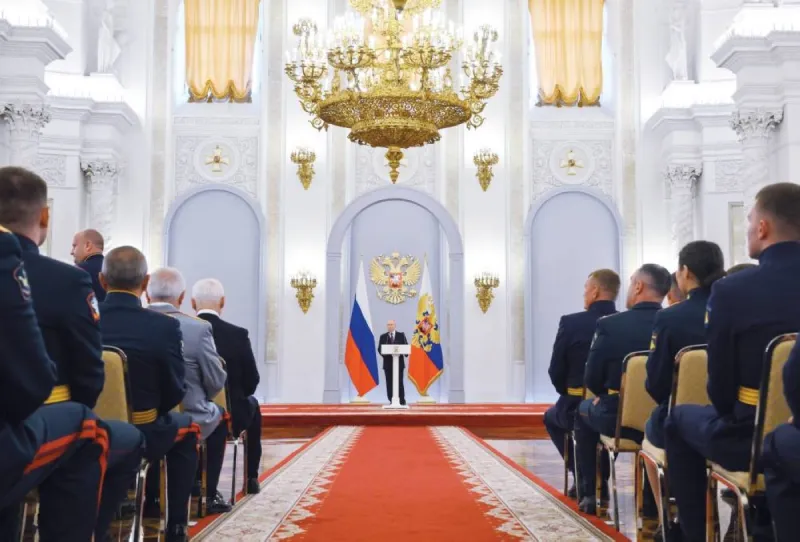
Speaking at a meeting with graduates of military academies, Putin stressed that Russian armed forces continue to carry out their mission in Ukraine. He confirmed that Russia's nuclear triad is undergoing continuous modernisation, and that cooperation between combat forces and the defence industry has led to qualitative advances in a number of weapons systems since the war began.
Putin defended his country's position, arguing that Moscow was compelled to act following the failure of the Minsk agreements and the continuation of fighting in Donbas. He reiterated that Ukraine is carrying out strikes against civilian targets inside Russia in an attempt to destabilise society.
Putin linked his political messaging to developments on the ground, announcing that Russian forces now exercise near-complete control over the city of Kostiantynivka in Donetsk, one of the most significant Ukrainian defensive strongholds in the east.
He confirmed that operations are ongoing inside some districts, while Russia's Ministry of Defence announced that its forces had cleared 128 buildings in the preceding 24 hours and continued to advance on several axes.
Ukraine, for its part, announced the downing of 118 Russian drones overnight, while Moscow said it had intercepted 143 Ukrainian drones and 5 Storm Shadow missiles, underscoring the continued aerial war of attrition alongside ground battles.
Meanwhile, statements by Foreign Minister Sergei Lavrov before foreign ambassadors in Moscow signalled a marked decline in Russian confidence in the negotiating track with Washington.
Lavrov said he did not even want to "so much as suspect" that previous understandings with the United States had been used to buy time and rearm Ukraine, while insisting that Moscow still regards the outcomes of the Alaska summit between Putin and US President Donald Trump as the basis for any possible settlement.
Lavrov accused the United States of moving away from the role of "neutral mediator" and engaging in a policy of escalating pressure and sanctions against Russia. Deputy Foreign Minister Sergei Ryabkov also spoke of "elements of drift" in the American position away from earlier understandings, while affirming that dialogue channels between the two sides remain open.