
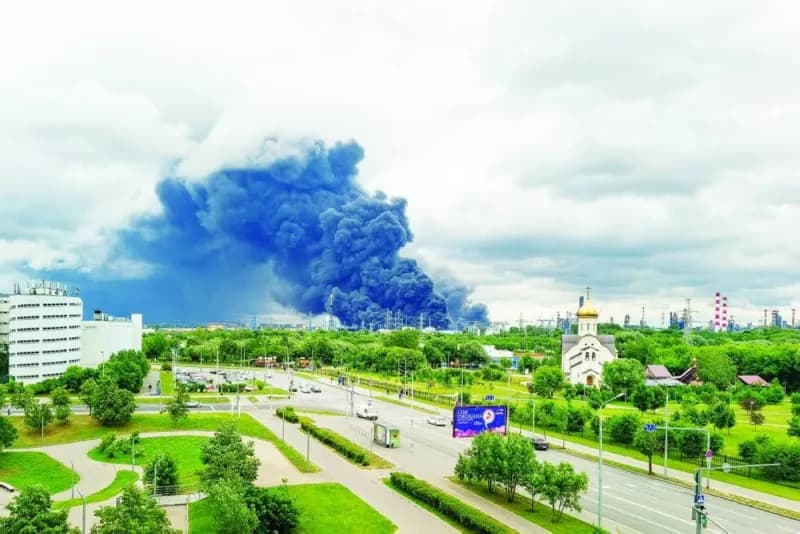
The Russian-Ukrainian war is witnessing mutual escalation through a strategy of 'fire messages' focused on targeting energy infrastructure. Ukraine is striking oil refineries and fuel depots deep inside Russia to paralyse airport operations and undermine Russia's financial capacity, while Russia responds with some of its fiercest missile and drone attacks on towers in the Ukrainian capital Kyiv and other vital areas.
4 people were killed and a number of civilians were wounded in a Russian attack on the city of Kharkiv in northeastern Ukraine, as strikes extended to several other regions amid continued mutual military escalation between Moscow and Kyiv.
Witnesses reported that 4 Ukrainian regions came under Russian attack in recent hours using drones, guided aerial bombs, artillery fire, and multiple rocket launchers.
In Kharkiv, Russian forces targeted the Kholodnohirskyi and Shevchenkivskyi districts with guided aerial bombs, killing 2 people and wounding 9 others, according to the latest toll announced by the local military administration.
Civilian facilities and infrastructure in the city and surrounding areas were also damaged, including Kupiansk, Bohodukhiv, Izium, and Lazova, as well as 8 residential buildings within the city. The attacks extended to the Dnipropetrovsk and Zaporizhzhia regions in the southeast of the country.
The military administration in Dnipropetrovsk announced that 3 areas — Kryvyi Rih, Samarivka, and Nikopol — came under 10 attacks overnight using drones, artillery, and multiple rocket launchers, with no casualties reported.
In Zaporizhzhia region, Russian strikes wounded 19 people, according to the military administration, which noted that more than 40 towns and villages, particularly those close to the front lines, were shelled. Damage was also caused to residential buildings, vehicles, buses, and civilian facilities.
The Ukrainian Air Force announced that Russia launched attacks using 99 drones, most of them of the Shahed type, confirming that Ukrainian air defences managed to shoot down or neutralise 92 of them, particularly in the southern and eastern regions of the country.
In response, the Russian Ministry of Defence announced it had shot down 187 Ukrainian drones overnight over various areas inside Russia, including the Moscow region, as part of mutual attacks that have become nearly daily between the two sides.
The balance of negotiations in the Ukrainian war appears still tied to developments on the ground and each side's ability to sustain operations, without Russia achieving a military decision that grants it a complete advantage, or Kyiv inflicting major damage, amid diverging international positions between Europe's support for Ukraine and Washington's pressure towards a settlement.
Military and oil facilities top the list of Ukrainian targets, as they are considered essential pillars in financing and managing Russian military operations, according to Ukrainian officials.
The fuel issue has returned to the forefront of the Russian scene, coinciding with the escalation of Ukrainian attacks on energy facilities and supply lines inside Russia, in addition to the continuation of Western sanctions on the energy and defence sectors.
The first signals came from the Kremlin, where Russian presidential spokesman Dmitry Peskov acknowledged a fuel shortage in Crimea, affirming that the authorities are working to take measures to address the situation.
A Politico report noted that 'Liuty' kamikaze drones are among the most prominent weapons on which Kyiv is banking in the current phase of the war, as they can carry warheads weighing up to around 150 pounds and fly distances exceeding 2,000 kilometres, giving them the ability to strike vital facilities deep inside Russia.
Meanwhile, Russia declared the end of wartime agreements with Ukraine following Moscow's attack. According to Russian Security Council Deputy Chairman Dmitry Medvedev, Russia no longer sees the need to abide by the Hague Conventions relating to the laws and customs of war in its confrontation with Ukraine, asserting that 'the only remaining limit' is not deliberately targeting civilians.
Russian forces have made notable advances in recent weeks in the city of Kostiantynivka and its surroundings in Donetsk, with most areas of the city now under Russian army control.
Sources had revealed to Politico a sharp division among European Union leaders over resuming dialogue with Russia, amid a clear divergence in positions regarding the timing and mechanism of a return to the negotiating table with Moscow.
French President Emmanuel Macron and German Chancellor Friedrich Merz both opposed holding any contacts with Moscow in its current form.