
As strikes between Russia and Ukraine continue and prospects for a political settlement recede, Moscow has reopened the file on biological laboratories in Ukraine, accusing the United States of funding secret military research into dangerous pathogens.
The Russian escalation comes alongside ongoing attacks on vital facilities on both sides, mutual hardening between Moscow and the West following the extension of European sanctions, and no sign of any imminent political breakthrough. Russia's Ministry of Defence announced the detection of large quantities of cholera, tularaemia, and brucella pathogens at the Mechnikov Institute in Ukraine, which it said the United States is rehabilitating and financing.
Lieutenant General Alexei Rtishchev, commander of the Radiation, Chemical and Biological Defence Forces of the Russian Armed Forces, said Russian forces had obtained, during military operations, new data relating to studies conducted in biological laboratories inside Ukraine concerning properties that could be used to develop potential biological weapons.
He added that documents published by US intelligence had confirmed, according to the Russian account, the locations of biological laboratories that Moscow had previously identified, noting that these facilities were funded from the US budget. He clarified that funding for Pentagon-linked military biological research was channelled through grants and intermediary organisations, and stressed that this research was carried out under conditions of secrecy with limited access for Ukrainian specialists.
Alexei Rtishchev indicated that Moscow holds information on research projects relating to highly dangerous infectious diseases, adding that experts at the Kharkiv Veterinary Institute studied diseases that can be transmitted to humans and have the potential to develop into large-scale epidemics.
Mutual strikes
In a related field development, the Russian administration of the Zaporizhzhia nuclear power plant announced that the plant's transport workshop came under a Ukrainian drone attack on the night of Thursday to Friday, comprising no fewer than 14 strikes, which sparked a fire and caused damage to a number of buildings. The administration said the attack targeted the transport and logistics infrastructure inside the plant, confirming that no casualties were recorded and that work continues to maintain the safe operation of the nuclear facility.
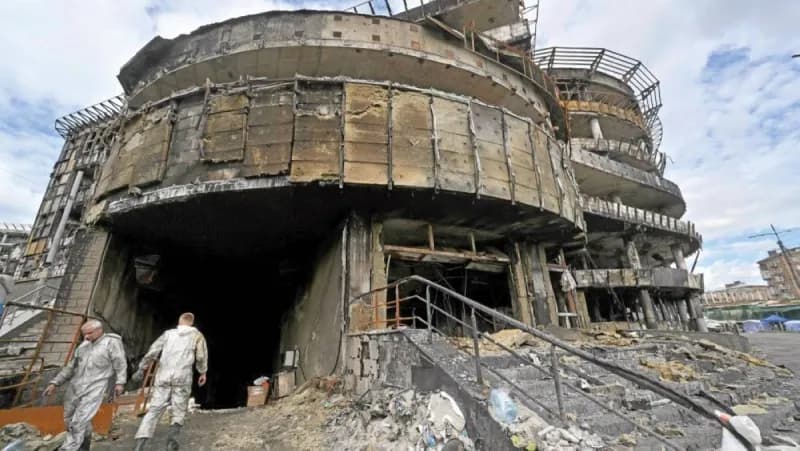
On the ground, mutual strikes between the two sides continued. Ukrainian authorities announced the killing of at least 3 people, including an 8-year-old girl, in Russian attacks targeting the Dnipropetrovsk, Odessa, and Kramatorsk regions, while 10 people including 4 children were wounded in strikes on the Kharkiv region.
Moscow, for its part, acknowledged a large-scale Ukrainian drone attack targeting the Russian capital and its surroundings, which sparked a fire at a major oil refinery, killed an 8-year-old girl, wounded 16 people, and caused damage to a number of residential buildings.
Russian position
Kremlin spokesman Dmitry Peskov confirmed that Russia is taking the necessary measures to deal with the consequences of the attack, stressing that Russian strikes against Ukraine will continue. Peskov also said that Europeans are mistaken if they believe they can negotiate with Russia from a position of strength, affirming that Moscow will remain open to dialogue if someone emerges in Europe who seeks direct engagement free of