
Moscow on Wednesday renewed its call for the Ukrainian president to engage in dialogue, as Western moves to increase pressure on Russia to end the war in Ukraine continued, against a backdrop of mutual escalation and an exchange of drone and missile strikes between the two sides. Kremlin spokesman Dmitry Peskov said that if Zelensky is ready for a serious dialogue, he can come to the capital Moscow.
Peskov said during a press briefing: "Zelensky, as you know — President Vladimir Putin has said everything, offered everything. He has said repeatedly that if Zelensky is ready to speak responsibly and seriously — and the regime in Kyiv is fully aware of this — he can always come to Moscow, where he will be received," according to Russia's Sputnik news agency.
Asked whether the Russian side had received an invitation through official channels to meet Zelensky on the sidelines of the G7 summit, Peskov said: "As you know, there are no official communication channels between Moscow and Kyiv."
Separately, British Prime Minister Keir Starmer announced that the United Kingdom will supply Ukraine with enriched uranium for its nuclear power plants through British export financing, reaffirming London's continued support for Kyiv. The British government also announced new sanctions on Russia covering around 70 entities, including financial institutions, insurance companies, and dozens of vessels linked to what London describes as the "shadow fleet" used to export Russian oil and gas.
The Canadian government also stated that Prime Minister Mark Carney announced new sanctions targeting Russia's "shadow fleet," energy revenues, the defence industries sector, and entities behind disinformation, in a statement issued following his meeting with Zelensky on the sidelines of the G7 summit in France.
In another political development, China denied European accusations that Russian soldiers had been trained on Chinese soil to participate in the war in Ukraine. Chinese Foreign Ministry spokesman Lin Jian said these allegations "have no basis in fact," describing them as fabrications and a distortion of the truth.
EU foreign and security policy chief Kaja Kallas had previously said the European Union was verifying reports that Russian individuals had received military training inside China before taking part in the war, noting that Brussels was examining the potential implications of this information.
On the battlefield, Russia's Ministry of Defence announced that its forces had seized the town of Novi Donbas in the Donetsk region, confirming continued advances along the Krasny Liman and Kostiantynivka axes.
The ministry said its forces had taken control of fortified positions and several buildings over the past 24 hours, adding that Ukrainian forces had suffered approximately 1,330 casualties during the same period.
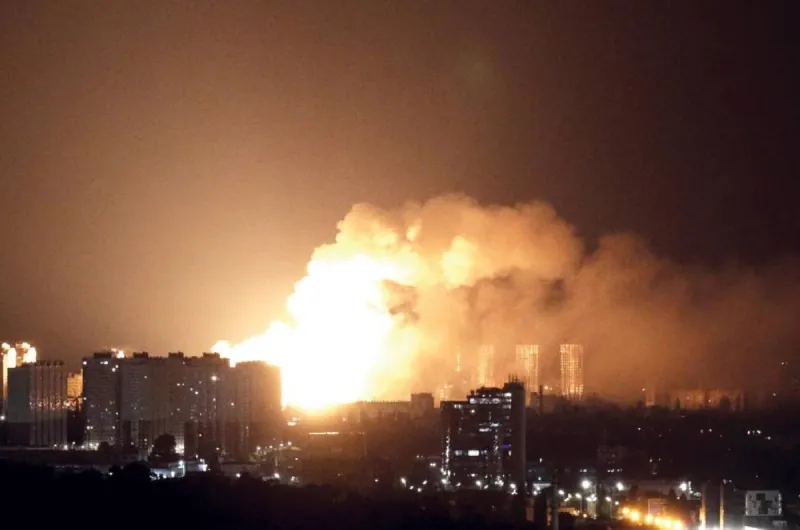
Moscow also announced the downing of 172 Ukrainian drones over various parts of the country, including around 60 over the capital. Moscow Mayor Sergei Sobyanin said one drone struck a site inside an oil refinery in the capital without causing casualties, while a Ukrainian official confirmed damage to one of the refinery's units.
Ukrainian President Zelensky said the strike targeted a facility belonging to Gazprom Neft inside Moscow, praising what he described as the effective work of Ukrainian agencies. For its part, the Ukrainian Air Force announced the downing or neutralisation of 114 out of 132 drones launched by Russia during attacks the night before last that targeted areas in the north, south, and east of the country. It noted that Russian forces also used 2 Iskander-M ballistic missiles in the attack.