
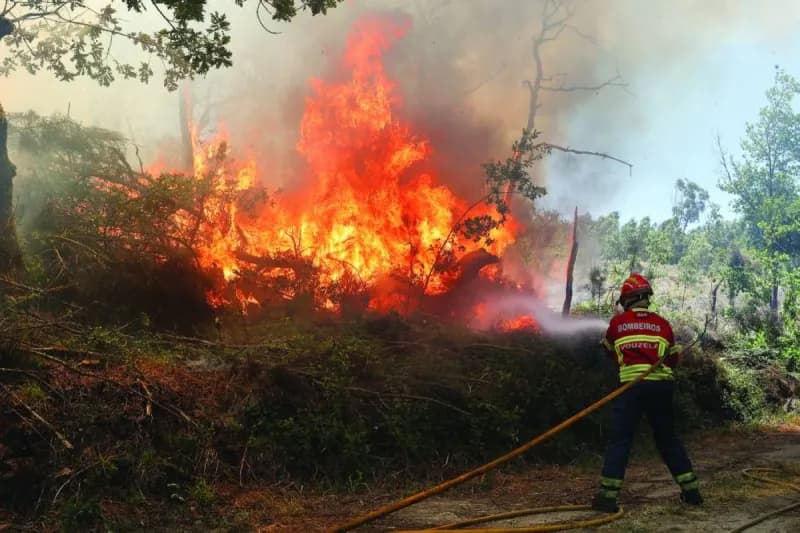
More than 1,300 excess deaths have been recorded by the World Health Organization in Europe, coinciding with historic temperature spikes exceeding 42 degrees Celsius in countries such as Germany and France.
Scientists' warnings are no longer merely deferred future scenarios — they have become a lived reality imposed by the scorching summer gripping the old continent.
As wildfires intensify and rivers run dry, a fundamental question preoccupying scientific and political circles has come to the fore: have these heatwaves become conclusive evidence of the human footprint in climate destruction, or are they simply a natural cycle of weather fluctuations?
Field readings and documented climate data indicate that the European continent is now recording warming rates more than double the global average, making it a hotspot for extreme environmental change.
Analysts explain that the heavy carbon emissions produced by the burning of fossil fuels, accelerating industrialisation, and deforestation have formed an insulating blanket trapping heat within the atmosphere. They also affirm that what Europe is witnessing today is the inevitable consequence of two centuries of carbon-based industrial revolution, with the likelihood of heatwaves having increased by at least tenfold compared to the pre-industrial era.
On the other side, a minority of analysts adopt a more cautious view, arguing that the atmosphere is a complex system subject to wide cyclical fluctuations — such as El Niño, La Niña, and Atlantic currents — which play a significant role in directing hot air masses.
However, the broader scientific consensus, supported by statistical studies, merges both views in a more nuanced formulation: natural fluctuations do indeed exist, but human intervention and greenhouse gases have "amplified" these fluctuations, transforming them from transient weather phenomena into extreme and lethal climate disasters.
Dr. Al-Sayed Sabri, a consultant on climate change and sustainable development, believes that the intense heatwaves Europe has been experiencing in recent times represent additional evidence of the reality of climate change linked to human activities, stressing that what is happening is no longer merely a passing weather phenomenon but a clear reflection of the global warming trajectory.
He explains that the last 12 to 14 years rank among the hottest since meteorological data recording began, confirming that the global warming phenomenon driving climate change has become an established scientific fact.
He notes that many regions — particularly in northern Europe and the northern parts of the world — are now experiencing heatwaves that are more frequent and intense compared to known historical averages, reflecting the accelerating climate shifts the planet is undergoing.
Sabri affirms that these changes are primarily attributable to human activities that have led to increased greenhouse gas emissions, chief among them carbon gases resulting from the extraction, production, and use of energy sources, alongside construction activities, urban expansion, and certain agricultural practices, as well as growing volumes of waste — factors that have collectively contributed to raising the concentration of greenhouse gases in the atmosphere and accelerating the pace of climate change.
For his part, Dr. Magdy Allam, an environment and climate expert and adviser to the World Climate Programme, affirms that the extreme heatwaves witnessed in Europe and globally reflect the profound shifts that have occurred in the global climate system. He notes that the features of traditional seasons have become less distinct than they once were, with spring and autumn periods receding in many regions in favour of a longer and hotter summer, and a winter of erratic characteristics.
He explains that Europe is among the regions most affected by current climate changes, where environmental and climatic impacts intersect with consequences for biodiversity, ecosystems, and natural resources.
He stresses that these phenomena cannot be separated from the accumulation of emissions generated by human activities, including the use of fossil fuels in all their forms, as well as industrial pollutants that have contributed to increasing the concentration of greenhouse gases in the atmosphere.
Allam points out that the world is witnessing an increasing frequency of extreme climate phenomena — from heatwaves and drought to desertification and sand encroachment — indicators that reflect the scale of pressures on the natural environment. He also draws attention to the melting of ice at both poles, and the consequent rise in sea levels and disappearance of some islands, as a clear warning of the danger of allowing current trends to continue.
He affirms that confronting the climate crisis requires a serious shift towards clean and renewable energy sources, such as solar and wind power, alongside reducing dependence on conventional fuels and curbing patterns of excessive consumption.
He stresses that the protection of humanity and the environment must take precedence over narrow economic considerations, calling for broader international cooperation and practical measures to promote afforestation, reduce emissions, and restore environmental balance before climate repercussions worsen in the future.