
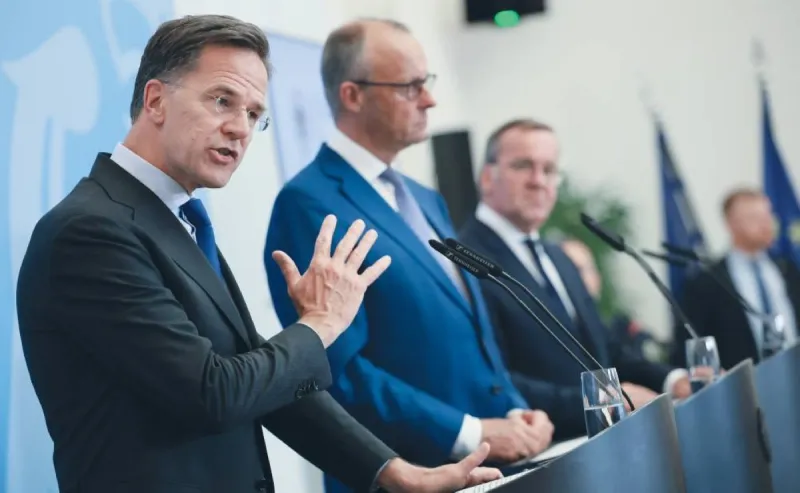
At a moment when the international security environment appears more turbulent than at any point since the end of the Cold War, Atlantic capitals are turning their eyes on 7 and 8 July to the Turkish capital Ankara, which is hosting the 36th NATO summit amid mounting questions about the alliance's future and the nature of the balances that will govern it in the years ahead.
The summit takes on exceptional significance given the distinct vision that US President Donald Trump brings to managing international alliances — one built on redefining security commitments according to a formula of direct interests and burden-sharing.
It also coincides with the rising role of Turkey within the Atlantic framework, at a time when the repercussions of the Russia-Ukraine war are intertwined with energy security challenges and regional tensions stretching from the Black Sea to the Middle East.
Alongside the Ukrainian file, the summit's agenda features issues relating to the alliance's future defence spending, joint military investment plans, the expansion of member states' defensive capabilities, and the strengthening of security partnerships on NATO's southern flank — notably with Arab Gulf states under the Istanbul Cooperation Initiative.
While some argue that the pragmatic approach adopted by Washington could give the alliance fresh momentum and push its members to shoulder greater responsibilities, others warn that privileging bilateral deal-making logic could erode the political and strategic foundations on which NATO has rested since its founding, raising questions about the future of the American commitment to European security.
Dr Mohamed Boubouche, professor of international relations at Mohammed I University in Oujda, Morocco, believes that the approach adopted by the American administration toward NATO — based on direct interests and bilateral deals — may help contain some immediate disagreements, but does not address the structural divisions within the alliance. It may, in fact, heighten European allies' concerns about the future of the US commitment to the continent's security.
He notes that the upcoming NATO summit in Ankara comes amid sustained US pressure on member states to shoulder a larger share of defence burdens — a trajectory reinforced after the 2025 The Hague summit.
In this context, Turkey emerges as a pivotal partner that cannot be dispensed with, by virtue of its possession of the alliance's second-largest army, its geopolitically influential position in the Black Sea, the eastern Mediterranean, the Caucasus, and the Middle East, as well as the growing pragmatic convergence between Ankara and Washington.
Boubouche affirms that this approach has yielded practical results, most notably an increase in member states' defence spending and enhanced security coordination in the face of Russian threats, drawing on Turkish military capabilities and strategic positioning. Shared security interests have also historically proven their ability to help the alliance weather numerous crises.
At the same time, he points out that tying security commitments to a deals-based logic is stoking growing European anxiety, as it risks undermining confidence in the principle of collective defence and could encourage Europe to accelerate the development of its own independent defence capabilities.
Divisions within the alliance, moreover, go beyond tactical files to encompass a divergence in strategic priorities between Washington — which is focused on China — and Europe, which views Russia as the more pressing threat.
Boubouche concludes that the Ankara summit will not refound NATO, but may entrench a new phase built on greater burden-sharing, with pragmatism remaining a tool for managing disagreements rather than a substitute for the strategic trust that forms the bedrock of the alliance's strength.
Dr Ashraf Sinjjar, a professor of international politics from Cairo, believes the summit will be a decisive juncture for assessing the future of the relationship between the United States and the alliance, in light of the divergences that have emerged in recent years over defence burden-sharing and the management of international security crises — chief among them the Russia-Ukraine war.
Sinjjar notes that the current disagreements do not amount to a rupture between Washington and its European allies, but rather reflect an American attempt to rewrite the rules of partnership within NATO in line with President Donald Trump's vision — one that calls for raising member states' defence spending contributions to 5% of GDP on a graduated timetable.
He considers this orientation to be aimed at ending Europe's long-standing dependence on the American security umbrella.
He stresses that Turkey will be a central player at the summit, given its strategic position and its role in linking European and Middle Eastern security files, as well as its awareness of the importance of preserving alliance cohesion despite existing disagreements.
The ongoing war in Ukraine and tensions linked to Iran and energy security further multiply NATO's need for broader and more effective security coordination.
Sinjjar believes that certain American positions toward Russia have raised concern among European allies, yet shared strategic interests remain stronger than circumstantial disagreements, particularly in light of China's rise and the growing array of global security challenges.
He emphasises that the United States is not seeking to disengage from NATO, but rather to redistribute burdens and strengthen allies' contributions to the costs of collective security.
He adds that preserving alliance cohesion remains a shared strategic interest for both sides, given Washington's recognition that any weakening of Atlantic solidarity could grant international competitors — foremost among them China — greater space to expand their influence.
Sinjjar concludes that the Ankara summit may produce new understandings on defence spending and shared security objectives, along with a reaffirmation of the effectiveness of Article 5 on collective defence.
Despite the existing disagreements, the alliance, in his assessment, is moving toward a reordering of its priorities and working methods — not toward division or dissolution.
Between the two perspectives, the Ankara summit appears as a genuine test of NATO's capacity to adapt to the rapidly accelerating shifts in the international order.
While Washington pushes toward a more pragmatic model built on sharing costs and responsibilities, European capitals seek to preserve the strategic guarantees that have formed the basis of Atlantic security for decades.
At the heart of this equation stands Turkey, capitalising on its exceptional geopolitical position and its wide-ranging relationships with all parties to play an increasingly prominent role in shaping the contours of the new balances within the alliance.