
Inside the emergency department of the Georges Pompidou European Hospital in Paris, corridors were filling with patients exhausted by the heatwave.
Elderly people, those in their fifties, and homeless individuals all arrived suffering from acute hyperthermia. The head of the emergency department, Philippe Juvin, told Agence France-Presse that the corridors had become packed with patients suffering severe rises in body temperature, noting that one homeless man arrived with a body temperature of 42 degrees Celsius.
But what was happening inside that hospital was only part of a larger picture.
After 7 consecutive days of heat, Le Monde reported that French emergency services had entered a critical phase. At Argenteuil Hospital in Greater Paris, the head of the emergency department, Catherine Leguay, said the unit recorded 6 deaths in a single night — from Wednesday to Thursday — most of them among elderly patients whose bodies had withstood the first days of the wave before being worn down by the unrelenting heat, day and night.
At the same time, French hospitals began postponing non-urgent operations, calling in additional staff, and redistributing medical teams in an attempt to ease mounting pressure on emergency departments.
It was not only patients who were being affected by the heat.
Reuters quoted doctors in Britain saying that the high temperatures had also begun to affect some sensitive medical equipment, including MRI scanners and cancer treatment devices, at a time when emergency calls were rising and pressure on hospitals was increasing.
Outside the hospitals, Paris was facing a different kind of decision.
Hours before it was due to begin, a march expected to draw around half a million people was cancelled after French police requested that large events be called off, fearing additional strain on emergency and healthcare services amid the continuing heatwave.
At roughly the same time, the story was writing another chapter on the other side of the English Channel.
According to the UK Met Office, the Suffolk area in eastern England recorded 36.9 degrees Celsius, breaking the June temperature record for the third consecutive day.
But the record was not the foremost concern of British authorities.
The company operating Britain's electricity grid issued a fresh warning of a possible supply shortfall during peak hours, calling on electricity producers to make additional capacity available, as energy demand rose across Europe while some French nuclear reactors reduced output due to rising temperatures in the river water used to cool them.
In Germany, the heatwave was revealing a different dimension of the picture.
The Marburger Bund German physicians' union announced that most hospitals have no air-conditioned rooms for patients, except in intensive care units and some specialist wards, and that medical staff are sometimes forced to use ice packs to mitigate the effects of the heat.
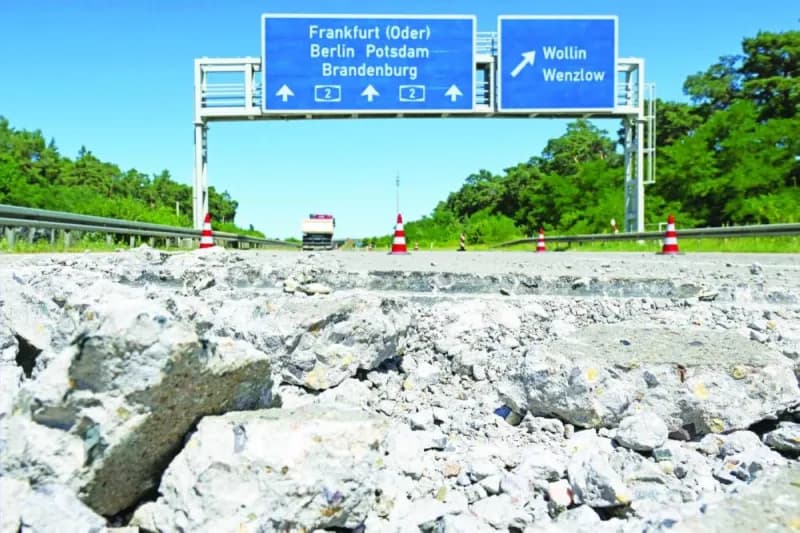
Outside hospitals, the soaring temperatures caused sections of one motorway to crack, while the German parliament decided to close the Reichstag building's glass dome to visitors over the weekend because of the intense heat.
Measures spread to other countries.
In the Netherlands, the highest level of heat warning was declared and residents were advised to avoid travelling, while several schools remained closed.
In Austria, authorities raised their alert level as temperatures were forecast to approach 40 degrees Celsius in a number of regions.
According to calculations carried out by Agence France-Presse based on European meteorological data, more than 150 million Europeans were living under temperatures exceeding 35 degrees Celsius, while more than 420 million people faced temperatures above 30 degrees, in one of the most widespread heatwaves the continent has seen this summer.
Scientists from the World Weather Attribution group believe that the intensity of the current wave would have been nearly impossible without climate change driven by human activity. The World Meteorological Organization noted that any assessment of whether this wave will prove the most severe in Europe's history will only be settled after summer ends, as the event continues and its reach expands.
In the emergency department of the Georges Pompidou Hospital, it was not climate maps or record figures that dictated the rhythm of the day — it was corridors filling with new patients.
In other cities, hospitals were postponing operations, electricity grids were raising alert levels, municipalities were cancelling events, and roads were cracking under the weight of the heat.
Between an emergency department in Paris, a grid control room in London, and a hospital in Germany searching for ways to protect its patients, the heatwave was reshaping the details of daily life across Europe — transforming from a meteorological phenomenon into a simultaneous test of hospitals, energy networks, and infrastructure, as much as of the hundreds of millions of people living through it.