
Relations between Europe and the United States are experiencing an unprecedented crisis that is driving a comprehensive reassessment of the historic alliance, amid American moves to reduce military contributions, while these shifts are pushing the European continent to accelerate its pursuit of "strategic autonomy" and build separate defence and economic capabilities.
Today, the world finds itself facing a new scene; the "Old Continent" is no longer that monolithic bloc that blindly follows Washington, but has found its own voice. The threats of former US President Trump and his administration's unpredictable policies have exposed the fragility of complete dependence on Washington, prompting Brussels to reconsider its frameworks. Are we witnessing a passing dispute imposed by exceptional circumstances, or the beginning of a deeper shift in the structure of international relations?
Trump's policies are redrawing the relationship with Europe, transforming it from "strategic dependence" to a confrontational "negotiating partnership".
These shifts have created deep fractures that are demolishing the bridges of historic trust between the two sides. European leaders who were previously allied with the United States tried using a "flattery" approach with Trump, but anxiety is growing among Europeans now that it has become clear that displays of praise and loyalty are no longer effective in changing the American president's entrenched positions towards Europe.
The transatlantic relationship has long formed the cornerstone of the post-World War II global order, but today it is shaking under the impact of stormy changes: a fracture in trust, diverging interests, and signs of a rupture on the horizon.
From the war with Iran to Ukraine, and from Middle East peace issues to immigration, terrorism, and climate files, the positions of Washington and Brussels diverge strikingly — not only in means, but in substance itself: who should intervene? How? And why?
The direct spark for this escalation was the ongoing war with Iran, as Trump clearly expressed his displeasure at European countries' refusal to engage in military operations or even contribute to protecting navigation in the Strait of Hormuz.
In his view, this stance does not reflect strategic caution but rather inaction and an unequal partnership. US Secretary of Defence Pete Hegseth announced on Thursday a new review of the deployment of US forces in Europe, and threatened to halt payment of some American dues to NATO.
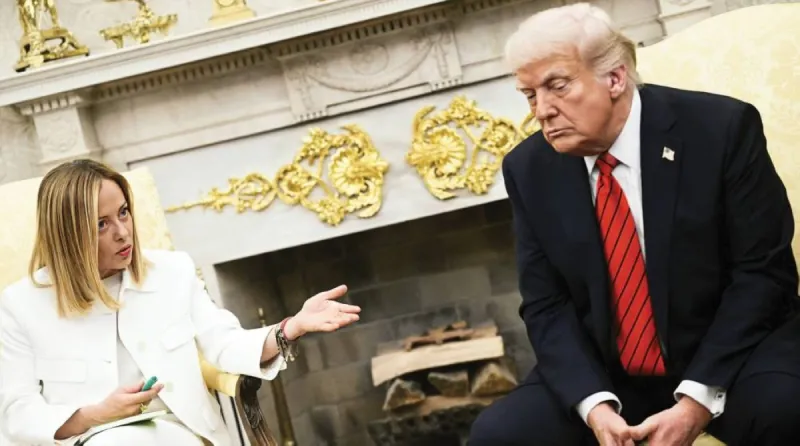
Trump's recent attack on the leaders of the Old Continent at the G7 summit, and his renewed mockery of Italian Prime Minister Giorgia Meloni — clinging to his account of the photograph that sparked a crisis between them — after he repeated that Meloni "begged him to take the photo" at the G7 meeting, further reinforced the belief among European leaders and analysts that he and his team view America's traditional European allies with a sense of superiority.
The Italian prime minister had accused the American president of "fabricating a narrative about her" on Friday regarding the photograph taken together. Meloni, with her nationalist leanings, had perhaps expected different treatment from that which Trump typically reserves for his adversaries, such as British Prime Minister Keir Starmer and Spanish Prime Minister Pedro Sánchez, but she was not spared his sharp criticism.
The new dispute between the leader who had been presented within Europe as "Washington's voice inside Brussels" — or what some described as "Trump's whisper in Europe" — appears to reflect a firm European resolve to put an end to Trump's high-handed policies and for Europe to leave the house of obedience, particularly given that elements of hostility towards Europe are embedded in ideological programmes such as the American National Security and Defence Strategy.
The US administration's policies aimed at forcing European countries to return to "the house of obedience" have produced the opposite results; they have pushed European capitals to accelerate efforts at financial and economic separation, reinforce "strategic autonomy" programmes, and reduce military and technological dependence on Washington. There is no doubt that Europe learned from Trump's demand to annex the Danish island of Greenland, when the unified and firm European response demonstrated its capacity to resist such pressure.
Current indicators suggest that Europe is increasingly inclined to redefine its global role, while the United States is adopting a sharper and more unilateral approach.
Calls within Europe are growing to reconsider strategic dependence on the United States and to build a more independent security approach. Brussels is seeking to construct its gradual independence on strong economic, military, and technological foundations that guarantee its ability to protect its interests and bear greater responsibility for its own security without excessive reliance on the United States — though decoupling efforts are still in their early stages.
It will take years before the bloc can free itself from dependence on American technology and military support, as reflected in measures such as banning the use of American video-conferencing platforms and developing European alternatives, in addition to diversifying energy sources and moving towards a digital euro.