
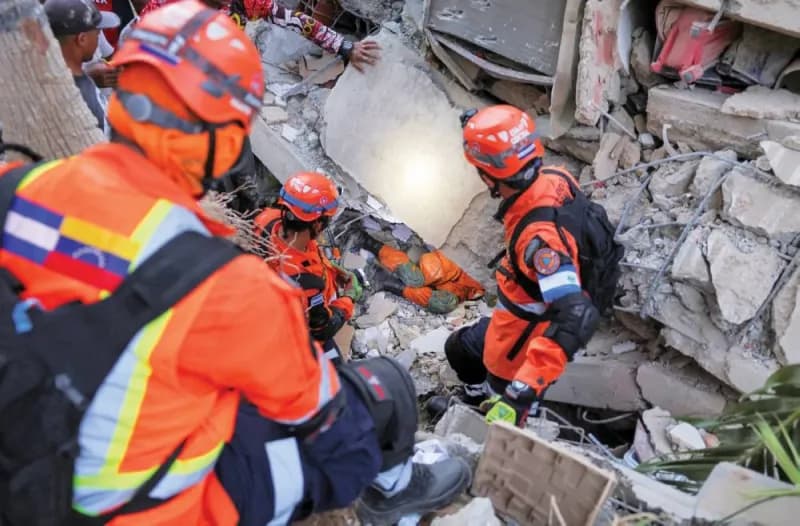
In La Guaira, some residents are still digging with their bare hands through mounds of concrete in search of their relatives, while rescue teams continue their race against the clock to reach anyone who may still be alive under the rubble.
Agence France-Presse quoted survivor Marlon Ochoa as saying: "I am searching for my mother, my wife and my son… There are survivors, but we don't have the tools to get them out."
Three days after two earthquakes of magnitude 7.2 and 7.5 struck northern Venezuela, rescue teams say the critical window for finding survivors is narrowing, as the death toll has risen to 920, with thousands injured and more than 50,000 people missing, according to Venezuelan authorities.
The tragedy is not confined to La Guaira, the hardest-hit city. The United Nations' International Organization for Migration estimated that approximately 6.76 million people may have been affected by the two earthquakes, including around 2 million in the capital Caracas, while the United Nations estimated, as reported by Reuters, that direct damages amount to approximately $6.7 billion.
La Guaira, the coastal city near Caracas, has become the centre of search and rescue operations.
The head of the Chilean rescue team, Nadiumar Bolanco, told Agence France-Presse that the chances of finding survivors had become "slim," while relief agencies confirm that the window for rescuing those trapped is typically within the first 48 to 72 hours after an earthquake.
1,600 rescuers
Amid this race against time, international rescue teams have begun arriving in Venezuela. Reuters reported that the country has received approximately 1,600 foreign rescuers, with the United States, the United Kingdom, the Czech Republic, Syria and other countries sending search and rescue teams, heavy equipment and trained dogs to participate in the operations.
Meanwhile, Venezuelan acting president Delcy Rodríguez announced the deployment of 14,000 army and police personnel in La Guaira state. Authorities have imposed restrictions on entry to the disaster zone to facilitate emergency teams' work, amid criticism from some residents who say the response has not kept pace with the scale of the catastrophe.
The repercussions of the earthquakes extend beyond search and rescue operations. The United States announced $150 million in aid and the dispatch of ships and aircraft to support the humanitarian response, while international relief teams continue to expand their operations in a country already burdened by an economic crisis and an overstretched health system, in one of the most severe natural disasters Venezuela has witnessed in more than a century.
With every passing hour, the chances of finding survivors diminish. Yet among the rubble, many continue to dig, believing that a single voice from beneath the debris may be enough to rekindle hope.