
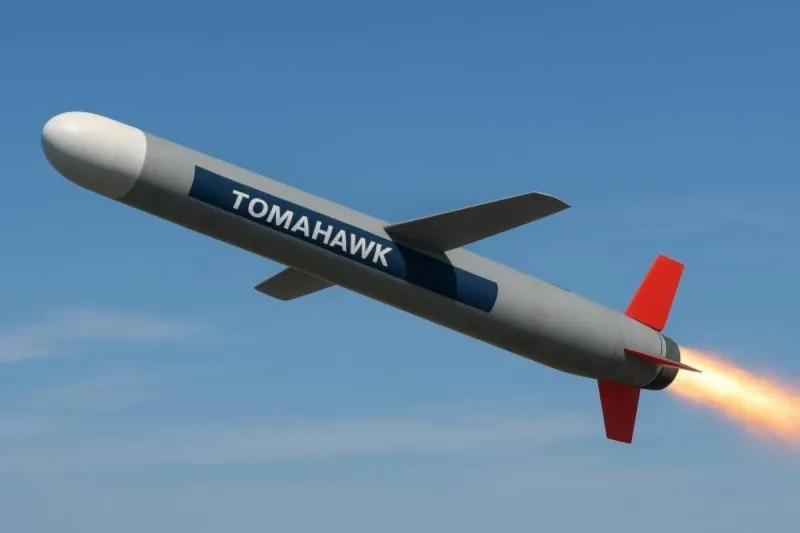
German Chancellor Friedrich Merz has announced that the United States has agreed to sell his country long-range Tomahawk cruise missiles, despite earlier controversy over a plan to deploy them.
Merz told parliament: "On the sidelines of the NATO meeting in Ankara, we agreed with the American government to purchase American Tomahawk missiles and deploy them in Germany."
He added that the step "will close an important strategic gap in our defences", continuing: "At the same time, we will work to develop our European systems and deploy them in Europe."
Merz did not specify a date for receiving the missiles.
Tomahawk missiles are launched primarily from submarines and warships and have a range of more than 1,600 kilometres.
German Defence Minister Boris Pistorius said: "The United States possesses essential capabilities that we in Europe cannot do without."
He added that Germany is committed to strengthening the European defence industry, but that purchasing Tomahawk missiles from Washington currently represents the "only way" to fulfil Germany's obligations to NATO.
He noted that this "applies in particular to the offensive capabilities needed for deterrence, as well as for responding to any attack targeting NATO territory, which is what we seek to prevent."
Berlin considers the deployment of long-range cruise missiles, such as the Tomahawk, an essential part of its deterrence strategy against Russia.
Moscow has deployed Iskander cruise missiles in the Kaliningrad exclave, which are capable of striking targets in European NATO member states.
A German government source said the two countries' defence ministers signed a letter of intent regarding the deal on Tuesday, following earlier negotiations between Merz, US President Donald Trump, and security officials from both countries.
In the letter of intent, the United States pledged to grant formal approval for the sale of Tomahawk missiles and Typhon ground-based launch systems by August.
As yet, there are no European-made alternatives with ranges and capabilities comparable to the Tomahawk, leaving Berlin and other European NATO member states dependent on Washington to acquire these weapons.
The United Kingdom announced on Wednesday that 12 European NATO member states, including Germany, will collectively spend around $50 billion over the next decade to develop new long-range, high-precision weapons.
A German government source said Berlin intends to contribute around half of that cost.
In May, Merz indicated the cancellation of a plan to deploy Tomahawk missiles in Germany that had been announced by former US President Joe Biden. The German chancellor justified this by citing the depletion of weapons stockpiles due to the wars in Iran and Ukraine.
This also came in the wake of a dispute between Merz and Trump over the war in Iran.