
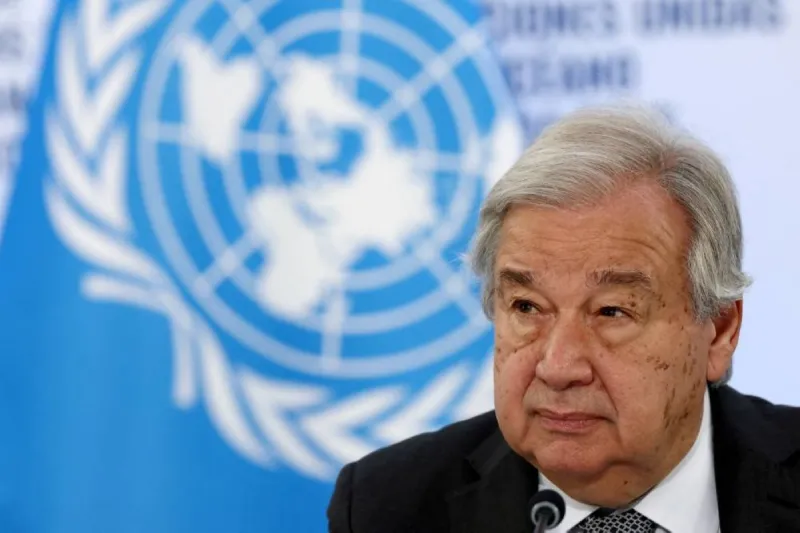
United Nations Secretary-General António Guterres has called on member states to uphold their international commitment to the principle of the "Responsibility to Protect", including strengthening efforts to prevent genocide, war crimes, ethnic cleansing, and crimes against humanity, stressing that this responsibility has become more important than ever amid escalating conflicts and growing geopolitical risks.
The call came in a statement by the Secretary-General, read on his behalf by his Chef de Cabinet Earl Courtenay Rattray, before the general debate held by the UN General Assembly on the Secretary-General's eighteenth report on the "Responsibility to Protect", which reviews more than two decades of progress since world leaders adopted this landmark commitment in 2005.
In his statement, the Secretary-General affirmed that the responsibility to protect populations rests first and foremost with each state towards its own people, noting that member states have pledged, in cases where national authorities fail to fulfil this duty, to take collective, timely, and decisive action in accordance with the UN Charter.
He noted that these models include employing preventive diplomacy, dialogue, and early warning mechanisms; developing institutions capable of preventing mass atrocities; strengthening independent and impartial judicial systems; and supporting independent media and civil society organisations, in addition to integrating the prevention of mass atrocities into the UN's humanitarian, political, peacebuilding, and peacekeeping work.
He pointed out that the world witnessed more than 120 conflicts during 2025, and that these conflicts have become more complex, protracted, and interconnected, at a time when violations of international law are increasing and the circle of impunity is widening.
He warned that technological developments are compounding the dangers of the situation, with the proliferation of sophisticated weapons — including drones and autonomous systems — alongside the rapid spread of hate speech and disinformation online, stressing that early warning indicators are often ignored and that the international response frequently comes too late and proves insufficient.
He called for the integration of mass atrocity prevention into all peacemaking, conflict prevention, and humanitarian action tools, including mediation and preventive diplomacy, as well as security, technology, human rights, and accountability frameworks.
The Secretary-General affirmed that the "Responsibility to Protect" principle embodies the core mission of the United Nations and provides a practical pathway for prevention and peacebuilding, calling on the international community to honour the pledge made by world leaders in 2005 and to make the protection of populations and the prevention of mass atrocities a permanent and universal practice.