
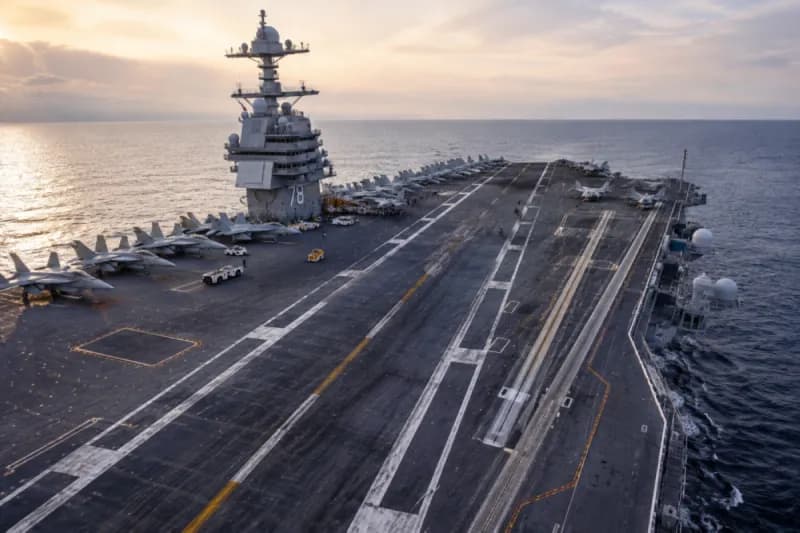
At first glance, the deck of an aircraft carrier may look like an ordinary airport runway covered in asphalt or concrete — but it is, in reality, entirely different. This surface, from which fighter jets launch and on which they land amid harsh maritime conditions, is made from high-durability naval steel specifically designed to withstand the enormous weight of aircraft, extreme heat, and continuous military operations.
Aircraft carriers are among the most complex naval vessels in the world, housing nuclear reactors, aircraft launch and recovery systems, and thousands of crew members. Yet the flight deck remains the most important element aboard, as it serves as the runway on which all take-off and landing operations at sea depend.
From wood to armoured steel
In the early stages of aircraft carrier development, flight decks were built from wooden planks fixed atop a steel frame. But as the pace of warfare accelerated and military aircraft evolved, wood could no longer withstand the immense pressures involved, prompting designers to adopt armoured steel decks from the Second World War onwards.
The purpose of using steel was not merely to provide a harder surface, but also to make the deck a fundamental part of the ship's structural framework, giving it additional strength and a greater capacity to absorb hits and explosions. The deck also provides protection for aircraft stored in the hangar below the flight deck in the event the ship comes under attack.
The thickness of the steel plates used in aircraft carriers remains classified military information, though they are designed to withstand the violent landings of fighter jets and the constant stress generated by flight operations.
An unforgiving working environment
An aircraft carrier's deck is subjected daily to conditions that are virtually unmatched at any other facility. It must endure the heat of engine exhaust and jet afterburners, tyre friction upon landing, the shock produced by arresting wires, as well as aviation fuel, hydraulic fluids, sea spray, wind, and waves.
For this reason, the steel is not left exposed. Instead, it is coated with a special non-slip layer that offers high resistance to heat and corrosion. The function of this coating is not limited to protecting the surface; it also provides sufficient friction to prevent aircraft, service vehicles, and crew members from slipping during operations, especially in difficult weather conditions.
Continuous maintenance to preserve efficiency
Over time, the protective coating wears down due to intensive use, requiring periodic reapplication. Its service life depends on the type of material used and the intensity of operations the deck sees.
In 2025, the US aircraft carrier USS Gerald R. Ford underwent its first complete replacement of the non-slip coating since entering service in 2017. The process took approximately 3 weeks and was aimed at maintaining the highest levels of safety and operational efficiency, according to the website SlashGear.
The use of this specialised coating is not limited to aircraft carriers; it is also applied to many other military vessels. Naval forces continue to develop more durable, faster-applying materials to reduce maintenance periods.