
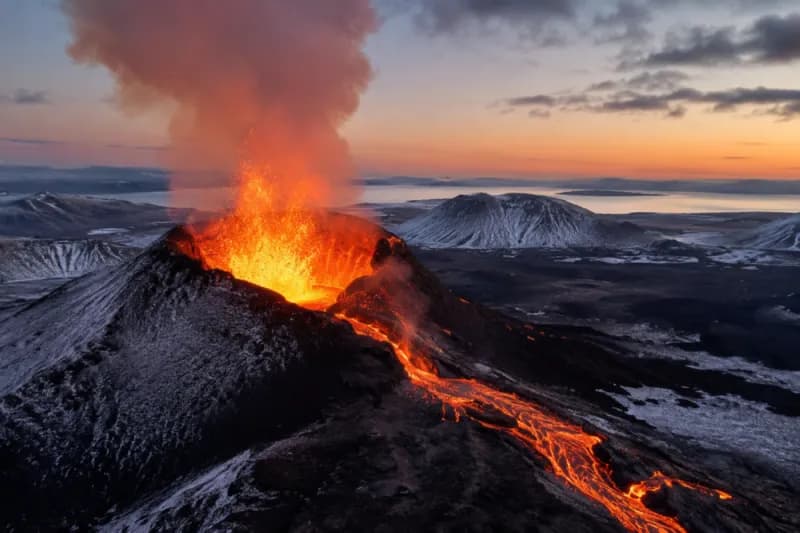
When the question arises of which country has the greatest number of volcanoes in the world, Indonesia or Japan usually come to mind, given their continuous volcanic activity. But the surprise is that the United States leads the list by a wide margin.
According to the Smithsonian Institution's Global Volcanism Program, the United States is home to 165 volcanoes that have erupted in the past 12,000 years, placing it ahead of Japan, then Russia, then Indonesia, which has 101 volcanoes despite being considered the most volcanically active country in the world.
Why does the United States have such a vast number?
The secret lies in its geography. Most American volcanoes are located in Alaska, while the rest are spread along the West Coast, including the Cascade mountain range stretching from Washington State to northern California, as well as the Hawaiian Islands.
The volcanoes of Alaska and the West Coast lie along the Pacific Ring of Fire, a geological belt approximately 40,000 kilometres long and considered the most seismically and volcanically active region on Earth.
This activity occurs as a result of tectonic plate collisions, where one plate slides beneath another in a process known as subduction. As the denser plate sinks into the Earth's depths, it melts and transforms into magma that gradually rises toward the surface, ultimately triggering a volcanic eruption.
The most famous American volcanic eruptions
The eruption of Mount St. Helens in Washington State in 1980 is considered the most destructive volcanic eruption in modern United States history.
The largest eruption in terms of the volume of volcanic material ejected was that of Mount Katmai in Alaska in 1912, which expelled approximately 13.5 cubic kilometres of magma, making it the largest volcanic eruption the world witnessed during the 20th century.
Why are Hawaii's volcanoes different?
Although Hawaii is home to one of the most active volcanoes on Earth — Kīlauea — it does not lie on the Ring of Fire, but rather above what is known as a hot spot.
A hot spot is a region in the Earth's mantle where temperatures rise unusually high, causing columns of molten rock to surge through the crust and form volcanoes independent of tectonic plate boundaries.
Kīlauea remains active, having produced continuous eruptions in recent years that have generated stunning spectacles — from lava fountains to fire whirlwinds — making it one of the most closely monitored and studied volcanoes in the world.
Although Indonesia remains the country most exposed to volcanic eruptions that directly threaten its population, the United States retains the title of the country with the greatest number of geologically active volcanoes in the world, thanks to its position on the Ring of Fire and the presence of hot spots within its territory.