
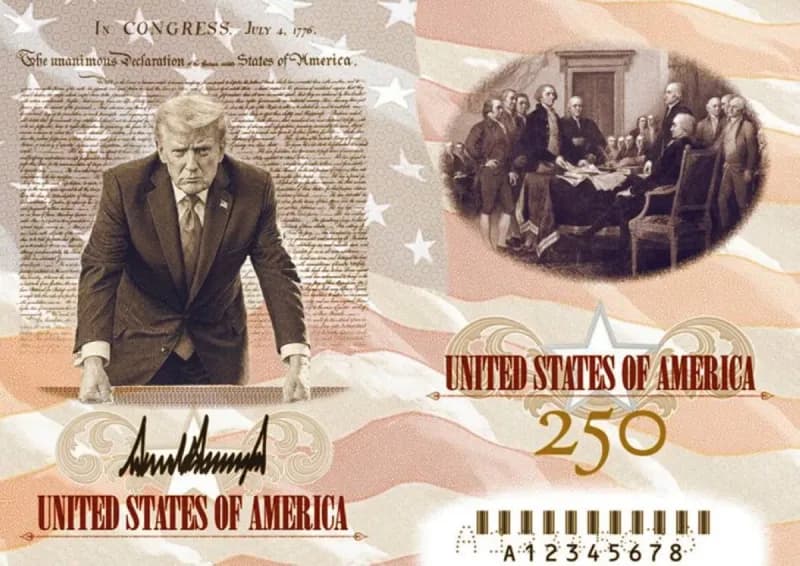
US President Donald Trump's announcement of a prototype for a new commemorative American passport, marking the 250th anniversary of United States independence, has triggered a wide wave of sharply divided reactions across American political and media circles. The passport, which features a personal photograph of Trump with a stern expression, has become fertile ground for controversy, drawing responses that range from outright support to categorical rejection.
American media outlets and news agencies tracked the event closely, examining its symbolic and political dimensions. CNN described the move as unprecedented in modern American history, noting in a report that "converting an official sovereign document such as a passport into a tool that promotes the president's personal political identity represents a flagrant departure from the state's protocolar traditions, and reflects Trump's persistent desire to stamp federal institutions with his own mark."
Conservative media, by contrast, offered broad praise for the step. Fox News described the design as "a bold tribute linking strong American leadership to the legacy of the Founding Fathers," adding in its coverage that "the limited-edition passport embodies the spirit of national pride at the country's semiquincentennial, and responds to the aspirations of millions of Americans who see the president as a symbol of the restoration of American prestige."
On the partisan front, Democratic leaders were quick to level sharp criticism at the decision, describing the inclusion of the president's photograph in an official travel document as conduct reminiscent of authoritarian regimes. The New York Times published a report containing excerpts from statements by Democratic Party leaders who argued that "a passport should represent the entire nation and its constitutional values, not be exploited as a platform for personal political propaganda or as an electoral tool to promote a personality cult."
Republican members of Congress, meanwhile, vigorously defended the new prototype. The Washington Post quoted prominent Republican sources as affirming that "the passport is a limited commemorative edition, available on an optional basis to citizens who wish to obtain it, and forms part of the major national celebrations marking the independence anniversary. It does not violate the laws governing the issuance of official documents; rather, it lends them a distinctive historical character."
On social media, digital platforms — particularly X and Truth Social — were consumed by heated debates that laid bare a deep divide in American public opinion. Trump's supporters and the political movement known as MAGA celebrated the announcement, viewing Trump's phrase "Welcome, but behave!" as an embodiment of the firm, order-imposing policies they have demanded. Supporters' accounts were filled with images of the design, which they hailed as "the most powerful travel document in the world, expressing a strong America."
On the opposing side, social media platforms became arenas of mockery and criticism through comics and rejection hashtags. Activists and independent analysts expressed concern over the "politicisation of sovereign documents," noting that the American passport had always been a symbol that transcends party lines, and that injecting political divisions into it could embarrass American citizens while travelling abroad or deepen the domestic rift over the state's symbolism and visual identity.