
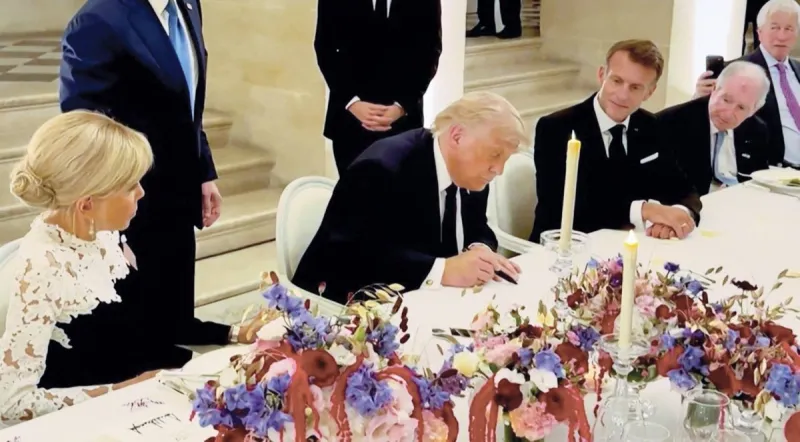
After months of war and tensions between the United States and Iran, the two sides finally signed a memorandum of understanding, which immediately launched 60 days of negotiations aimed at reaching a comprehensive agreement. US President Donald Trump dismissed critics of the move, describing them as "bad and foolish", while Washington reiterated its warning to its rival that it would resume hostilities and reimpose the blockade if Iran failed to honour its commitments.
The memorandum of understanding between the United States and Iran entered into force after being signed electronically by Donald Trump and his Iranian counterpart, Masoud Pezeshkian.
A White House official said Trump signed the memorandum with Tehran while he was in France, while Iranian state television reported that Pezeshkian had signed the document.
Trump described the understanding with Iran to end the war as a victory for the United States. He stated: "The United States will not pay Iran $300 billion — that is fake news! For the United States it is all about success, lower oil prices, and victory. Check the stock market." He added that Democratic propaganda was at its peak.
Trump defended the memorandum of understanding, while his Iranian counterpart Masoud Pezeshkian hailed it as a historic agreement between their two countries.
Trump and Pezeshkian signed the memorandum remotely. It stipulates a halt to the war on all fronts, including Lebanon, and the opening of the Strait of Hormuz, with the two countries set to begin negotiations on Iran's nuclear file and sanctions.
In response to criticism from some quarters in the United States — which alleged that Washington had made concessions and abandoned the objectives it had set at the outset of the war — Trump maintained that the benefits of the understanding would become apparent quickly.
The Republican president wrote on his Truth Social platform: "Those fools who think I wasn't tough enough on Iran, while stock markets hit record highs and oil prices collapse, are either jealous, bad people, or fools." Trump said the United States expects a full ceasefire on all fronts, including Lebanon, Hezbollah, and Israel.
Trump added: "We encourage all parties in the Middle East to commit to supporting our negotiations and making them a success."
For his part, Pezeshkian praised the historic memorandum of understanding with the United States, posting on social media a copy of the document bearing his signature and Trump's, along with that of Pakistani Prime Minister Shehbaz Sharif, whose country led the mediation between the two sides. He commented: "This is a historic document and a message from a strong Iran: peace will be achieved under mutual respect."
US Vice President JD Vance announced that the 60-day negotiation phase with Iran stipulated in the memorandum of understanding between the two countries had begun. Speaking at a White House press conference, Vance said: "We will start the 60 days, we will begin the countdown."
A document showed that the White House sent a copy of the agreement to Congress. The Swiss Foreign Ministry announced that negotiations between the United States and Iran would begin on Friday near Lucerne, following the signing of the memorandum of understanding to end the war.
The ministry said: "At present, the United States and Iran, along with mediators Pakistan and Qatar, are still scheduled to meet at Bürgenstock to begin initial negotiations on implementing the agreement." Pakistani Prime Minister Shehbaz Sharif postponed his planned visit to Switzerland after the memorandum of understanding was signed remotely, according to a spokesperson.
The spokesperson said in a statement: "The proposed visit has been postponed after the Islamabad Memorandum of Understanding was signed electronically and entered into force. The political breakthrough has been achieved at the highest level." He added: "The next phase will proceed through separate technical tracks on several issues within this comprehensive framework," noting Pakistan's commitment to contributing to this diplomatic effort.
US Defence Secretary Pete Hegseth told reporters on Thursday that the United States would resume military operations and reimpose the blockade if Iran did not honour its commitments under the agreement.
Hegseth said in Brussels, following his meeting with NATO defence ministers: "President Donald Trump has indicated that we will be ready to resume military operations if Iran does not honour what it has promised within the timeframe set for these talks. If Iran does not comply, we are fully capable of reimposing a tight blockade."
Pakistani President Asif Ali Zardari warmly welcomed the signing of the memorandum of understanding, describing it as a historic moment for the region and the world.
The Associated Press of Pakistan reported that Zardari said in his message that the conflict had caused immense suffering to the peoples of the region and severely disrupted global energy supplies, trade, and economic stability. He expressed hope that such a tragedy would not be repeated and that countries of the region would now dedicate their efforts to development, prosperity, and the well-being of their peoples.
Qatar also welcomed the signing of the memorandum of understanding on addressing outstanding issues between the United States and Iran, including a halt to military operations and guaranteeing freedom of navigation in the Strait of Hormuz.
The Qatari Ministry of Foreign Affairs, in a statement, renewed Qatar's full appreciation for the partnership and efforts of Pakistan and all regional and international parties in de-escalating tensions and bringing positions closer, leading to the signing of the memorandum.
The ministry stressed that the memorandum of understanding represents a solid foundation from which to launch the next phase of negotiations between the American and Iranian sides, calling on all parties to maintain the positive spirit, good offices, and joint coordination to ensure comprehensive and sustainable outcomes.
The ministry affirmed Qatar's continued full support for all efforts and good offices aimed at enhancing regional security and stability, reaching sustainable solutions to outstanding issues through dialogue and peaceful means, in accordance with the principles of international law and good neighbourliness, opening new horizons for cooperation, development and prosperity, and serving the common interests of the peoples of the region and the world.
China also welcomed the agreement. A spokesperson for China's Foreign Ministry in Beijing said the signing of the first-phase memorandum carries positive significance for easing tensions and bolstering the momentum of the ceasefire.
China expressed hope that all parties involved would adhere to the spirit of the agreement and fulfil their commitments.
The Chinese spokesperson called on both sides to approach the second phase rationally and realistically, affirming that China would continue to play a constructive role. Russia's Foreign Ministry also stated that Moscow welcomes the ceasefire agreement between the United States and Iran.
For his part, Director General of the International Atomic Energy Agency Rafael Grossi said in Geneva that the agency would participate in talks on a final agreement between the United States and Iran regarding Iran's nuclear programme. He added that the issues to be resolved include the sites that agency inspectors will be permitted to visit and inspect.
Grossi said at a press conference that there is still work to be done and that further talks are scheduled to begin in Switzerland on Friday, following the signing of the preliminary framework agreement. He added that the time has now come to take other concrete steps with American and Iranian representatives.
In the same context, the International Campaign to Abolish Nuclear Weapons (ICAN) said on Thursday that the American–Iranian framework agreement proves that nuclear weapons confer no strategic advantage.
The campaign, which won the Nobel Peace Prize in 2017 for its role in drafting the Treaty on the Prohibition of Nuclear Weapons, stressed that the agreement revealed the limited utility of the nuclear arsenals of both the United States and Israel.
Melissa Parke said in a statement that the lesson drawn from this war is the opposite of what nuclear-armed countries seek to convince us of. She argued that it was clear nuclear weapons had brought neither security nor leverage, and that all they had done was drive the United States to destroy an entire civilisation.
ICAN expressed hope that governments would draw the right lessons from a war that proved nuclear weapons are dangerous and strategically irrelevant.
Hours after the signing, the US military announced the lifting of the naval blockade it had imposed on Iranian ports.
US Central Command said in a statement on the X platform: "US forces have lifted the blockade on all maritime traffic entering and leaving Iranian ports and coastal areas," noting that US warships would remain in the region to ensure compliance with all provisions of the agreement. The US military allowed at least 12 vessels to pass through Iranian ports.