
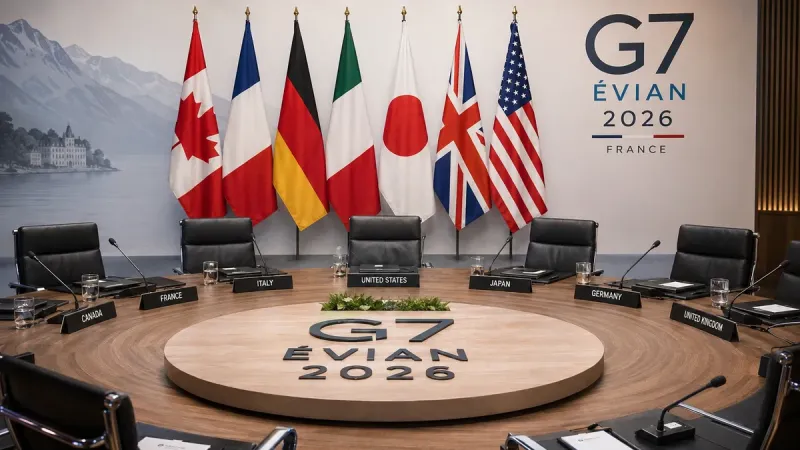
Leaders of the Group of Seven concluded their 2026 summit in the French city of Évian by pledging unwavering support for Ukraine and increased pressure on Russia, while welcoming a "historic" US-Iran agreement and stressing the importance of stability in the Indo-Pacific region.
Breakthrough in the Middle East
The leaders acknowledged that a breakthrough and a timely opportunity now exists in the Middle East, welcoming the announcement of an agreement between the United States and Iran reached under the leadership of President Trump and with the support of mediating countries.
The communiqué described the agreement as providing a historic opportunity to prevent Tehran from acquiring any nuclear weapons and to counter threats linked to its regional and ballistic activities. The group affirmed its support for an independent, multinational defence initiative led by France and the United Kingdom, which could play an important role in facilitating the resumption of maritime navigation through the Strait of Hormuz by protecting commercial vessels, reassuring commercial operators, and supporting verification operations for the removal of all mines. The leaders also expressed strong support for a comprehensive diplomatic agreement to follow the memorandum of understanding secured by President Trump, in order to ensure peace and security for all in the region and to address Iranian threats.
On Lebanese affairs, the communiqué backed the efforts of Lebanese leadership to reach an immediate and robust ceasefire, aimed at disarming Hezbollah and establishing a state monopoly on weapons, and protecting Lebanon's territorial integrity and sovereignty with appropriate international security guarantees. Regarding the Gaza Strip, the leaders pledged to accelerate humanitarian relief and reconstruction efforts and the swift implementation of relevant political and security measures, while calling for an end to violence in the West Bank.
To reduce global dependence on the Strait of Hormuz, the group committed to accelerating the diversification of energy supply routes, welcoming Canada's potential to provide significant additional capacity to global markets in the coming years.
Support for Ukraine and pressure on Russia
In their final communiqué on geopolitical issues, G7 leaders expressed solidarity with the Ukrainian people in the face of attacks on critical infrastructure and cultural heritage, praising the new momentum achieved by Kyiv and progress on the battlefield. To accelerate this momentum, the group agreed to increase supplies of air defence capabilities, interceptor systems, and long-range weapons, while expressing readiness to consider extending licences to increase Ukrainian military production. The group also committed to providing further support to ensure the resilience of Ukraine's energy sector ahead of the coming winter.
The leaders pledged to increase pressure on Russia's war economy through tighter sanctions, including sanctions on the oil and gas sectors. The communiqué stated that this is the right time to move forward with additional measures, following President Donald Trump's presentation of a deal — supported by the group — to reopen the Strait of Hormuz.
G7 leaders stressed the importance of keeping the Indo-Pacific region free and open on the basis of the rule of law. They renewed their opposition to any unilateral attempts to change the status quo by force or coercion, particularly in the East and South China Seas and across the Taiwan Strait, affirming that any resolution must be peaceful and through dialogue.
The communiqué expressed deep concern over North Korea's nuclear and ballistic missile programmes, demanding complete denuclearisation in accordance with United Nations Security Council resolutions, the immediate resolution of the abductees crisis, and the need for collective action against its cybercrimes and cryptocurrency thefts.
Finally, the leaders welcomed the "Global Convergence Summit for Growth" convened by French President Emmanuel Macron on 11 June 2026 with China's participation, affirming shared interest in working with major economies to address the causes of large and persistent global imbalances, and in continuing these efforts within the G20 and relevant forums.