
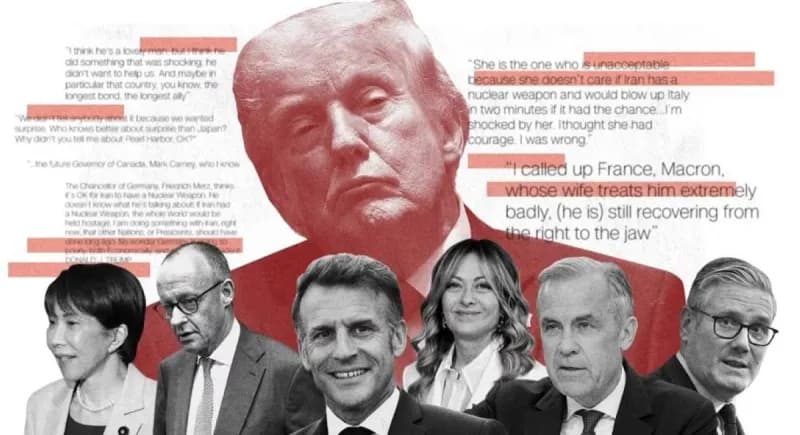
CNN has revealed in a report the depth of the tension and turmoil enveloping US President Donald Trump's relations with leaders of the Group of Seven, as he arrives this week at the French spa resort of Évian-les-Bains to attend the anticipated summit.
The report noted that the tranquil atmosphere and enchanting lakeside setting of the resort may conceal a highly charged backdrop, particularly after Trump repeatedly insulted most of his counterparts in the group over the past few months, reopening old grievances and igniting new rivalries with leaders he previously appeared to respect.
According to the network's report, prepared by writers Kevin Liptak and Alex Leeds Matthews, the principal roots of the US president's recent anger stem from the G7 leaders' unwillingness to join the American-Israeli war against Iran — a matter that will be a focal point of the summit, especially following Trump's announcement of a deal with Tehran over the weekend.
The report stressed that these tensions are not new, but stretch back years and have passed through charged episodes since his first presidential term. Although allied leaders have attempted to overlook his persistent criticism, some have begun to respond publicly.
The CNN report mapped the complex nature of Trump's relationships with his counterparts, beginning with the summit's host, French President Emmanuel Macron. Their relationship swings sharply between displays of mutual respect on one day and biting criticism and mockery of Macron's marriage on another, leading the French leader to show growing displeasure recently after years of boasting about his ability to handle Trump.
As for Canada, Trump's northern neighbour, despite positive signals last year with Prime Minister Mark Carney, trade disputes and Carney's forceful speech in Davos earlier this year prompted Trump to sharply reverse his position, dubbing him "Governor Carney" — a pointed reference to his earlier threat to make Canada the 51st US state.
Trump's critical lashing also reached British Prime Minister Keir Starmer, whose relationship with the White House deteriorated suddenly after he refused to support the war on Iran. Trump mockingly described him as "no Winston Churchill," after Starmer had spent the better part of the past year successfully cultivating his goodwill.
German Chancellor Friedrich Merz fared no better. Despite the excellent first impression he made at the White House — arriving with the birth certificate of Trump's German-born grandfather — his standing was severely damaged after he questioned the utility of war with Iran and stated that the United States was "being humiliated by the Iranian leadership."
In a notable shift, presidential anger also reached Italian Prime Minister Giorgia Meloni — considered the European leader closest to Trump — following her refusal to participate in the Iran war and her description of Trump's attacks on Pope Leo XIV as "unacceptable." This drew a sharp rebuke from Trump, demonstrating that even close allies are not beyond the reach of his fury.
By contrast, the network's report hinted that Japan's Prime Minister Takaichi, the group's newest member, has been relatively successful in avoiding this anger by building a close personal relationship, drawing on the legacy of the late Prime Minister Shinzo Abe. Nevertheless, Tokyo has not escaped Trump's criticism over its refusal to participate militarily, and Japanese circles have also expressed irritation at an offhand joke Trump made about Pearl Harbor inside the Oval Office earlier this year.