
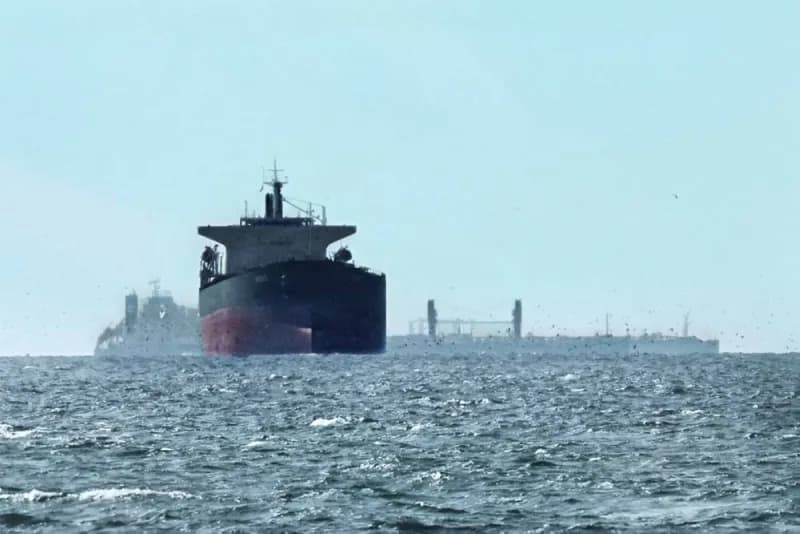
US President Donald Trump settled the debate on Saturday over the signing of an understanding with Iran to end the war and reopen the Strait of Hormuz, announcing that the anticipated agreement is scheduled to be signed this Sunday. He confirmed that the strait would be opened "immediately to everyone" upon signing, after Pakistani Prime Minister Shehbaz Sharif said on Saturday he expected the deal to be finalised within 24 hours.
Trump wrote on his Truth Social account: "The agreement is scheduled to be signed tomorrow, and immediately upon signing, the Strait of Hormuz will be open to everyone."
The US president, whose birthday falls on this Sunday, added: "We hope this process goes quickly, easily, and smoothly, and if it doesn't, we have the final option."
Trump continued: "At the right time, when calm prevails, we will go in and get the nuclear dust."
He stated regarding Iran: "In reality, they no longer want a nuclear weapon, and they will not have one — whether through purchase, development, or any other means of obtaining it."
On the matter of releasing frozen funds that Iran is seeking, Trump wrote: "Our relationship with Iran is different and far better than that of previous administrations. Unlike the hundreds of billions of dollars Obama paid them, including $1.7 billion in cash paper currency, no money will be exchanged."
He noted that "at the right time, when calm prevails, we will go in and extract the nuclear dust buried deep under the powerful, submerged granite mountains, with our B-2 bombers and their brilliant pilots, and we will dilute and destroy it, whether in Iran or in the United States."
The US president returned to a tone of warning, saying: "We look forward to working with Iran, and with the entire Middle East, for many long years to come. We hope this entire process goes quickly, easily, and smoothly. And if it doesn't, we have the final option, and we hope we don't have to use it again!"
He affirmed that the relationship with Iran is "different and far better than that of previous administrations."
Trump also stressed that the new agreement represents a "complete opposite" of the nuclear deal concluded by the administration of former President Barack Obama.
He said the nuclear deal known as the Joint Comprehensive Plan of Action, concluded in 2015, was "an easy, paved road toward possessing a nuclear weapon," arguing that Iran would have obtained such a weapon six years ago had the deal remained in effect.
Pakistan, which is playing a mediating role between the United States and Iran, revealed on Saturday that an electronic signing ceremony for a peace agreement is expected to take place this Sunday. Prime Minister Shehbaz Sharif wrote on X: "We are closer to a peace agreement than ever before. With the agreement expected to be concluded within the next 24 hours, Pakistan is then preparing for an immediate electronic signing of the peace agreement, followed by technical talks next week."
A senior US official said the United States "believes it has reached a very strong agreement with Iran," adding that the Pakistani statements issued on Saturday confirm this.
He added that the agreement obliges Iran to open the Strait of Hormuz as a fundamental condition, and that it may be opened without imposing any fees on shipping traffic.
He explained that the United States will halt its naval blockade on Iran simultaneously with the step of reopening the Strait of Hormuz, noting that the next phase will see an intensive and simultaneous operation to clear naval mines.
The official said the United States will participate significantly in mine-clearing operations to restore normalcy quickly, adding that Britain and France had discussed forming a naval coalition and that they have military vessels nearby, ready to participate in these operations.
Bloomberg cited a senior US official as saying that the United States expects the agreement to guarantee that Iran will not possess nuclear weapons.
He added that if Tehran fulfils the conditions, Washington will ease sanctions and allow Iran's integration into the global economy.
The Washington Post also cited a Trump administration official as saying it is difficult to determine the value of funds Iran could receive, explaining that this depends on what it offers under the agreement.
He added that the wide-ranging agreement will include Lebanon and Israel, but Tel Aviv will retain the right to respond if it comes under threat.
In Tehran, Iranian Foreign Ministry spokesman Esmail Baghaei told the official IRNA agency: "We must wait to know the exact date of signing. It will not be on Sunday," suggesting it would happen in the coming days. Iranian media also cited Baghaei as saying the Iranian negotiating delegation had no plans to visit Geneva or anywhere else in the next few days.
Iranian Foreign Minister Abbas Araghchi said in an interview with official Iranian television: "Once the final stages of our negotiations are completed, this agreement will be signed and announced," indicating that this "could happen in the coming days. I am very optimistic."
A US official said the Iranians had agreed to five points including "the destruction and removal of Iranian nuclear materials, the dismantling of the nuclear programme, no release of frozen funds before compliance with conditions, the opening of the Strait of Hormuz, and Iran refraining from financing terrorist groups."
On the ground, US Central Command (CENTCOM) announced that Iran launched one-way attack drones in an attempt to strike commercial vessels transiting the Strait of Hormuz.
CENTCOM said in a statement that the strait "remains open to navigation." The United States also announced it had shot down Iranian drones that were targeting commercial ships in the strait.
In a related development, CNN reported, citing two informed sources, that President Donald Trump halted plans in recent weeks that included sending ground forces into Iran to seize its stockpile of highly enriched uranium.