
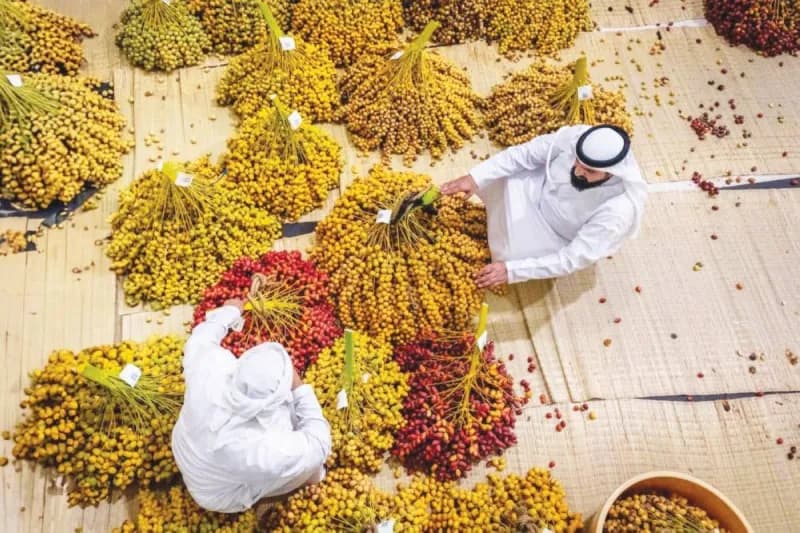
The UAE's farms boast a remarkable agricultural diversity that reflects the development and sustainability of the sector, encompassing more than 300 varieties of date palm and mango trees — over 150 varieties of each crop — embodying the richness and breadth of domestic production.
Dates and mango varieties differ in form and flavour, with each variety carrying a distinct name. The roots of many of these names trace back to ancestors whose descendants have inherited them from generation to generation, making them an authentic part of the country's agricultural and cultural heritage, while modern varieties carry contemporary names before being formally adopted into the domestic production system.
July is the peak of the date and mango season in the UAE, with the majority of varieties ripening during this month. It represents the most important harvest period for farmers after months of tending to trees, irrigating, fertilising, and careful monitoring, making UAE farms exceptionally abundant in crop diversity at this time of year.
In the date palm and date production sector, the UAE continues to strengthen its standing as one of the world's leading producers, by preserving date palm cultivation as a cornerstone of the national agricultural heritage, alongside its growing role in supporting the food security system and diversifying domestic output.
Dozens of well-known date varieties are grown on the country's farms, most notably the Barhi, Khallas, Sukkari, Shishi, Khunaizi, Sultani, Zamli, and Abu Maan — varieties that differ in ripening time, fruit size, colour, and flavour, providing a wide diversity that meets consumer needs throughout the season.
The date palm sector receives particular attention from the wise leadership, reflected in national initiatives, specialised programmes, and annual festivals celebrating date and fresh-date seasons across the country's emirates, contributing to the preservation of this agricultural heritage, enhancing its presence in society, and supporting farmers while encouraging them to develop production and improve quality.
Date and fresh-date festivals have also evolved into platforms that bring together farmers, experts, and investors to exchange expertise and learn about the latest agricultural technologies, in addition to highlighting the multifaceted economic value of the date palm and fostering interest in the agricultural sector among new generations.
The economic value of the date palm extends well beyond dates alone to encompass all its components; national factories have for decades been utilising palm fronds, leaves, and fibre to manufacture environmentally friendly products including baskets, furniture, decorations, and heritage figurines, in line with circular economy and sustainability objectives.
Despite its economic value, the date palm retains a deeply rooted social and cultural dimension, having been historically intertwined with Emirati society as a source of food, shade, and livelihood, contributing to the strengthening of family and social bonds. Many families continue to maintain date palm farms and pass them on to their children as part of the national identity.
In the global economic context, the date trade has become one of the most promising food industries, driven by rising demand for natural and healthy foods. Data from DP World indicates that date shipments through ports grew by more than 40% between 2020 and 2024.
The value of the global dates market is estimated at approximately $31 billion in 2024, with projections pointing to a rise to around $49 billion by 2032, driven by increasing demand in European, Asian, and American markets, with the Middle East and Africa region holding the largest share of the global market.
Meanwhile, the mango crop — known locally as "Al Hamba" — has an increasingly prominent presence on the country's farms, having become one of the most notable summer crops, enjoying strong consumer demand, supported by the success of specialised exhibitions and festivals that have recorded significant sales.
The mango season begins with a meticulous phase of tree care that extends through to harvest, within a modern agricultural system that relies on irrigation technologies and sustainable management to produce high-quality crops capable of competing with the finest varieties worldwide.
Mango fruit is no longer limited to fresh consumption; it has become an ingredient in multiple food industries including juices, jams, confectionery, and ice cream, enhancing its economic value and opening new horizons for local food industries.
Mango varieties in the UAE are distinguished by considerable diversity in shape, taste, and size, owing to the success of programmes to introduce varieties suited to the local environment and to preserve genetic diversity, in support of food security targets.
Taken together, this agricultural diversity reflects the UAE's vision of building an advanced agricultural sector that combines the preservation of agricultural heritage with the deployment of modern technologies and innovation.