
The United Arab Emirates has recorded numerous successes throughout its history, marking many milestones of exceptional achievement across its various economic sectors, while continuing to reinforce its position as one of the world's leading destinations for foreign direct investment in recent years.
Tracking the volume of foreign direct investment attracted by the country in recent years, according to reports by the United Nations Conference on Trade and Development (UNCTAD), the UAE succeeded in attracting investment flows worth $168 billion (605 billion dirhams) over the past five years.
This achievement reflects the strength of the national economy, the efficiency of the legislative environment, and the success of government policies in cementing the country's status as a global hub for business and investment.
Data from UNCTAD's World Investment Report 2025 confirm that the UAE delivered an exceptional performance in attracting foreign direct investment between 2021 and 2025, at a time when the global economy faced successive challenges including the fallout from the Covid-19 pandemic, rising inflation rates, tightening monetary policies, supply chain disruptions, and geopolitical tensions that affected international capital flows.
The data show that foreign direct investment flows into the UAE reached $20.7 billion (76 billion dirhams) in 2021, before rising to $22.7 billion (83.3 billion dirhams) in 2022, then making a significant leap to $30.7 billion (112.7 billion dirhams) in 2023.
The country then recorded an unprecedented historic level of $45.6 billion (167.3 billion dirhams) in 2024, followed by another record of $48.3 billion (177.3 billion dirhams) in 2025 — the highest figure the country has achieved since these statistics began to be published.
This brings total foreign direct investment attracted by the UAE over the past five years to approximately $168 billion, reflecting sustained growth in global investors' confidence in the Emirati economy and confirming the country's success in translating economic and legislative reforms into tangible results on the ground.
The 2025 performance represents an exceptional milestone in the country's foreign investment journey, with flows rising by approximately 6% compared to 2024. This achievement carries added significance when compared to the global situation.
UNCTAD notes that global foreign direct investment flows declined in 2024 due to continued economic uncertainty, higher financing costs, and slowing growth in a number of major economies, as well as the challenges faced by the global economy throughout 2025.
This contrast confirms that the UAE did not merely benefit from a global economic recovery, but managed to achieve growth that outpaces international trends, thanks to a set of structural factors that have enhanced its competitiveness — chief among them economic stability, advanced infrastructure, flexible legislation, and openness to global markets.
Over the past five years, the country has implemented a series of economic reforms that have contributed to raising the attractiveness of its investment environment, most notably the modernisation of the Companies Law and the expansion of full foreign ownership to a wide range of economic activities.
The country also developed its long-term residency system through the Golden Visa and Green Visa schemes, in addition to simplifying company formation procedures and reducing the time required to start a business.
The country also continued to invest in developing its infrastructure — including ports, airports, free economic zones, and transport and logistics networks — making it a key hub for managing the business and investment operations of global companies across the Middle East, Africa, and South Asia.
The UAE's geographic location has played a pivotal role in enhancing its investment appeal, as the country serves as a link between Asian, European, and African markets, giving investors access to markets encompassing billions of consumers within short timeframes, which positively affects the efficiency of business operations and supply chains.
Among the factors that have further reinforced the UAE's standing are the stability of its fiscal and monetary policies, high levels of transparency, the development of its banking system, and the elevated credit ratings the country enjoys, all of which give investors greater confidence in its economic environment.
UNCTAD data indicate that foreign direct investment has become a key pillar in capital formation within the Emirati economy, with its contribution rising to more than 40% of total gross fixed capital formation in 2024, compared to approximately 29% the previous year and more than 40% during the past year, reflecting the growing role of international investments in supporting economic growth and financing new projects.
Foreign investments have not been confined to traditional sectors, but have increasingly moved towards future-oriented sectors, foremost among them advanced technology, the digital economy, and artificial intelligence.
These also include renewable energy, advanced industries, financial services, healthcare, e-commerce, and logistics, in line with the UAE's economic vision targets aimed at building a knowledge- and innovation-based economy.
The country has also benefited from signing a large number of Comprehensive Economic Partnership Agreements with various countries around the world, which have helped open new markets to investors and boost trade and investment flows, while also supporting the competitiveness of the national economy and attracting more multinational companies.
The UAE has today become a regional headquarters for thousands of global companies managing their operations across the region, benefiting from its flexible legislative environment, availability of skilled human capital, advanced digital infrastructure, and smart government services that rank among the best in the world.
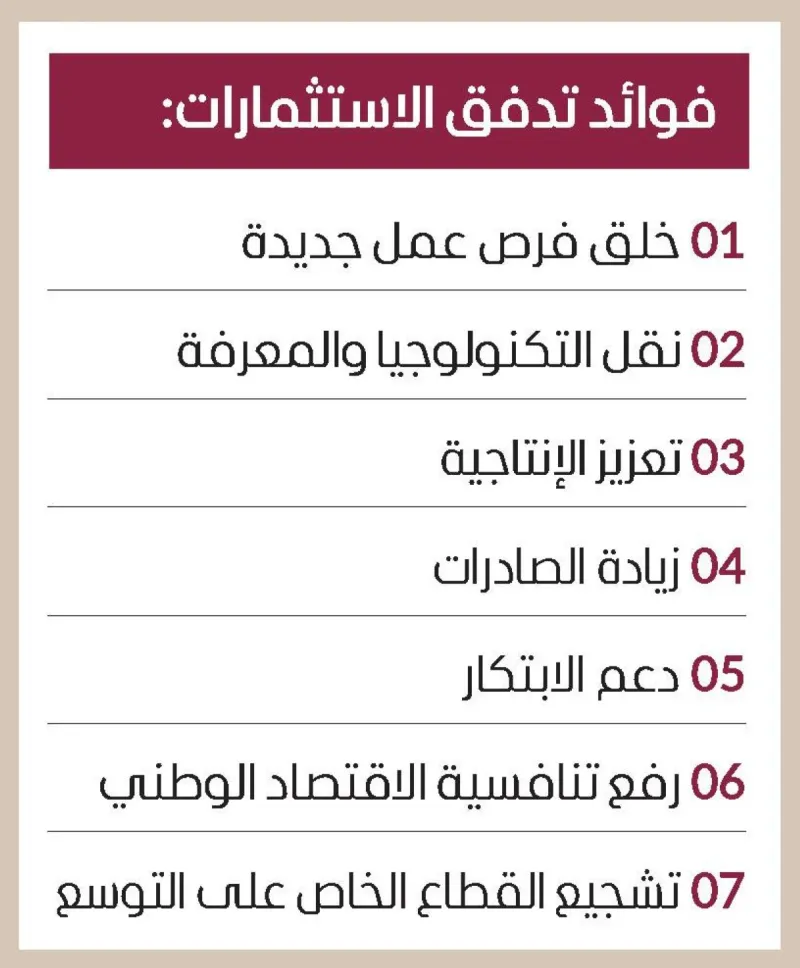
From an economic standpoint, foreign direct investment flows are reflected in a number of vital indicators: they contribute to creating new job opportunities, transferring technology and knowledge, boosting productivity, increasing exports, supporting innovation, and raising the competitiveness of the national economy, in addition to encouraging the private sector to expand its investments.
Foreign investment also contributes to diversifying sources of national income and reducing dependence on traditional sectors, which is consistent with the country's economic strategy targeting the building of a more sustainable and resilient economy capable of withstanding global fluctuations.
The significance of these results is further underscored by the intensifying regional and international competition to attract foreign capital, with many countries racing to offer investment and legislative incentives to draw in investors.
The UAE, however, has succeeded in establishing a set of competitive advantages that are difficult to find in combination in many other markets, chief among them stability, ease of doing business, economic openness, speed of completing transactions, and the advancement of government services.
Observers believe that the continued flow of foreign investment at this pace reflects investors' confidence in the country's long-term economic vision, particularly with the launch of strategic projects in the areas of the digital economy.
These also include artificial intelligence, the green economy, advanced manufacturing, and clean energy — sectors expected to attract a growing share of global investments in the coming years.
Forecasts from international institutions point to continued growth in foreign investment in the UAE in the coming years, supported by ongoing economic reforms, an expanding network of trade agreements, increased spending on infrastructure and the digital economy, and the country's growing role as a global hub for trade, services, and finance.
Overall, UNCTAD figures confirm that the UAE managed, in just five years, to more than double its capacity to attract foreign direct investment, with annual flows rising from $20.7 billion in 2021 to more than $48 billion in 2025 — a development that reflects the success of its economic model in attracting global capital and converting it into a key driver of growth and economic diversification.
As the country continues to develop its legislative framework, promote innovation, and invest in the economy of the future, the UAE appears to be in a strong position to maintain its standing as one of the world's most attractive investment destinations, supporting its development goals and reinforcing the contribution of foreign direct investment to building a competitive and sustainable economy capable of keeping pace with global economic transformations.