
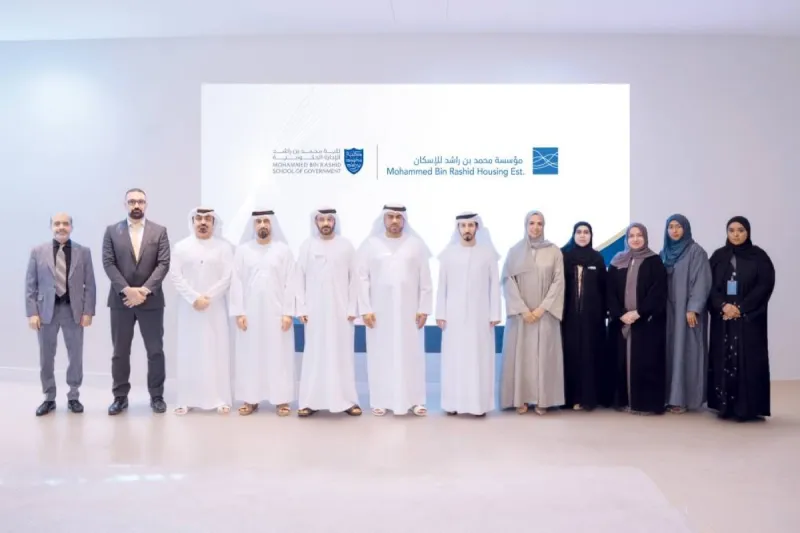
The Mohammed bin Rashid Housing Establishment has launched the second cohort of its 'Housing Pioneers' initiative, in cooperation with the Mohammed bin Rashid School of Government, in a step that reflects the establishment's commitment to developing national talent and preparing future leaders capable of keeping pace with the rapid transformations in the housing sector and enhancing the establishment's readiness for the next phase.
The initiative falls within the establishment's approach to empowering second-tier leadership with the necessary leadership and specialist tools to create a sustainable impact within the housing ecosystem, through a quality training programme spanning 6 months, comprising 185 training hours, covering 12 training themes, alongside 7 development stages that combine theoretical knowledge, practical application, and field experience.
The programme covers a range of general leadership themes, including leadership in an age of challenges, institutional management and understanding, strategic planning and the UAE's strategy, innovation and design thinking, digital leadership and the future, and behavioural insights in policymaking.
The programme also includes specialist themes in the housing sector, covering housing projects, urban development and construction management, contract and procurement management in housing projects, private sector partnerships and financing models, sustainability in housing and green construction, as well as innovation in the housing sector through 3D printing, smart housing and rapid construction, and the deployment of artificial intelligence and housing data analytics.
Mohammed Hassan Al Shahi, Executive Director of the Mohammed bin Rashid Housing Establishment, affirmed that the launch of the second cohort of the 'Housing Pioneers' initiative embodies the establishment's keenness to prepare a new generation of national leaders capable of driving institutional development and contributing to building a more resilient and sustainable housing ecosystem.
He said: "Investing in people is the foundation for achieving institutional excellence and shaping the future. Through the Housing Pioneers initiative, we work to empower national talent to acquire advanced leadership and specialist knowledge, enhancing their ability to develop innovative solutions that meet Dubai's aspirations and support family stability and quality of life."
He added that the cooperation with the Mohammed bin Rashid School of Government represents a qualitative value for the programme, given the school's academic and applied expertise in preparing government leaders and developing institutional capabilities, noting that the initiative contributes to translating knowledge into practical, applicable projects and supports the establishment's directions in innovation, digital transformation, and sustainability.
For his part, Dr. Ali bin Sba'a Al Marri, Chief Executive Officer of the Mohammed bin Rashid School of Government, said: "The 'Housing Pioneers' programme embodies an advanced model of collaboration between government and academic institutions in preparing and qualifying national talent, enhancing their readiness to lead transformation and development in vital sectors, foremost among them the housing sector.
"The programme reflects the UAE's approach to investing in people as the primary driver of sustainable development, by developing leadership and specialist capabilities and equipping government talent with modern knowledge and tools that enable them to keep pace with rapid changes, anticipate future opportunities, and contribute to creating a sustainable institutional impact."
He affirmed that the partnership with the Mohammed bin Rashid Housing Establishment represents an effective model for the integration of academic knowledge and applied expertise in designing specialised executive programmes.
He noted that the programme provides a comprehensive development experience that combines practical learning, applied projects, and direct engagement with real-world challenges, contributing to enhancing institutional work efficiency and entrenching a culture of innovation and proactiveness.
He added that continuous investment in developing government leadership remains a fundamental pillar for raising institutions' readiness for future requirements and supporting national directions aimed at building a more resilient, efficient, and sustainable government ecosystem, in line with Dubai's vision and future development aspirations.
Shaikha Ahmed Al Muhairi, Director of Executive Education at the Mohammed bin Rashid School of Government, said: "The launch of the second cohort of the 'Housing Pioneers' programme in cooperation with the Mohammed bin Rashid Housing Establishment reflects the level of integration between academic institutions and government entities in developing the executive education ecosystem.
"The school's commitment to entrenching this approach as a fundamental tool for preparing government leaders capable of keeping pace with rapid transformations in vital sectors, foremost among them the housing sector, contributes to achieving a sustainable impact that supports government work priorities and Dubai Government's directions towards enhancing innovation, sustainability, and quality of life."
She added that this programme embodies an approach based on integrating academic knowledge with practical application, through a comprehensive development experience that enables participants to translate leadership and specialist concepts into applicable practices and executive projects that support the sector's development and enhance its operational efficiency.
She affirmed that executive education at the school represents a strategic pillar for preparing front-line leaders through an advanced learning ecosystem that equips them with tools for future thinking, analysis, and decision-making.
It supports government institutions' readiness to adopt more flexible, effective, and proactive work models, in line with the nation's aspirations to develop government work according to the highest levels of efficiency and quality, while reinforcing the role of institutional partnerships in building national capabilities capable of leading transformation and achieving sustainable development outcomes.