
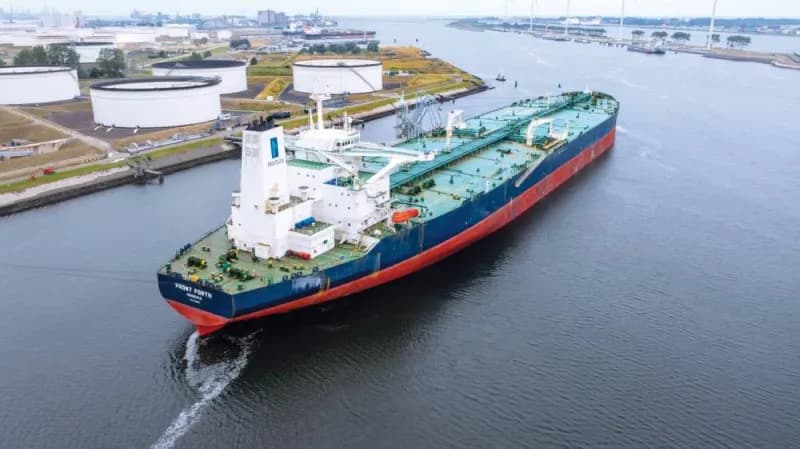
The two UAE national oil tankers Mombasa and Al Bahia were targeted by two Iranian cruise missiles while transiting the southern passage of the Strait of Hormuz in Omani territorial waters, resulting in the death of one crew member and injuries to eight others, in an escalation that the United Arab Emirates has condemned.
The UAE affirmed that the attack constitutes a serious violation of international law and a threat to regional security, freedom of navigation, and global energy supplies, and that it reserves its full right to respond. Gulf and Arab condemnations of the Iranian aggression followed in succession.
The Ministry of Defence announced that the two national tankers Mombasa and Al Bahia were targeted by two Iranian cruise missiles in the southern passage of the Strait of Hormuz in Omani territorial waters.
The Ministry explained that the attack resulted in the death of an Indian national crew member aboard the tanker Mombasa and the injury of eight others, four of them critically, noting that the injured included 6 Indian nationals and 2 Ukrainian nationals.
The Ministry added that the attack also caused material damage to both tankers as a result of fires that broke out aboard them, confirming that the fires on both vessels had been brought under control.
The Ministry of Defence condemned this blatant attack, which constitutes a serious violation and a clear breach of international law and threatens the security and stability of the region, stressing that the country reserves its full right to respond to this escalation and to take all necessary measures to protect its territory, its people, and its residents, in a manner that safeguards its sovereignty, security, and stability and protects its interests and national assets.
The Ministry affirmed that it is in a state of full readiness and preparedness to deal with any threats, and that it is taking all necessary measures to firmly confront everything that seeks to destabilise the country's security and stability. It called on the public to obtain information from official state sources and to avoid circulating rumours or unverified information.
In a separate statement, the United Arab Emirates expressed its strong condemnation and denunciation of the Iranian aggressive attacks that targeted the two national oil tankers Mombasa and Al Bahia after they were struck by two cruise missiles while passing through the southern passage of the Strait of Hormuz within Omani territorial waters.
The Ministry of Foreign Affairs stated in a communiqué that this Iranian aggressive attack resulted in the death of one Indian national and the injury of 8 persons — 6 Indian nationals and 2 Ukrainian nationals, including 4 in critical condition — expressing its sincere condolences to the victim's family, to the Republic of India, and to its friendly people, and wishing the injured a speedy recovery.
The Ministry affirmed that this Iranian aggressive attack constitutes a flagrant violation of UN Security Council Resolution 2817, which stressed freedom of navigation and rejected the targeting of commercial vessels or the disruption of international maritime passages.
It noted that targeting commercial shipping and using the Strait of Hormuz as a tool of pressure or economic extortion constitutes an act of piracy and a direct threat to regional stability and the wellbeing of its peoples, as well as to global energy security.
The United Arab Emirates stressed the necessity of Iran halting these aggressive attacks, ensuring its full commitment to ceasing all hostile acts, and reopening the strait fully and unconditionally, thereby achieving regional security and the stability of the global economy and trade.
Reactions to the Iranian aggressive attack continued to pour in, as the Secretary-General of the Gulf Cooperation Council, Jasem Mohammed Al-Budaiwi, condemned the Iranian aggressive attack on the two tankers, affirming that it constitutes a flagrant violation of international law and the rules of freedom of maritime navigation, and an explicit contravention of UN Security Council Resolution 2817.
Al-Budaiwi affirmed that the Gulf Cooperation Council stands as one alongside the United Arab Emirates and supports all measures it takes to protect its security, sovereignty, the safety of its installations, and its vital interests, calling on the international community —
— and in particular the Security Council — to assume its responsibilities and adopt a firm and deterrent stance toward these serious and repeated Iranian aggressions, in a manner that ensures their immediate cessation, the accountability of their perpetrators, the securing of international freedom of navigation, and the preservation of regional security and stability and of the global economy.
The Kingdom of Bahrain likewise condemned the Iranian aggressive attack, considering it a serious escalation that threatens regional security and stability and a grave violation of international law and UN Security Council Resolution 2817, affirming its full solidarity with the United Arab Emirates and its support for the legitimate measures it is taking to preserve its security, sovereignty, and vital interests.
The State of Kuwait expressed its strong condemnation and denunciation of the Iranian aggressive assault, affirming that it constitutes a flagrant violation of international law and UN Security Council Resolution 2817,
and a direct threat to the security and safety of maritime navigation and global energy supplies, stressing its full support for the United Arab Emirates and its backing of all measures it takes to protect its security and national assets.
The State of Qatar likewise strongly condemned the targeting of the two UAE oil tankers, affirming that the continuation of these rejected aggressions constitutes a serious escalation that threatens the security and stability of the region and undermines efforts aimed at consolidating regional security and stability.
Egypt, for its part, condemned the targeting in the strongest terms, describing it as a serious violation of the rules of international law and a direct threat to the security and safety of maritime navigation and the freedom of movement of trade through one of the most important international waterways.
His Excellency Mohammed bin Ahmed Al Yamahi, President of the Arab Parliament, also condemned the Iranian aggressive attacks in the strongest terms, stressing that they constitute a flagrant violation of the rules of international law and freedom of maritime navigation and a direct threat to the security of international maritime passages and the safety of commercial vessels.
The country reserves its full right to respond and to take all necessary measures to protect its territory, its people, and its residents.
Targeting commercial shipping and using the strait as a tool of pressure or economic extortion constitutes an act of piracy.
The Gulf Cooperation Council stands as one with the UAE and calls on the Security Council to hold Iran accountable for its aggressions.