
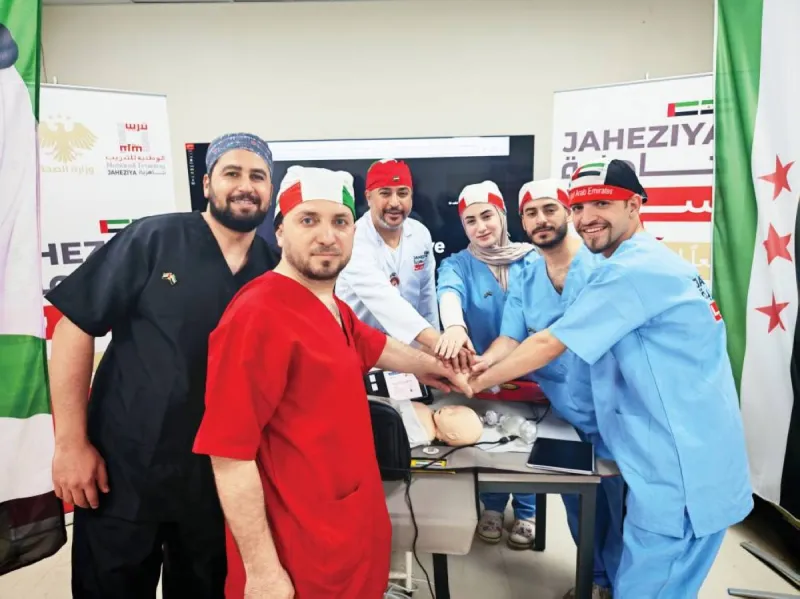
The UAE-Syrian readiness and response programme 'Jahez Syria' has successfully qualified 1,000 doctors, nurses, and paramedics working on the frontlines of hospitals under the ministries of health, higher education, and police, following a unified training curriculum internationally accredited by the European Centre for Disaster Medicine and the American institution for emergency services. The programme forms part of a UAE-Syrian project targeting the training of 20,000 health and non-health personnel.
The programme is implemented through a partnership between the Syrian Ministry of Health and the 'Jahez' Academy, affiliated with Al Wataniya for Training. It aims to enhance the skills of frontline workers in emergency and disaster management, and to raise the readiness of health institutions and response teams, through the Jahez Academy centre at Sheikh Mohamed bin Zayed Field Hospital in Damascus.
The fourth phase of the programme builds on the success of previous phases, which saw 1,000 frontline workers trained at hospitals under the ministries of health, higher education, police, and the military, under the supervision of experts from Syria, the UAE, and Europe, within a national programme to build sustainable capabilities in medical preparedness and emergency and disaster response.
The current phase includes the preparation of accredited national trainers, the qualification of Syrian and Emirati experts to manage training programmes, the establishment and activation of medical training centres, and the formation of reserve teams operating within a unified preparedness and response system. The phase adopts an advanced training curriculum developed in cooperation with the European Centre for Disaster Medicine, the Jahez Academy, and a number of specialised institutions in the UAE, the United States, and Europe.
The programme serves as a platform for the exchange of expertise between Syrian, Emirati, and international personnel. It also focuses on preparing national leaders and accredited trainers to ensure the sustainability of training and to build an integrated national system that supports health institutions and government bodies during emergencies and crises, by qualifying teams with skills in command and control, mass casualty management, and handling critical situations in accordance with unified scientific standards.
The programme aims to support the health sector in Syria by building human capacities and qualifying medical and paramedical personnel, as well as emergency response teams, civil defence units, and medical and administrative leadership, thereby contributing to improved response efficiency in major incidents and disasters.
The programme also seeks to enhance hospital readiness and standardise concepts of command, control, and crisis management. Dr Mohammed Al Khateeb, Director General of the Syrian Board of Medical Specialties, affirmed that the programme contributes to preparing national cadres capable of ensuring the sustainability of training and improving the readiness of hospitals and emergency response teams, through a joint committee overseeing the management of the programme and the development of its training outcomes in line with the needs of the health sector.
For his part, Dr Asaad Sharaf Al Din, head of the 'Jahez Syria' programme, said the programme is being implemented within a five-year plan based on international standards, focusing on advanced training and modern simulation technologies to build a sustainable national system capable of handling various emergency and disaster scenarios, enhancing hospital readiness, and raising the efficiency of medical response to critical cases.