
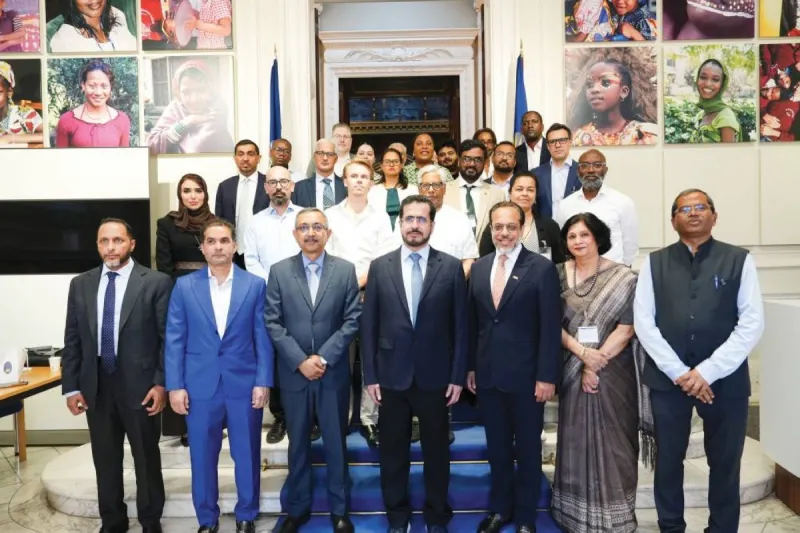
His Excellency Saeed Mohammed Al Tayer, President of the World Green Economy Organization (WGEO), affirmed that the transition towards a climate-resilient future is not solely an environmental challenge but a fundamental economic transformation, and that critical minerals form the cornerstone of the clean energy economy, underpinning all green economy initiatives — including solar panels, wind turbines, electric vehicle batteries, and electricity grid infrastructure.
He made these remarks in his keynote address at London Climate Action Week 2026, organised jointly by the Commonwealth Secretariat and the World Green Economy Organization (WGEO) under the theme "Building Collaborative Pathways Towards Sustainable Prosperity", held at Marlborough House in the British capital, London.
The session was attended by members of the WGEO delegation, including Engineer Walid bin Salman, Vice Chairman of the Board of Directors; Engineer Marwan bin Haidar; Dr. Yousef Al Akraf; and Abdulrahim Sultan, Director General of the Organisation.
Al Tayer stated that achieving a carbon-neutral future under the Paris Agreement requires more than simply reducing emissions — it demands that financing be directed in alignment with a pathway leading to reduced greenhouse gas emissions and a lower carbon footprint, in order to foster climate-resilient development. This means channelling public and private capital towards responsible critical mineral value chains, from exploration through to recycling, while ensuring that such investments do not entrench carbon-intensive or socially harmful practices.
He added that critical minerals represent an unprecedented opportunity for resource-rich Commonwealth nations to drive green industrialisation, build industrial capacity, attract high-quality investment, foster local innovation, and diversify their economies. Realising this opportunity, he noted, requires robust governance, strategic partnerships, and shared value across the entire supply chain, pointing out that the failure to achieve this has meant that previous extraction cycles left resource-rich countries with depleted assets and no genuine, sustainable development to show for it.
He praised the work of the United Nations Secretary-General's Panel on Critical Energy Transition Minerals, which established seven guiding principles for fair, sustainable, and transparent mineral value chains — encompassing benefit-sharing and the circular economy.
He noted that the Commonwealth Secretariat and the World Green Economy Organization are natural partners in applying these principles and translating global standards into tangible local practices.
Concluding his address, His Excellency Saeed Al Tayer affirmed that the green transition represents one of the most significant development opportunities of our era, calling for stronger partnerships, responsible investment, local innovation, and genuine community benefits — to ensure that critical minerals contribute not only to achieving global climate goals, but also to building more diversified, resilient, and inclusive economies. These, he said, are the shared values that unite the Commonwealth Secretariat and the World Green Economy Organization.
The event also featured a panel discussion bringing together representatives from the World Green Economy Organization (WGEO), the Intergovernmental Forum on Mining, Minerals, Metals and Sustainable Development (IGF), the Council on Energy, Environment and Water (CEEW), the International Council on Mining and Metals (ICMM), the International Trade Centre (ITC), and a technical expert from the Commonwealth Secretariat.
The discussion ranged broadly across key themes focused on exploring economic opportunities and strengthening international cooperation, seizing the potential of critical minerals as a primary driver of economic transformation towards green industrialisation, enhancing the role of the Water, Energy, Technology and Environment Exhibition (WETEX) — organised annually by Dubai Electricity and Water Authority (DEWA) — as a leading global platform for green business and sustainable partnerships, and reinforcing intra-Commonwealth cooperation through the activation of the Commonwealth Minerals Alliance.