
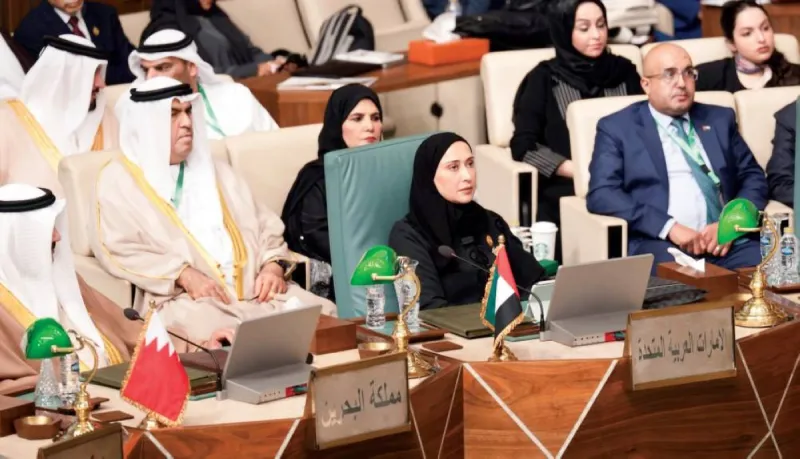
Maryam bin Thuniyya, Second Deputy Speaker of the Federal National Council, has affirmed that sovereignty in the age of digital transformation is no longer limited to protecting borders and resources, but is now tied to possessing knowledge and technological capabilities, and to strengthening production in artificial intelligence and the digital economy — contributions that consolidate the developmental standing of nations and protect their national security.
She stressed that the United Arab Emirates, despite its sustained focus on building its digital and technological capabilities, remains committed to the belief that concepts of power and sovereignty are only complete when grounded in the values of justice and humanity, affirming that the Palestinian cause will remain at the forefront of the UAE's political, humanitarian, and ethical priorities.
These remarks came in a speech she delivered on behalf of His Excellency Saqr Ghobash, Speaker of the Federal National Council, at the Eighth Conference of the Arab Parliament and Speakers of Arab Councils and Parliaments, held yesterday at the headquarters of the Arab League in Cairo under the theme "The Arab Parliamentary Vision for Strengthening Arab Digital Sovereignty and Protecting National Privacy in the Age of Digital Transformation."
Bin Thuniyya affirmed that the rapid changes the world is witnessing are imposing a new concept of power and sovereignty — one based on possessing knowledge and technology and the capacity to produce them. She noted that the UAE's wise leadership has adopted a forward-looking vision through which it has diversified the economy, entrenched governance, built a flexible legislative environment, and invested in advanced technology and artificial intelligence, cementing the country's standing as a global hub for innovation and development.
She said: "The world is witnessing growing interconnection in supply chains, sources of knowledge, and economies, which has made the concept of sovereignty contingent on possessing productive knowledge and technological capabilities — particularly in the sectors reshaping the new global economy, foremost among them artificial intelligence and the digital economy."
She added that recent developments in the region, and the Iranian aggressions to which the UAE and a number of Arab states have been subjected, have underscored the need to develop the framework and mechanisms of joint Arab action in a manner that keeps pace with the scale of challenges and rapidly evolving international changes, making joint Arab action a strategic necessity for enhancing security and stability.
She noted that the UAE has continued to deliver humanitarian aid to the Gaza Strip under Operation Noble Knight 3, having provided more than 46% of the total global humanitarian assistance delivered to the people of the Strip, in parallel with its firm and unwavering political stance in support of establishing an independent Palestinian state along the 4 June 1967 borders with East Jerusalem as its capital.
She affirmed that the battle for awareness has become part of the digital sovereignty equation, given the growing influence of digital media and artificial intelligence technologies — a reality that enhances the importance of the role of Arab media professionals and content creators in countering disinformation campaigns and hate speech, and in building an informed and responsible public opinion.
She explained that Arab parliamentary responsibility requires building a flexible legislative and oversight framework that keeps pace with digital transformations and achieves a balance between innovation and security, openness and privacy protection, and the availability of knowledge while safeguarding values and national security — stressing that modern legislation represents a fundamental pillar for consolidating Arab digital sovereignty.