
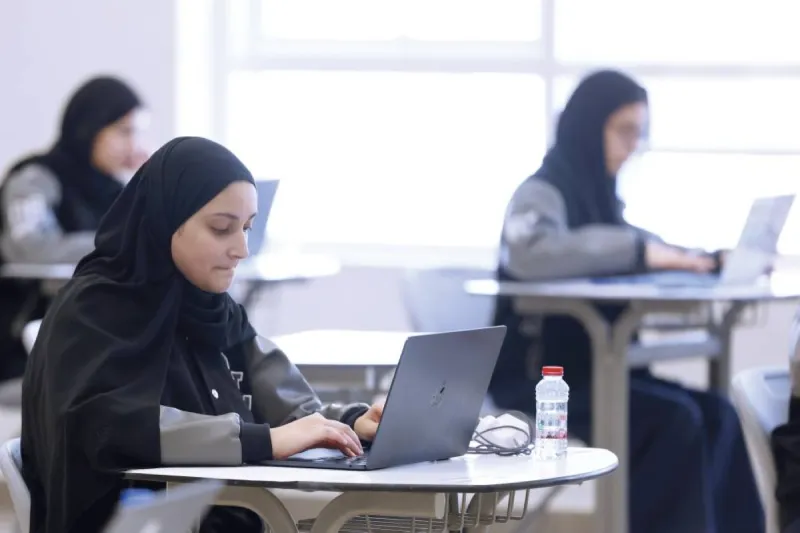
Grade 12 students sat the Islamic Education exam on Wednesday as part of the end-of-third-term final examinations for the 2025–2026 academic year, amid stable organisational conditions and full order across examination halls. Students in both the general and advanced tracks agreed that the exam questions were straightforward, comprehensive in covering learning outcomes, and considerate of individual differences among students.
Students confirmed that the exam included varied questions covering different parts of the curriculum, written in clear and uncomplicated language, which allowed most of them to complete their answers before the allotted time expired and to review their responses calmly.
They noted that the questions relied on comprehension and understanding, as well as recall of information, with no unexpected elements. Government and private school administrations implementing the Ministry of Education curriculum stated that the exam proceeded in a calm and disciplined manner, with technical and supervisory support provided inside the examination halls.
Electronic devices were verified to be ready before the exam began, which helped students complete their tests without technical or organisational obstacles. Schools added that students adhered to exam instructions throughout, while supervisory teams monitored proceedings and provided immediate support when needed, ensuring an appropriate examination environment for all students.
Grade 12 students will conclude their third-term examinations on Friday, 3 July, with the Biology exam, after which the marking and recording of results will begin in accordance with the procedures approved by the Ministry of Education.
In Sharjah, student Jana Raed expressed her satisfaction with the exam's level, affirming that it was easy, considerate of individual differences, and that the questions were clear and direct, with sufficient time for answering and reviewing.
She added that sitting the exam electronically is the most suitable option for Islamic Education, as it allows for quick answering, easy editing, and convenient review of skipped questions at the touch of a button.
Student Ghadeer Walid Al Kathiri, from Grade 12 (advanced track), affirmed that the exam was easy and consistent with the curriculum, noting that all questions were within the syllabus, which gave students a sense of confidence and ease during the exam.
Student Majd Abdullah Al Zaabi, from Grade 12 (advanced track), described the exam as average, noting that it was appropriate for measuring students' levels in Islamic Education and achieved a balance across different student groups.
General secondary students in both the advanced and general tracks in Ajman affirmed that the Islamic Education exam was easy, clear, and consistent with the ministerial framework, noting that the questions were direct and balanced, which helped them complete the exam with ease and gave them a sense of comfort and confidence.
Advanced track students unanimously agreed that all exam questions came directly from the ministerial framework and were distinguished by their clarity and lack of complexity, while a number of them felt that some questions were below average level, which allowed them to answer easily and use the remaining time for review.
In the general track, an atmosphere of ease prevailed inside the examination halls, with students expressing satisfaction with the exam paper's level, affirming that it was accessible and considerate of individual differences, which contributed to completing the exam smoothly and without notable difficulty.
For his part, Dr Hisham Omar Abdulaziz Daoud, acting principal of a private school and former chief supervisor at the Ministry of Education, affirmed that the Islamic Education exam was aligned with the approved ministerial framework and built on educational foundations reflecting the philosophy of assessment for learning, through a focus on comprehension and understanding rather than rote memorisation.
He explained that the clarity and fluency of the questions' phrasing enhanced students' motivation and reinforced the importance of deep understanding of the subject, noting that the exam paper varied between comprehending texts, linking to real-life situations, and applying Islamic values, rulings, and concepts in line with the curriculum's objectives.
Grade 12 students in both the general and advanced tracks at Fujairah schools affirmed that the Islamic Education exam was accessible, and was distinguished by the clarity, comprehensiveness, and balance of its questions.
Students Al Reem Mohammed Suleiman Al Naqbi, Hajer Abdel Rahman, and Aisha Ali Kareem Al Amiri, from the advanced track, said the exam was distinguished by its clear organisation and balanced questions, which helped them focus. They noted that the questions were direct and within reach for any well-prepared student, consistent with the curriculum, and free of surprises or complexity, which gave students a sense of reassurance while answering.
Students Nahyan Ahmed Al Mazrouei and Marwan Saeed Al Yamahi noted that the exam was clear and similar to practice models, with a focus on comprehension and understanding and balanced coverage of most parts of the curriculum, adding that the time was sufficient for solving and reviewing.