
Follow-up – Rehab Halawa, Aisha Al Kaabi, Reid Al Suwaidi and Mariam Al Addan
Grade 12 students in the General and Advanced tracks said that scheduling the physics exam after the weekly holiday gave them extra time to revise and prepare, particularly given that the subject relies on understanding, analysis, and application more than memorisation. Their views on the exam's difficulty level varied, however, with General track students finding it straightforward and Advanced track students facing greater challenges.
General track students said the exam was pitched at the level of an average student, containing direct and varied questions that covered different parts of the curriculum and drew from the approved framework, which allowed them to approach it with confidence. A number of them finished before the allotted time expired, noting that the questions took individual differences into account and contained no ideas outside the syllabus.
Advanced track students, by contrast, said the exam was broadly balanced but included 5 questions that required higher-order thinking and analysis, relying on an understanding of physical relationships and their application across multiple scenarios rather than straightforward memorisation.
They noted that the paper consisted of 25 questions, each worth 4 marks, which demanded careful reading and a high level of concentration before selecting the correct answer.
Advanced track students added that the exam's length was due not only to the number of questions but to the nature of the problems, which required linking more than one law and following sequential analytical steps. They confirmed that they used the full allotted time until the end of the exam in an effort to ensure the accuracy of their answers.
Students noted that placing the physics exam after the weekend was one of the most positive aspects of the schedule, as it gave them the opportunity to devote themselves to revision and practise exercises without the pressure of an immediately preceding test. This was reflected in their level of readiness and confidence during the exam, particularly in a subject that requires more time to understand laws and apply them practically.
They also confirmed that the intensive revision sessions conducted by schools in the lead-up to the exam played a significant role in preparing them, whether through in-class reviews or virtual sessions. Teachers focused on the most important concepts and expected applications, and also trained students in time management within the electronic exam, which helped reduce anxiety and improve performance.
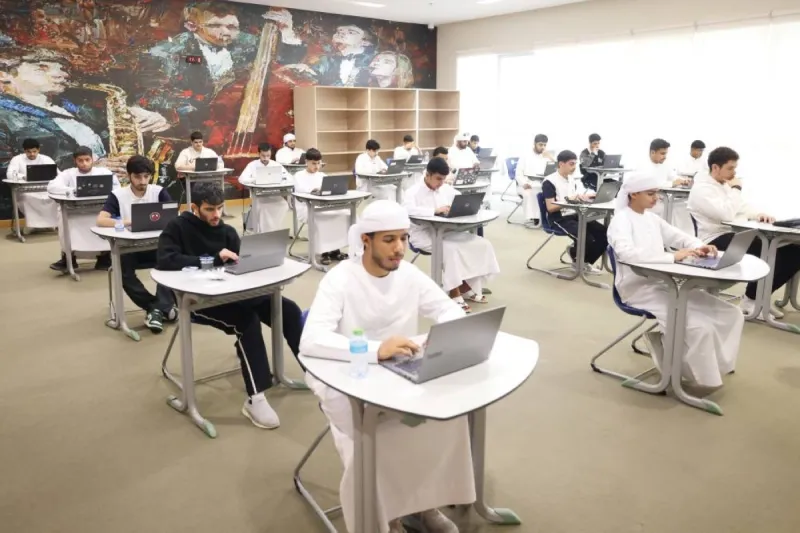
A number of students pointed out that sitting only the electronic exam this term reduced pressure compared with previous years, which included both an electronic and a paper-based test.
They affirmed that relying on a single exam gave them a greater ability to concentrate and manage their time, especially given their extensive experience in using the electronic platform, which meant the technical aspect had no adverse effect on the conduct of the exam.
Opinions among Advanced track students in Sharjah were divided: some felt the exam was of moderate difficulty and easier than the first-term test, while others considered certain questions to be difficult, particularly because the answer choices were very close to one another, requiring greater concentration.
A number of students noted that the formula sheet did not include all the required laws, while others felt time was limited given the lengthy solution steps involved.
In Ajman, Dr Hisham Omar Abdul Aziz Daoud, acting principal of Ajman Private School and former lead supervisor at the Ministry of Education, said the exam papers for both tracks were in line with the ministerial framework and drawn entirely from the curriculum, while incorporating inferential questions to measure higher-order skills and differentiate between student levels.
He said the time allocation was generally appropriate but limited the margin for review among some Advanced track students, while General track students expressed satisfaction with the clarity and level of the questions, with only minor challenges on a limited number of items.
School administrations confirmed at the close of coverage that third-term exams are proceeding according to plan with no significant complaints recorded, either at the technical or organisational level.
On the East Coast, student opinions showed a clear divergence. The majority of General and Elite track students said the exam was clear and matched the approved framework, while Advanced track students were split between those who considered it fair and an accurate measure of understanding, and those who felt it required deeper thinking and analysis along with complex calculation steps. Some also pointed to one question they considered unfamiliar and closer to chemistry topics.