
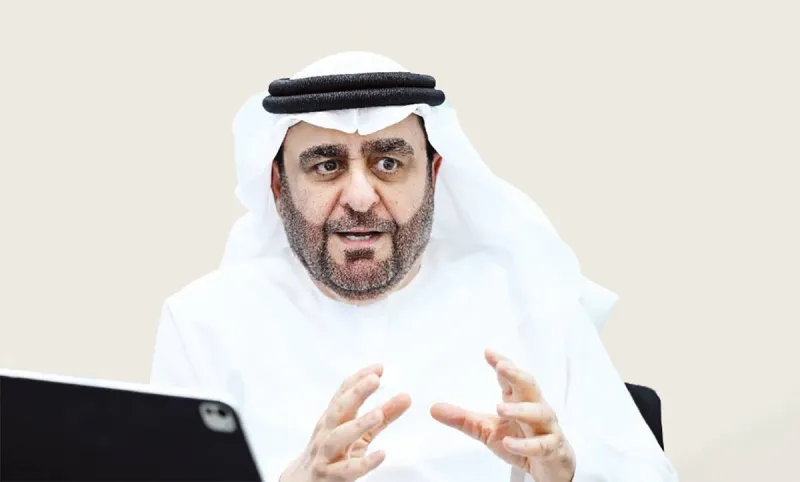
Dr. Mansour Al Awar, president of Hamdan Bin Mohammed Smart University, has affirmed that higher education institutions stand at a moment of fundamental transformation, driven by rapidly shifting labour market dynamics and successive advances in artificial intelligence technologies.
He noted that the traditional model of university study — enrolment for a fixed number of years followed by graduation — is no longer sufficient to meet the demands of the future.
In an interview with Al Bayan, he explained that universities are required to transition to a more flexible model built on continuous learning and lifelong skills development, stressing that the future value of universities will be measured by their ability to draw graduates back to update their knowledge and skills in line with the requirements of the digital economy.
He also emphasised that artificial intelligence does not represent a threat to education, but rather an opportunity to redefine the roles of academic institutions and teaching staff in ways that reinforce critical thinking, human values, and decision-making capacity.
The world is witnessing unprecedented shifts in the nature of jobs and skills — are we still preparing our children for the jobs of the future, or for jobs that have already begun to disappear?
We are living through one of the greatest transformations that education and the labour market have seen since the Industrial Revolution. Artificial intelligence, automation, and the digital economy are reshaping jobs at an accelerating pace, compelling a fundamental re-examination of many traditional educational models.
The question is no longer: are we preparing our children for the jobs of the future? It is: are we still using educational models designed for a world that no longer exists?
Global studies indicate that a large proportion of future jobs have not yet been created, while others will change radically or gradually disappear. It is therefore no longer enough to focus on preparing students for specific occupations.
I believe the most dangerous thing any educational institution can do today is prepare students solely for current jobs, because the future will reward the capacity for continuous learning far more than the possession of a fixed profession.
I do not believe we are facing the end of the university degree, but rather a redefinition of its role and value. It still represents an organised educational pathway that establishes an important knowledge base, but it is no longer sufficient on its own.
Employers are increasingly seeking practical skills, the capacity for achievement, adaptability, and continuous learning. Consequently, the coming phase will not merely be a transition from a credentials economy to a skills economy, but to a value economy — where the individual is measured by their ability to learn, apply, innovate, and generate impact.
Artificial intelligence has brought about a radical shift in the concept of professional competence. Specialised knowledge alone is no longer the source of value; rather, it is the ability to deploy that knowledge. The question is no longer: what do you know? It is: what can you do with what you know?
We will see a rise in the value of skills that are difficult to automate, such as critical thinking, creativity, innovation, leadership, ethical judgement, and working within multidisciplinary teams.
The ability to ask the right questions will also become more important than having the answers, because artificial intelligence provides information but cannot replace human vision or ethical responsibility.
Yes, and I regard this as one of the most important shifts in higher education. Specialisation was once a long-term investment, whereas the lifecycle of skills today has grown much shorter.
The most important question is therefore no longer: what is your specialisation? It is: do you possess the capacity for continuous learning? This capacity is what I call the