
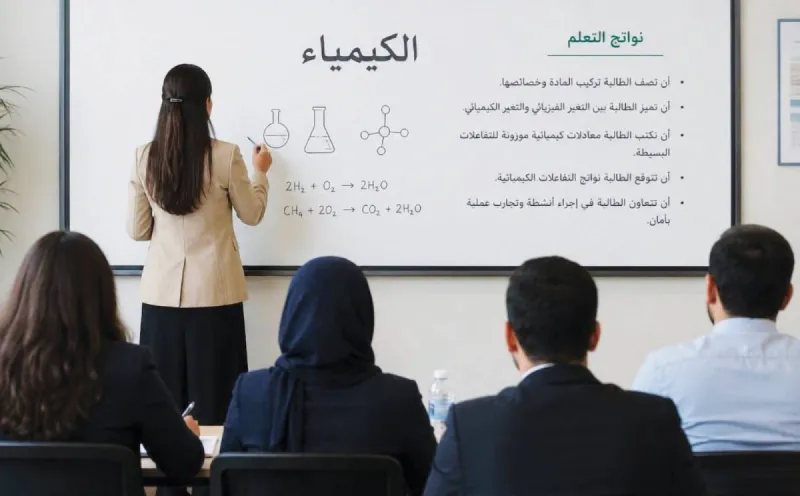
Private schools across the United Arab Emirates are intensifying their preparations for the upcoming 2026–2027 academic year by conducting observation classes for candidates applying for teaching positions. This phase is considered the most critical in the hiring process, aimed at selecting competent educators capable of delivering quality teaching aligned with the objectives of developing the educational system and enhancing learning quality in classrooms from the very first day of school.
School administrations confirmed that observation classes have become a primary benchmark for comparing candidates, having proven their ability to reveal a teacher's true classroom skills — beyond what personal interviews or CVs can show. They afford academic committees the opportunity to assess a teacher's practical performance in a real teaching situation, gauging their readiness to manage a lesson, interact with students, and apply the latest teaching strategies.
They noted that many teachers possess strong academic qualifications and good experience on paper, but the trial lesson reveals aspects that cannot be identified through interviews alone — such as classroom management ability, building positive relationships with students, handling unexpected situations, motivating participation, and diversifying learning activities in a manner suited to different learner levels.
They added that evaluation committees typically include the school principal, deputy principal, and head of department for the relevant subject, and sometimes subject coordinators. Teachers are assessed using forms that cover a set of professional and pedagogical indicators, including lesson planning, time management, subject mastery, approach to dealing with students, use of technology, ability to apply active learning strategies, reinforcement of national identity within lessons, as well as communication skills and the management of classroom discussion.
School administrations stressed that the greatest focus during observation classes is on modern educational philosophy, which requires that the student be at the centre of the learning process and that the teacher's role shift from transmitter of information to facilitator of learning, leader of discussion, and guide directing students towards thinking, research, analysis, and drawing conclusions — rather than relying on rote instruction or direct explanation throughout the entire lesson.
They indicated that committees closely monitor the extent to which the teacher succeeds in transforming the lesson into an interactive learning environment — through posing open-ended questions, encouraging students to express their opinions, conducting individual and group activities, motivating them to solve problems, and linking academic concepts to real-life situations, thereby contributing to deeper understanding and consolidation of knowledge.
They pointed out that among the aspects also evaluated is the teacher's ability to account for individual differences among students and to engage all learners in classroom activities — not limiting attention to high-achieving students — as well as using varied methods to motivate shy or less participatory students, ensuring equal learning opportunities for all.
They confirmed that the use of educational aids and digital technologies has become an essential component of teacher evaluation, with committees monitoring the extent to which candidates deploy smart boards, interactive presentations, educational applications, and artificial intelligence tools in ways that genuinely support learning rather than merely using them for their own sake, while keeping the focus on achieving lesson objectives efficiently.
School administrations added that observation committees also pay attention to measuring the teacher's ability to manage time, transition smoothly between lesson segments, and strike a balance between explanation, activity, and assessment. They also monitor the manner in which the teacher concludes the lesson, verifies that its objectives have been met, and employs varied assessment methods that help gauge student learning in real time.