
The Dubai Future Foundation has issued the fifth edition of the 'Future Opportunities Report: 50 Global Opportunities', which this year focuses on analysing the level of progress made on 50 diverse opportunities featured in previous editions of the annual knowledge report.
The aim is to give governments, institutions, and individuals the opportunity to explore their roles and capabilities in turning these future opportunities into reality.
Each opportunity in the report poses a fundamental question to institutional decision-makers: 'How can your organisation benefit from this opportunity, and what role should it play?' It also poses a practical question for individuals: 'Where are you directing your efforts and investments, and what skills do you need to keep pace with this change?'
The report examined the potential pathways that can lead us towards the future we aspire to — one of growth, prosperity, and quality of life — and focused on the importance of moving from ideas to implementation mechanisms, clarifying ways to provide the investments and financing needed to realise opportunities, and making the most of promising innovations.
The Dubai Future Foundation prepared the report with the participation of more than 180 experts and specialists from the United Arab Emirates and various countries around the world, who contributed their expertise and future visions to the analysis of the opportunities presented and how they can be applied and implemented under 5 long-term assumptions: continued climate change, widening gaps between communities, improving human health and longevity rates, increasing global interconnectedness, and accelerating technological progress.
His Excellency Mohammed Abdullah Al Gergawi, Minister of Cabinet Affairs, Deputy Chairman of the Board of Trustees and Managing Director of the Dubai Future Foundation, and Chairman of the Museum of the Future, affirmed that the future is made by minds that see in challenges the beginning of new paths towards progress and growth, and that every future opportunity is an invitation to think differently, act with greater courage, and believe that tomorrow can be better than we imagine.
He said: 'The United Arab Emirates has succeeded, since its founding and thanks to the vision of its leadership, in developing an inspiring global model that embraces an ambitious mindset — one that sees in challenges promising opportunities for growth and progress, and achieves what many might consider impossible. The most successful future planning decisions have always been made under the most difficult circumstances and have exceeded all expectations.'
He added: 'The UAE's experience has confirmed that bold decisions do not only change the present — they reshape the entire future. This is how great transformations are made: with bold decisions, and with minds that believe the future is not an event we wait for but a project we design. This is the mindset that our institutions, cities, and communities need today.'
The report includes 50 opportunities across various key sectors, among the most prominent of which are: 'The next generation of robotics, where globally deployed robotic platforms at reasonable cost can provide scalable solutions that support the achievement of sustainable development goals that were previously difficult to reach.'
Making all scientific and academic publications available to everyone through a centralised open platform would also accelerate innovation, strengthen cross-disciplinary collaboration, deepen the global spread of knowledge, and integrate all segments of society into the cycle of scientific production and benefit.
The report points to the opportunity to establish clusters of floating solar panels in space, operated by advanced artificial intelligence that ensures the selection of the optimal location and orbit, enabling the production of renewable energy around the clock and its reliable transmission to Earth.
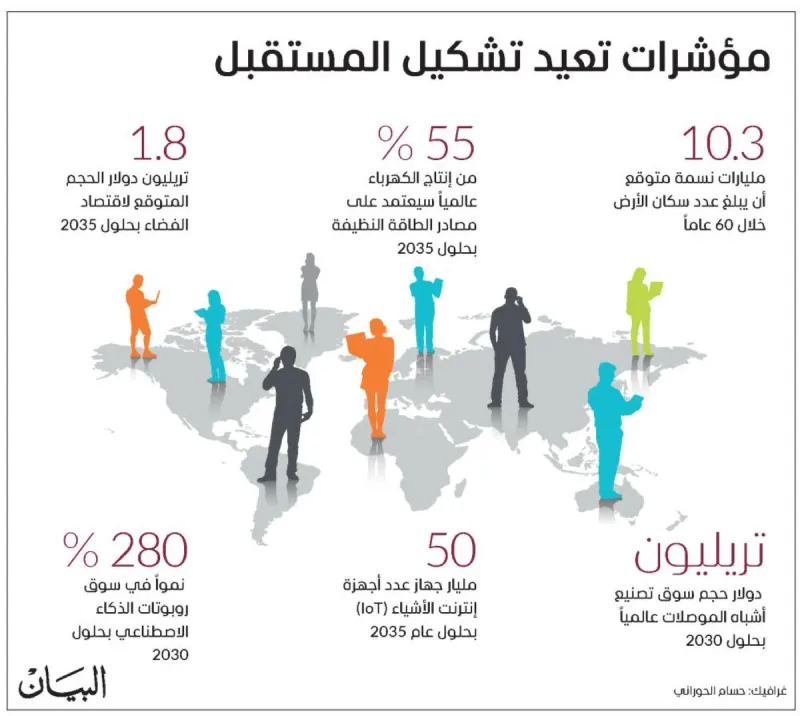
This would enhance efforts towards a transition to renewable energy sources, with estimates suggesting that 55% of global electricity production will rely on clean energy sources by 2035.
Space could also become a strategic location for large-scale energy storage, through networks of orbital supercapacitors capable of storing energy and transmitting it to Earth to meet humanity's growing needs on the planet.
In space as well, we will soon see the possibility of transmitting electricity to individuals and industries via superconducting materials without loss, enabling more efficient, flexible grids capable of meeting the increasing demand for energy.
The report notes that nanobiomaterials and synthetic materials will soon enable the production of smart fabrics and clothing capable of supplying the human body with its minimum daily vitamin requirements, to enhance health and address the problem of nutritional deficiencies.
The report affirms that the oceans harbour immense biodiversity, only a limited portion of which has been explored, opening vast horizons for the development of marine biotechnology and pharmacology, and supporting innovation in the pharmaceutical and food industries, while enhancing ecosystem conservation efforts — noting that 75% of new infectious diseases have emerged in areas that experienced severe disruptions in biodiversity.
There is a promising opportunity for the development of nano-carbon materials capable of removing contaminants with high efficiency, including ultrafine particles, bringing about a qualitative transformation in efforts to provide clean water globally, given that 2.1 billion people worldwide lack access to safe drinking water.
Bacteriophages, including genetically modified viruses, may also become an effective therapeutic alternative to antibiotics by directly and precisely targeting disease-causing bacteria.
According to the report, we may witness in the near future a wave of revolutionary technological innovations in the field of vehicle wheel and tyre production that will reshape the future of the automotive industry, ranging from magnetic levitation technologies and solutions inspired by drones to advanced alternatives to rubber tyres that reduce energy consumption and emissions.
The rapid advances in quantum physics may revolutionise communications, encryption, and computing, and transform digital reality into one that is more present and impactful.
The report affirms that advances in satellites and advanced artificial intelligence will enable all people in the world to access the internet with high efficiency, while supporting the Internet of Things and reducing network failures through intelligent switching between cellular and satellite networks.
It will also be possible to build advanced homes inspired by space research, designed to be self-sufficient, provide life's essentials, and reduce the burden on planet Earth — with estimates indicating that the space economy could reach $1.8 trillion by 2035.
We may soon be able to store and process data in local devices close to their source on a wide scale, rather than transmitting it across networks to centralised data centres. This contributes to accelerating data processing, improving performance, reducing latency, and enhancing the efficiency of technologies such as artificial intelligence, machine learning, augmented reality, and connected systems. Estimates indicate that the number of Internet of Things (IoT) devices could reach 50 billion by 2035, and the global semiconductor manufacturing market is expected to reach approximately $1 trillion by 2030.
Machines will be able to repair their own faults without human intervention, by integrating predictive maintenance, smart materials, and advanced sensors. This enables continuous manufacturing without interruption, enhances the sustainability of consumer products and robots, and extends their operational lifespan.
Personalised bioprinting will bring about a radical transformation in the field of organ transplantation by printing organs from the patient's own cells, increasing the likelihood of the body accepting them and raising survival chances.
Meanwhile, contactless haptic technologies will take digital experiences to a new level by enabling the sense of touch without wearable devices, enhancing the quality of interaction in gaming, extended reality, healthcare, and daily life. The report also reviews opportunities in the context of global demographic shifts, where the world's population is expected to reach 10.3 billion within 60 years, increasing the need to accelerate the development of scalable solutions in the energy, health, food, water, infrastructure, and technology sectors.