
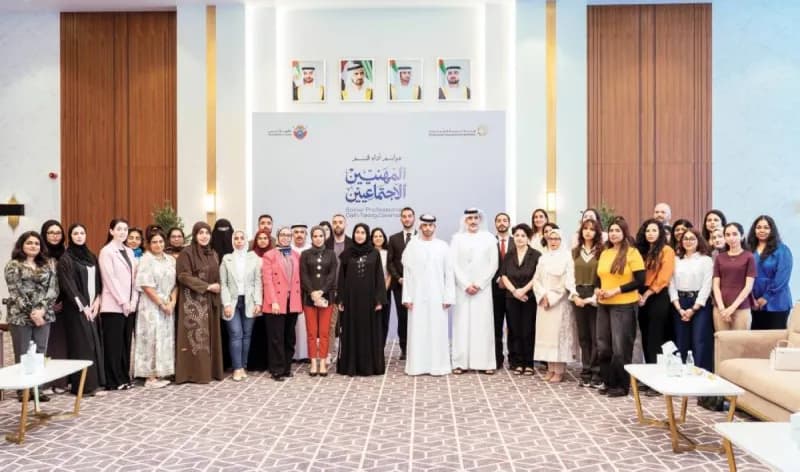
38 social specialists across various psychological, educational and social disciplines took the professional oath before Her Excellency Hessa bint Issa Buhumaid, Director General of the Community Development Authority in Dubai, after completing all professional requirements. The total number of officially licensed and accredited social professionals in the emirate has thereby risen to 1,144 practising professionals.
Her Excellency Hessa bint Issa Buhumaid affirmed that the sustained increase in the number of licensed social professionals reflects the progress achieved by the social sector in Dubai and the success of the emirate's vision to build qualified cadres in accordance with the highest professional and ethical standards.
She noted that the number of licensed professionals had risen from 450 at the beginning of 2024 to 1,144 currently, more than doubling and a half within two and a half years.
She pointed out that this figure does not represent a mere statistic, but reflects stories of dedication, professional effort and a belief in the importance of building cadres capable of making a real impact on the lives of individuals and families.
Her Excellency said that investing in the qualification and licensing of social professionals is a direct investment in people, the family and quality of life, stressing that this achievement is aligned with the targets of the Dubai Social Agenda 33, which places the family at the forefront of priorities and seeks to consolidate a more effective and sustainable social system.
She added that social work should not be limited to professional intervention after a problem has occurred, but must be grounded in a proactive understanding of community needs, monitoring challenges before they escalate, and intervening at the right time to support individuals and families and reinforce stability.
She explained that a licence grants a social professional the right to practise in Dubai, just as is the case for practitioners in other regulated professions, and that social work may not be practised in the emirate without obtaining a licence and fulfilling the approved professional requirements.
Her Excellency stated that taking the oath and obtaining a licence represent an important stage in the professional lives of specialists. A licence, she said, is not merely a professional title or a regulatory procedure, but an ethical, societal and professional commitment that strengthens the community's confidence in social practitioners and places upon them the responsibility of supporting individuals and families, particularly the most vulnerable groups.
She affirmed that the requirement to complete 40 hours of continuing professional development upon renewing the licence every two years contributes to developing professionals' knowledge and skills and ensures they remain abreast of the latest practices and scientific advances.
She noted that the value of this achievement is amplified by its coincidence with the Year of the Family, stressing that social professionals represent the first line of defence for the family and that their role begins with proactively understanding family needs and supporting and empowering members to face challenges.
Ali Ibrahim Saeed Mubarak, Head of the Licensing Department at the Authority, confirmed that issuing a professional licence takes between one and two months after applicants have fulfilled all basic requirements, which include an accredited academic qualification, a certificate of good conduct, taking the oath, and passing the examinations and training programmes prescribed according to the nature of each specialisation.
He noted that the number of UAE nationals who have obtained a professional licence has exceeded 171, adding that the licence is renewed every two years on the condition that the licence holder completes 40 hours of continuing professional development, ensuring the development of skills and the maintenance of professional competency.
He added that the Authority is moving towards employing artificial intelligence technologies in developing its services, and is working to enrol licensed professionals in educational and training programmes in cooperation with universities and educational institutions, with the aim of raising the quality of services provided in the emirate.
The professional licensing system is underpinned by Law No. 12 of 2026 concerning the Community Development Authority in Dubai, which granted the Authority the mandate to regulate, license and supervise practitioners of social professions across the emirate.
A number of newly licensed professionals affirmed that obtaining the licence marks a new stage in their careers and enhances their sense of responsibility towards the community, noting that licensing raises families' confidence in specialists and ensures that services are delivered with greater quality and organisation.
Alia Al Falasi, a social specialist, said that obtaining the licence gives a professional greater motivation to work according to systematic and well-considered plans, stressing that dealing with families requires a deep understanding of their needs and a commitment to keeping up with professional and scientific developments.
Mariam Samir, a psychology graduate and assistant psychological specialist at the Community Development Authority in Dubai, explained that licensing is an important step for those working in the social sector, particularly specialists dealing with people of determination, given the scientific and professional knowledge it requires along with the completion of training and formal prerequisites.
Israa Dessouki, an assistant psychological specialist at the Dubai Centre for Autism, affirmed that licensing strengthens families' trust in specialists and gives parents greater reassurance that service providers possess the necessary qualifications and competencies.
Iman Jaber, a social specialist at the Dubai Centre for Autism, said that licensing constitutes an important launching point for delivering services in a stronger and more organised manner, and helps specialists deepen their knowledge of relevant legislation and procedures in order to better support families.
The approved professional specialisations within the licensing system include: psychologist, assistant psychologist, social specialist, social counsellor, special education teacher, assistant behaviour analyst, learning support assistant and behaviour analyst — reflecting the diversity of community needs and the evolution of social services in Dubai.