
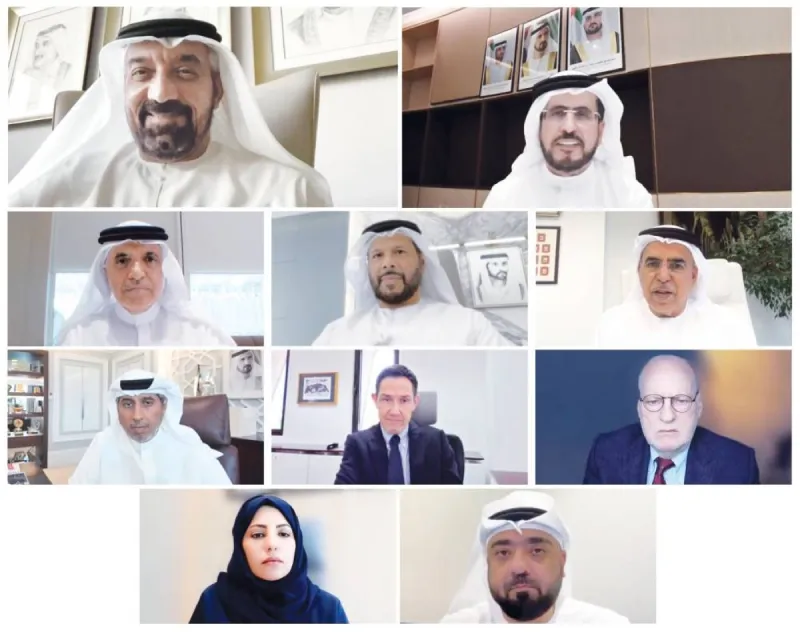
Sheikh Ahmed bin Saeed Al Maktoum, Chairman of the Dubai Supreme Council of Energy, presided over the council's 95th meeting, held virtually, in the presence of His Excellency Saeed Mohammed Al Tayer, Deputy Chairman of the Council.
Sheikh Ahmed affirmed that Dubai, guided by the vision of Sheikh Mohammed bin Rashid Al Maktoum, Vice President and Prime Minister of the UAE and Ruler of Dubai, continues to build a more resilient and future-ready energy system.
In a post on X, he wrote: "I chaired the 95th meeting of the Dubai Supreme Council of Energy, during which we reviewed progress towards achieving sustainable development goals and approved the results of the greenhouse gas emissions measurement for 2025.
Guided by the vision of Sheikh Mohammed bin Rashid Al Maktoum, we continue to build a more resilient and future-ready energy system — one built on forward-looking governance, that stimulates innovation, attracts investment, and supports sustainable economic growth, thereby strengthening Dubai's competitiveness and global leadership for generations to come."
The meeting was attended by Ahmed Buti Al Muhairbi, Secretary-General of the Council, as well as council members His Excellency Marwan bin Ghalaita, Director General of Dubai Municipality, and Abdullah bin Kalban, Managing Director of Emirates Global Aluminium.
Also in attendance were Hussein Sultan Lootah, CEO of ENOC Group, Juan Ferrel, Director General of Dubai Petroleum and DUSUP, and Mona Al Osaimi, Executive Director of the Strategy and Corporate Governance Sector at the Roads and Transport Authority (RTA).
The Dubai Supreme Council of Energy reviewed the emirate's performance in achieving sustainable development goals and approved the results of the 2025 greenhouse gas emissions measurement, which showed a continued decline in the emirate's carbon footprint, reflecting progress in implementing policies and initiatives supporting sustainability and the transition to a green economy.
This achievement is attributed to a number of key factors, most notably increased clean energy production, rationalisation of electricity and water consumption, improved operational efficiency across various sectors, and the expanded use of environmentally friendly vehicles.
The council also discussed the feasibility of producing Sustainable Aviation Fuel (SAF) from organic waste in Dubai, in line with global trends aimed at increasing the blending ratio of sustainable fuel with conventional jet fuel in the coming years.
This initiative would provide a cleaner local alternative for the aviation sector, make use of solid waste, and reinforce the principles of the circular economy in Dubai.
His Excellency Saeed Mohammed Al Tayer said: "These achievements are a translation of the vision and directives of Sheikh Mohammed bin Rashid Al Maktoum, Vice President and Prime Minister of the UAE and Ruler of Dubai, aimed at cementing Dubai's position as a global model in sustainable development and the green economy."
He added that projects emanating from the Dubai Integrated Energy Strategy 2050 and the Dubai Carbon Emissions Reduction Strategy 2030 have demonstrated the effectiveness of the emirate's strategic direction.
They have succeeded in attracting investments and partnerships from the private sector at both local and international levels to implement pioneering projects in solar energy, battery energy storage, green hydrogen production, waste-to-energy, waste recycling, and green building construction.
He noted that the council has succeeded in providing a supportive environment to accelerate the implementation of strategic projects and enhance cooperation and integration between government entities and the private sector, ensuring the sustainability of achievements and the realisation of the emirate's future goals in energy and sustainability.
For his part, Ahmed Buti Al Muhairbi affirmed that the governance model adopted by the council — and continuously developed over the past 15 years — has been a fundamental pillar in achieving qualitative results and distinguished performance indicators, through the implementation of an integrated set of programmes and initiatives within the energy and water demand management strategy.
These efforts have contributed to tangible savings in electricity and water consumption, in accordance with a clear roadmap and sustainable methodology that has been applied since 2012.