
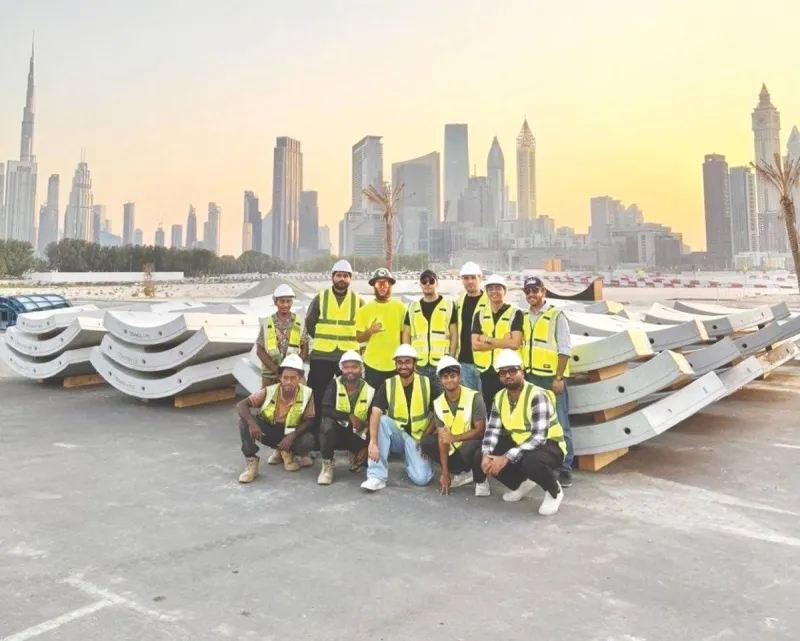
The Boring Company, owned by American businessman Elon Musk, has revealed that manufacturing has begun on the precast concrete segments to be used in the Dubai Loop project, marking a step that reflects the progress of the underground high-speed transit tunnel network in Dubai.
The company announced via its official account on X that the first phase of the project will require approximately 25,000 precast concrete segments, each weighing around 4,000 pounds, with the total weight of the tunnel components approaching 100 million pounds, as construction work proceeds to complete the project.
The Dubai Loop project is one of the emirate's landmark future mobility initiatives. The Roads and Transport Authority (RTA) began studying its implementation by signing an agreement with The Boring Company on the sidelines of the World Government Summit 2025.
The RTA provided the company with geotechnical data, utility and structural information, and environmental risks, in addition to the approved specifications and standards for Dubai's transport systems. The company, in turn, submitted technical studies, safety information, and system development details for the proposed routes, in collaboration with international centres of expertise.
At the World Government Summit, the project culminated in the signing of a strategic partnership agreement with the same company to begin implementing an advanced passenger tunnel network in the Emirate of Dubai — the Dubai Loop — using advanced technologies that contribute to a qualitative leap in the mobility ecosystem and enhance the efficiency and fluidity of movement in high-density urban areas.
Under the agreement, the first phase of the project will commence with the construction of a 6.4-kilometre pilot route featuring four stations, connecting the Financial Centre area to Dubai Mall, as a precursor to expanding the full route, which will extend 22.2 kilometres and include 19 stations linking the Business and Financial Centre area with the Business Bay area.
The Dubai Loop project involves constructing tunnels with a diameter of 3.6 metres, dedicated to vehicle transport, using advanced boring technologies that enable faster delivery, lower implementation costs, and reduced impact on existing roads and utilities compared to conventional transport systems.
The cost of implementing the first phase of the route is estimated at approximately 565 million dirhams (AED), with an implementation period of approximately one year after the completion of design work and necessary preparations, while the total cost of implementing the full route is estimated at approximately 2 billion dirhams, with an implementation period of approximately 3 years.
The project will be a qualitative addition to Dubai's transport network, contributing to enhanced integration of various mobility modes and providing flexible and efficient first- and last-mile solutions. The pilot route is expected to serve approximately 13,000 passengers per day, while the full route's capacity is estimated at approximately 30,000 passengers per day.