
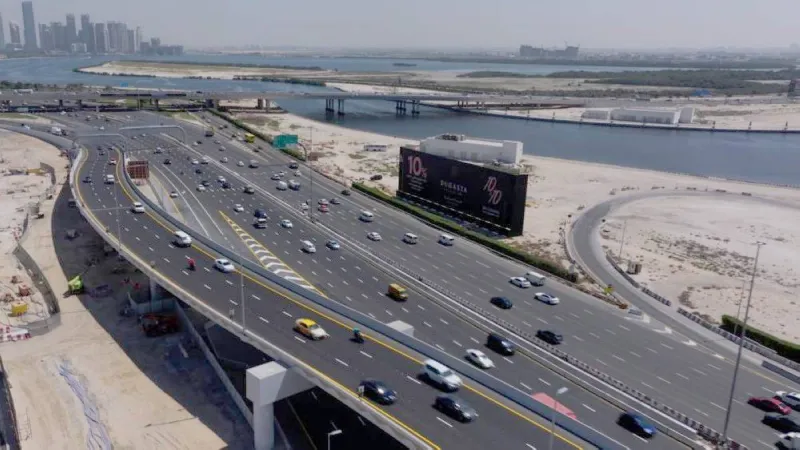
The approval by Sheikh Hamdan bin Mohammed bin Rashid Al Maktoum, Crown Prince of Dubai, Deputy Prime Minister, Minister of Defence, and Chairman of the Executive Council of Dubai, of the Al Khail Avenue One development plan marks a new milestone in Dubai's journey to consolidate its standing among the world's leading cities in infrastructure development and smart mobility. The project reflects the emirate's continued commitment to investing in strategic initiatives that anticipate future needs.
It keeps pace with the rapid urban, economic, and population growth Dubai is experiencing, through innovative engineering solutions designed to ensure the sustainability and efficiency of the road network for decades to come.
The project reflects the continuation of the policy the emirate has pursued over the past two decades, which has been built on making infrastructure one of the primary drivers of economic and social development.
Investment has not been confined to road construction alone; it has encompassed building an integrated system comprising roads, bridges, and tunnels, public transport networks, and smart mobility projects. This has provided an advanced infrastructure capable of keeping up with urban expansion and absorbing the continuous increase in the number of residents and visitors, while helping to entrench Dubai's position among the most globally competitive cities in infrastructure quality and mobility system efficiency.
The Al Khail Avenue One development project falls within this direction. It involves the implementation of a new strategic corridor running parallel to Sheikh Zayed Road, in addition to the construction of the first connected elevated track stretching 15 kilometres — a project that aims to provide a route for through traffic, increase the road network's capacity, and enhance the flow of movement between various vital areas, in line with anticipated growth over the coming decades.
The project reflects Dubai's continued approach of implementing infrastructure projects before demand for them reaches its peak. The emirate relies on population, urban, and economic growth indicators when drawing up its future plans, ensuring that the road and transport network is ready to accommodate the continuous expansion of new residential areas, commercial centres, and investment projects, without affecting the efficiency of movement or the quality of services.
The Al Khail Avenue One development project will join the list of major and ambitious projects that Dubai will complete in the infrastructure and mobility sector over the coming years — projects united by a single goal: building an integrated transport system that places human comfort and ease of movement at the forefront of its priorities, alongside supporting the urban and economic growth the emirate is experiencing.
These projects span road network development, public transport system expansion, and the adoption of future mobility solutions, enhancing connectivity between Dubai's various areas and facilitating access to residential zones, business centres, services, and vital facilities, while keeping pace with the continuous expansion of new urban communities.
These projects are being implemented in parallel with Dubai's urban expansion, with transport projects closely linked to new residential communities. This ensures easy access to educational, healthcare, leisure, and business services, reduces commuting time, and raises quality of life — all of which is consistent with the emirate's vision of building a human-centred city that provides a more efficient and accessible urban environment.
These projects also complement the targets of the 20-Minute City initiative, which is premised on enabling residents to access their daily needs and essential services within a shorter time through an advanced transport network and an interconnected infrastructure linking all parts of the emirate, supporting diverse mobility patterns, enhancing movement efficiency, and bringing services closer to residents.
The Al Khail Avenue One development project represents a new addition to this system. Its role is not limited to increasing the capacity of one of the most important traffic arteries; rather, it comes within a broader vision targeting the provision of infrastructure capable of keeping pace with future growth, connecting the emirate's various regions, and facilitating the movement of residents and visitors — thereby enhancing quality of life and continuing to consolidate Dubai's position as one of the world's leading cities in infrastructure development and innovative mobility systems.