
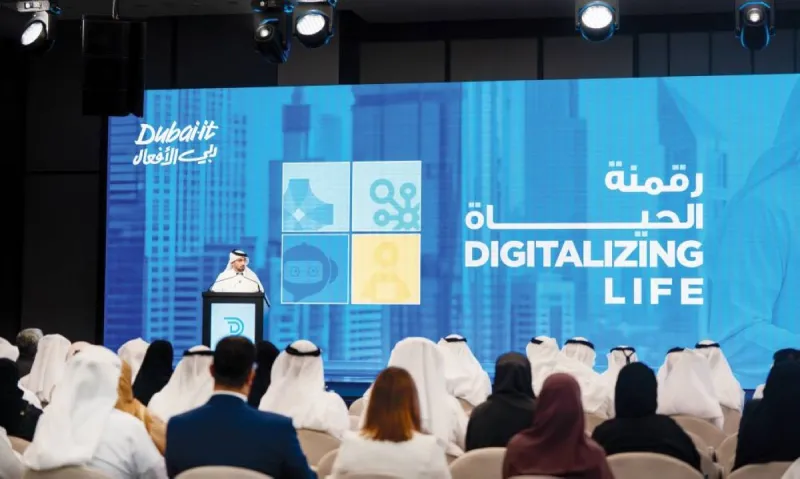
Dubai Digital organised the "Digitalising Life in Dubai 2026" event, with broad participation from government entities responsible for services, data, and digital technologies, aimed at coordinating government efforts and accelerating the development of a digital operating model for the next phase.
Working sessions and specialist discussions at the event focused on four strategic pillars representing the foundations of the next phase of Dubai's digital transformation journey.
The first pillar is AI data readiness, in which participants discussed ways to develop interconnected, high-quality data ecosystems that enable the safe and responsible deployment of artificial intelligence, and support decision-making and the development of future services.
The second pillar addressed the future of service and experience delivery, focusing on developing a more customer-centric government model built on designing services from the perspective of individuals and businesses rather than traditional institutional structures.
The third pillar addressed AI implementation by examining mechanisms for integrating artificial intelligence and agentic AI within government services and operational processes.
The fourth pillar focused on the future of digital maturity by developing new measurement models that keep pace with the requirements of the next phase and help guide continuous improvement and future policy-making.
His Excellency Hamad Obaid Al Mansoori, Director General of Dubai Digital, said: "With confidence and capability, Dubai is moving towards a new phase of government work — a phase in which data, systems, and services are integrated within a single ecosystem grounded in artificial intelligence and centred on the human being.
"Today, the question is no longer how to deliver more digital services, but how to make services closer to people and more capable of understanding their needs and responding to them before they are even requested. The future is heading towards proactive and integrated government experiences that operate in harmony and seamlessly."
Younis Al Nasser, Chief Executive Officer of the Dubai Data and Statistics Establishment under Dubai Digital, said:
"Data is no longer merely a resource supporting decision-making; it has become the infrastructure upon which digital services and artificial intelligence applications are built. The higher the quality, integration, and readiness of data, the greater the ability of government entities to develop more proactive, personalised, and efficient services.
"Building an AI-driven government requires an integrated data ecosystem founded on governance, trust, and interoperability, ensuring that data is transformed into real value that is reflected in quality of life and in enhancing Dubai's competitiveness."
Matar Saeed Al Humairi, Chief Executive Officer of the Dubai Digital Government Corporation, said the future of service delivery depends on the ability to design integrated experiences that start from the customer's needs rather than the organisational structure of government entities.
"When we succeed in unifying platforms, standards, and methodologies, the customer journey becomes simpler, smoother, and more consistent. Consolidating services within shared digital channels is an important step towards building a unified government experience that reflects Dubai's vision of operating as one interconnected ecosystem.
"The success of the next phase requires continued partnership and coordination among the various government entities, and joint efforts to remove challenges and accelerate the implementation of solutions that translate the vision into tangible impact on people's lives and the business environment."