
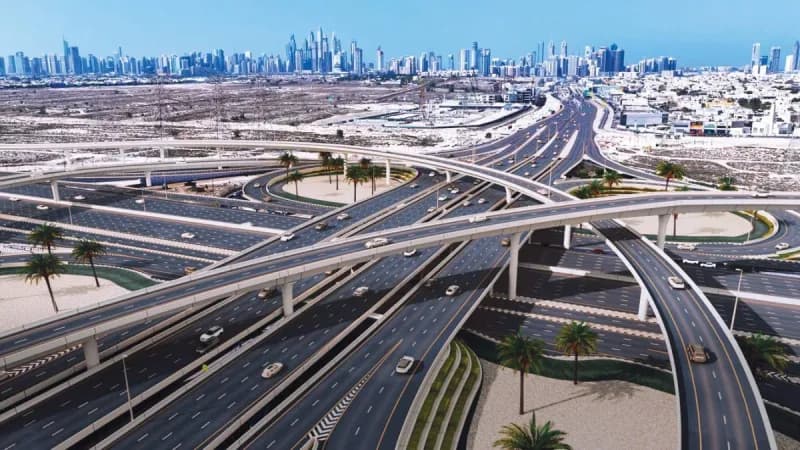
The Roads and Transport Authority (RTA) in Dubai completed more than 12 strategic projects and development initiatives during the first quarter of this year, spanning roads, infrastructure, smart mobility and sustainable transport. The projects are part of the authority's ongoing efforts to keep pace with the emirate's rapid urban and population growth, enhance the efficiency of the transport network, and elevate services for residents and visitors.
The achievements encompassed a diverse range of projects and initiatives targeting the development of roads, bridges and intersections, the widening of several vital traffic corridors, and the implementation of projects supporting flexible mobility and cycling, alongside initiatives aimed at accelerating the transition to smart and sustainable transport systems.
The works also included traffic improvements in a number of vital areas to enhance traffic flow, reduce journey times and raise road safety levels.
The authority confirmed that these projects embody its sustained commitment to executing strategic plans aimed at developing advanced infrastructure in line with the best global practices, thereby reinforcing Dubai's standing among the world's leading cities in ease of mobility and quality of life.
It noted that the development of the road network and transport modes constitutes one of the key pillars supporting economic and social development in the emirate, by providing an integrated, safe and sustainable transport system that meets future growth requirements.
As part of its efforts to promote sustainable mobility patterns, the authority completed 13 new cycling tracks in various parts of Dubai, within a comprehensive plan to expand the dedicated cycling network and encourage the use of environmentally friendly transport modes.
These tracks contribute to enhancing cyclist safety and connecting numerous residential, commercial and recreational areas through an integrated mobility network that supports the emirate's drive to increase reliance on alternative transport modes.
Within the framework of road network and vital corridor development, the authority completed the construction of two bridges as part of the Al Asayel and Oud Metha streets development project, with the aim of raising road capacity and improving traffic flow in one of the emirate's busiest areas.
It also opened a new bridge linking Sheikh Zayed Street and Sheikh Khalifa bin Zayed Street, which contributed to strengthening connectivity between the main traffic corridors and providing smoother routes for vehicles travelling between different parts of Dubai.
The completed projects also included the development of Al Ruwayya Street, one of the important corridors supporting traffic movement in the southern areas of the emirate. The works involved engineering and traffic improvements that raised the road's efficiency and enhanced traffic safety levels in line with expected future growth in traffic volumes.
The project contributed to improving the link between Sheikh Mohammed bin Zayed Road and Sheikh Zayed bin Hamdan Al Nahyan Street near Dubai Silicon Oasis and Nad Al Hessa, as well as increasing the capacity of Sheikh Zayed bin Hamdan Al Nahyan Street by up to 40% and reducing journey time to Sheikh Mohammed bin Zayed Road from 10 minutes to 4 minutes, an improvement of 60%.
The authority also completed a new bridge project at the intersection of Al Qudra Road with the connector road between Arabian Ranches and Dubai Studio City, contributing to reducing journey times and improving access to and from the surrounding residential areas, in addition to raising road safety levels and reducing congestion during peak hours.
In the area of smart and future transport, Dubai saw the official launch of self-driving taxi services, a step that reflects the emirate's leadership in adopting the latest technologies and innovative solutions in the transport sector.
The project forms part of Dubai's Smart Mobility Strategy, which aims to enhance reliance on autonomous and sustainable transport modes, thereby raising service efficiency, improving user experience and cementing Dubai's position as a leading global city in innovation.
The authority also completed, during the first quarter, 67 traffic improvements that had been initiated in 2025 at a number of vital locations across the emirate. These improvements included intersection upgrades, the addition of new lanes, improvements to entry and exit points, and the reorganisation of traffic flow, all of which contributed to raising network efficiency, reducing journey times and enhancing traffic flow.
As part of promoting the concept of flexible and sustainable mobility, the authority implemented a series of flexible mobility projects in the Al Quoz Creative District, encompassing the development of pedestrian and cycling infrastructure and light mobility modes. This supports the transformation of the area into an integrated urban model that caters to the needs of residents and visitors and enhances ease of access to various facilities and services.
Among the most notable projects completed by the authority during the same period was Phase 1 of the Hessa Street development project, one of the largest traffic projects currently under way in Dubai. It targets increasing the street's capacity and enhancing connectivity between a number of vital residential and commercial areas, contributing to reducing traffic congestion and providing sustainable mobility solutions to meet future needs.
The authority also completed the widening of the bridge leading to Terminal 1 at Dubai International Airport, with the aim of improving traffic flow for arrivals and departures and enhancing access efficiency to one of the world's busiest airports, in line with the continuous growth in passenger numbers.
The achievements also included traffic widening works on Al Warqa'a 1 Street in both directions, which involved engineering and traffic improvements that enhanced traffic flow and eased pressure on the road, particularly in light of the increasing urban expansion and population density in the area.
In the area of land use organisation and service facilities, the authority completed the Al Ruwayya yard project, designated for the organised parking of caravans, boats and trailers. The project aims to provide an organised and safe environment for these vehicles and equipment, curb random practices, enhance the emirate's urban appearance and raise the efficiency of space utilisation for this purpose.
The authority affirmed that these projects represent part of a comprehensive, long-term plan to develop Dubai's transport system and infrastructure, noting that each project constitutes a new step towards building a more efficient, sustainable and flexible transport network capable of keeping pace with future growth requirements and achieving the targets of Dubai's economic and development agenda, reinforcing the emirate's position as one of the world's best cities for living, working and mobility.