
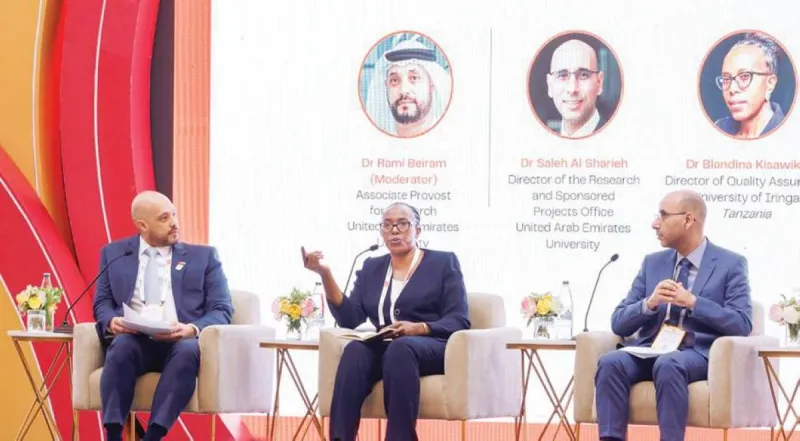
United Arab Emirates University organised the QS Africa Summit 2026, held in the Ethiopian capital Addis Ababa from 9 to 10 July, in partnership with QS Quacquarelli Symonds. The event drew broad participation from ministers, university leaders, experts, academics, and representatives of higher education institutions, government, industry, and civil society.
In his opening address, Prof. Dr. Ahmed Ali Al Raisi, Chancellor of the University, said: "Academic and research partnerships remind us that the challenges facing the world — whether climate change, food security, digital transformation, or youth employment — know no borders. We must therefore create innovative, forward-looking solutions without boundaries, by empowering young people and equipping them with knowledge and science to become effective leaders of the future."
Prof. Dr. Kenedia Gebreyhiot, State Minister and Adviser at the Ministry of Education of the Federal Democratic Republic of Ethiopia, highlighted the importance of cooperation in developing higher education and advancing national development, noting that universities cannot operate in isolation but must build strong partnerships with industry, government, society, and other universities to foster innovation and scientific research.
The summit featured dialogue sessions and specialised discussions addressing the future of higher education in Africa, ways to develop future skills, talent retention, enhancing graduate employability, and expanding mobility opportunities for students and researchers. Sessions also examined the role of artificial intelligence in reshaping universities' educational, research, and administrative systems.
Participants in the forum's sessions stressed the importance of developing the higher education ecosystem through an integrated approach linking skills with sustainable development. They called for modernising academic curricula in line with labour market requirements, strengthening digital, entrepreneurial, and research skills, and expanding opportunities for applied learning and practical training.
The summit underscored the need to invest in artificial intelligence as an institutional pillar for education, research, and university governance, alongside establishing ethical frameworks to ensure the responsible use of modern technologies, strengthening inter-university cooperation to retain talent, expanding academic mobility programmes, and building international partnerships based on knowledge exchange and responsiveness to the needs of the African continent.