
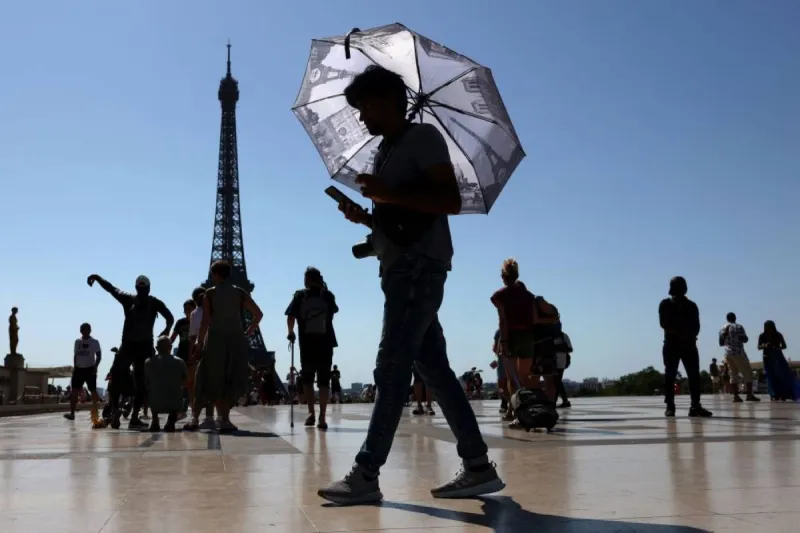
France has placed nearly a quarter of its territory on maximum alert due to a heatwave that is also fuelling wildfires, while several tourist landmarks including the Eiffel Tower have opted to close early.
24 departments in the centre-west of the country, including the Paris region, home to 22.2 million people according to AFP calculations, are under the highest level of alert (red level) declared by the national meteorological authority, which has urged "total vigilance".
With 59 other departments placed on orange alert (level two) due to weather conditions, only the south-eastern regions and the island of Corsica remain relatively spared from the third heatwave in two months.
The meteorological authority warned that temperatures could reach 39 or even 40 degrees Celsius "in some areas", noting that the intense heatwave would continue until the middle of next week.
During this weekend, which falls at the peak of the summer holiday season, high-speed TGV train services will run normally in line with the extended national holiday, but one in every 3 regional train journeys will be cancelled during the hottest parts of the day, with replacement buses provided.
Authorities urged drivers to exercise "extra caution" because of the heat and heavy traffic.
Fires and fatalities
In these conditions, wildfires are multiplying. President Emmanuel Macron warned on the platform X that "9 out of 10 forest fires are caused by human activity", adding that "one second of negligence can threaten families, endanger those who protect us, and destroy our landscapes". Since the start of summer, police have detained 32 people on suspicion of involvement in arson.
More than 25,000 hectares have burned since the start of the year — nearly double the area recorded by the same date in 2025 — according to civil defence figures.
While the human toll bears no comparison to that recorded in southern Spain, where at least 12 people have died, scattered fires have been reported across many areas of the south as well as in regions less accustomed to summer wildfires, particularly in western France.
In the Savoie region, two villages were cut off, and although the forest fire that consumed 60 hectares has now "stabilised" according to local authorities, securing access routes will require several days of work.
Climate scientists have established that recurring heatwaves are a clear indicator of climate change driven primarily by the burning of coal, oil, and gas. These episodes are expected to increase in frequency, with severe consequences both for people and the economy, and will require infrastructure to be adapted accordingly.
The French government has faced widespread accusations of unpreparedness for intense heatwaves, with deaths recorded above normal rates, particularly among the population aged over 75.
Early closure of tourist landmarks
Another consequence of the extreme heat is a roughly 20% rise in drowning cases compared with last year; official data indicate that 131 people have drowned since 19 June, particularly among minors and those over the age of 60.
Celebrations and tourist landmarks are also suffering as a result of the heatwave.
In Paris, prominent tourist sites including the Eiffel Tower, the Louvre — some of whose galleries lack air conditioning — and the Musée d'Orsay have moved their closing time forward to 4:00 p.m.
The police prefecture also cancelled the highly popular firefighters' balls scheduled for 13 and 14 July, along with outdoor sporting events and others planned for non-air-conditioned venues. Cities across France likewise cancelled their Bastille Day fireworks displays.