
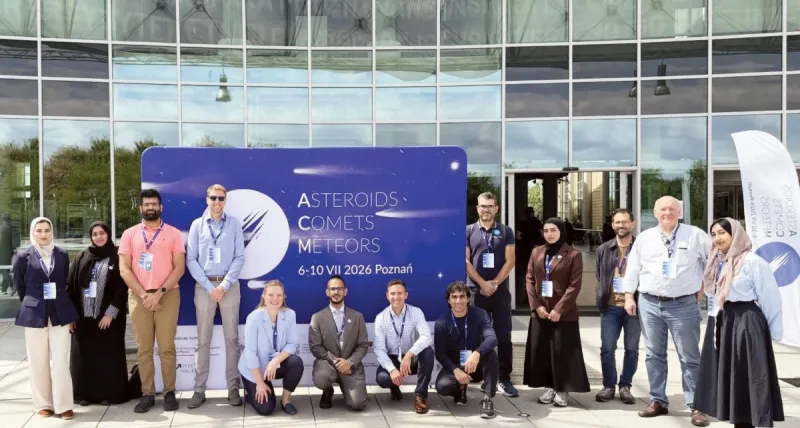
The UAE Asteroid Belt Exploration Mission team participated in the 15th International Conference on Asteroids, Comets and Meteors (ACM 2026), held from 6 to 10 July in Poznan, Poland. The conference is one of the most prominent international scientific forums specialising in the study of small bodies in the solar system, and brought together leading scientists, researchers and specialists in planetary science from around the world.
Engineer Mohsen Al Awadhi, Director of the UAE Asteroid Belt Exploration Mission and Director of the Space Missions Department at the UAE Space Agency, said: "Our participation in this conference represents an important milestone in strengthening the UAE's presence within the global scientific community specialising in asteroid and small-body sciences, and in showcasing the progress achieved by the UAE Asteroid Belt Exploration Mission. It also provides an opportunity to exchange expertise with leading researchers, scientific institutions and international space agencies, contributing to the advancement of scientific research and broadening the horizons of international cooperation in space exploration."
He added: "This participation reflects the UAE's commitment to supporting scientific knowledge and enhancing its contribution to international space exploration efforts, in alignment with the objectives of the National Space Strategy 2031, which aims to establish the country as an active partner in the development of space sciences, build national capabilities, and empower Emirati talent to help shape the future of space exploration."
Workshop
During the conference, the UAE Asteroid Belt Exploration Mission organised a specialised workshop titled "Scientific Opportunities in the UAE's Asteroid Belt Mission", with the participation of scientists and experts from around the world. The workshop aimed to introduce the mission and its scientific objectives, present opportunities for research collaboration with the international scientific community, and highlight ways in which researchers and academic institutions can contribute to its scientific programmes — thereby strengthening international cooperation and supporting the mission's goals of exploring small bodies in the solar system.
The mission team participated in the conference's scientific programme through 4 presentations covering a general overview of the mission, the scientific objectives of the Mohammed bin Rashid Explorer, studies on the stability of volatile materials in target asteroids, and thermal imaging research and its role in supporting asteroid science.
The team also presented 5 scientific posters showcasing the latest mission-related research, covering the UAE's stellar occultation campaign for asteroid (269) Justitia, asteroid classification using the mission's colour camera, dynamical constraints on the origin of asteroid (269) Justitia, thermophysical analysis of the mission's target asteroids, and the design of a multi-asteroid mission using low-thrust propulsion.
This participation reflects the progress achieved by the UAE Asteroid Belt Exploration Mission and underscores the UAE's growing standing in the field of space science and exploration, through the expansion of research partnerships and its increasing contribution to the production of scientific knowledge at the international level.