
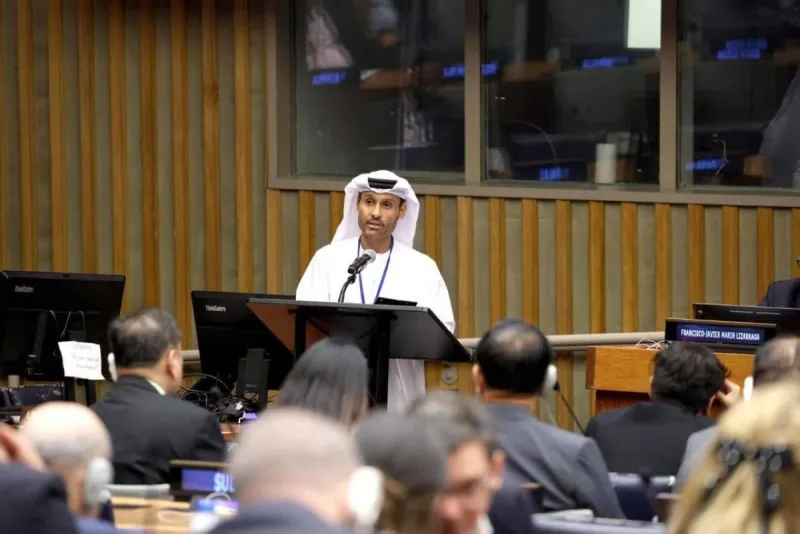
The United Arab Emirates has reaffirmed its commitment to strengthening international cooperation to counter the misuse of artificial intelligence and new and emerging technologies by terrorist organisations and extremist groups, and to building a safe and trustworthy cyberspace in support of global efforts to preserve international security and stability.
This came during the participation of a UAE delegation, which included the Cybersecurity Council, in the high-level counter-terrorism conference held as part of the United Nations Fourth Counter-Terrorism Week, taking place from 26 June to 2 July.
His Excellency Dr. Mohamed Al Kuwaiti, Head of the Cybersecurity Council of the UAE Government, delivered a speech during the fourth session, held under the title "Strategic Capacity-Building Responses: Countering the Misuse of Artificial Intelligence and New and Emerging Technologies."
Al Kuwaiti said that rapid advances in artificial intelligence and cyberspace provide governments with sophisticated tools to monitor threats, protect critical infrastructure, and enhance community security, but that these technologies are increasingly being exploited by terrorist organisations and extremist entities to spread propaganda on a wide scale, recruit and radicalise individuals, produce synthetic and misleading incitement content, and operate across borders in efforts to evade detection — all of which necessitates strengthened international cooperation to ensure these technologies are developed and used in a safe, responsible, and trustworthy manner.
He affirmed that maintaining a secure cyberspace requires the development of resilient national institutions capable of keeping pace with technological evolution, noting that possessing technology alone is insufficient and must be accompanied by strong institutions, qualified human competencies, secure and well-governed data, resilient cyber infrastructure, and institutional coordination mechanisms that ensure rapid responses to evolving threats.
His Excellency explained that the UAE's experience has demonstrated that building sustainable capacities is the cornerstone of confronting cyber threats, noting that investment in national competencies, exchange of operational expertise, establishment of technical partnerships, and enhancement of national resilience in the cyber and digital domains are essential elements for building an institutional framework capable of adapting to rapid developments and meeting future challenges.
Al Kuwaiti noted that cyber threats recognise no borders, making international cooperation an urgent necessity, and called for expanding partnerships among governments, the United Nations, the private sector, and academic institutions to share expertise, support national capacity-building, and ensure that artificial intelligence and cyber capabilities are employed in ways that promote justice and security, in accordance with international law, including obligations under international human rights law.
The UAE presented at the conference its integrated national cybersecurity framework, which supports national readiness to confront cyber threats, protects critical digital infrastructure, and enhances national cyber defence capabilities through institutional development, investment in national competencies, entrenchment of governance principles, and advancement of digital resilience.
At the conclusion of its participation, the UAE reaffirmed its commitment to continuing to work with international partners to build a safe, trustworthy, and resilient digital space, and to promoting the responsible use of artificial intelligence and emerging technologies in ways that contribute to international counter-terrorism efforts and to the preservation of peace, security, and stability at both the regional and international levels.