
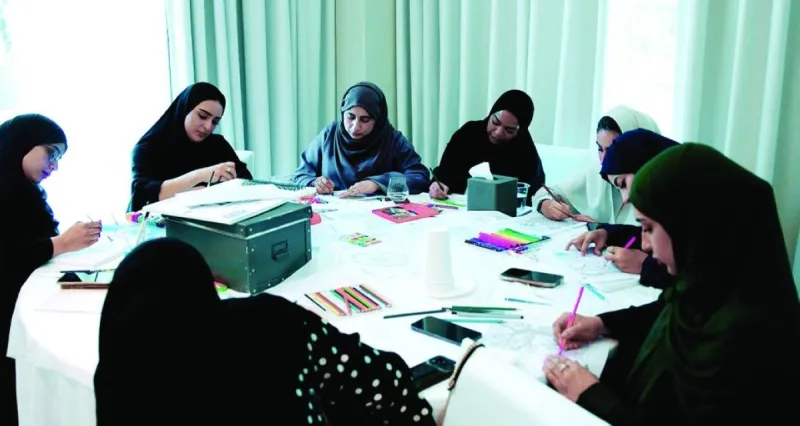
The Dubai Foundation for Women and Children has launched a specialised training workshop in art therapy, aimed at qualifying more than 60 professionals working in the fields of psychological and social support, child protection, and family care, in the use of expressive arts as a supporting tool for understanding and assisting cases.
The workshop, organised by the foundation under its 'Inclusive Rehabilitation' initiative, trains participants to employ drawing, collage, doll-making, ornamentation, and other artistic means in therapeutic sessions that provide clients — particularly those who have been exposed to traumatic situations or experiences — a safe space to express what they may find difficult to put into words.
Dr Ghaneema Al Bahri, Director of the Care and Rehabilitation Department at the Dubai Foundation for Women and Children, affirmed that art therapy represents one of the modern therapeutic approaches that helps specialists approach human feelings and experiences in an indirect and safe manner. She noted that expressive arts can form a bridge for disclosure and recovery, away from pressure or judgement.
She said that the arts reflect a person's inner world and the internal struggles and varied emotions they go through — such as grief, distress, anxiety, depression, and trauma — alongside both positive and negative experiences. She explained that the goal of employing art therapeutically is not limited to practising a creative activity, but extends to using artistic tools in a systematic way that helps specialists understand and support a case without reaching individual or inaccurate conclusions.
She noted that the workshop targets professional cadres working with the most vulnerable and at-risk groups in society, with participation from representatives of the foundation, the Community Development Authority, social support centres, family centres, and entities concerned with care and rehabilitation across the various emirates of the country. She pointed out that the objective is to develop the capacities of psychological and social specialists.
Dr Al Bahri highlighted that art therapy relies on free expression, whereby the specialist does not direct the client to draw a specific thing or execute a particular work, but instead provides an open space to manifest what lies within, helping to surface unexpressed feelings and experiences. She affirmed that this type of therapy is linked to a number of psychological disorders and traumas, including post-traumatic stress disorder, anxiety, depression, and other conditions that require flexible and supportive therapeutic interventions.
Al Bahri also revealed initiatives in the field of positive parenting, explaining that the foundation has developed a training guide drawing on Arab, Gulf, and international experiences that is compatible with Arab and Emirati culture. The guide comprises 12 sessions directed at parents, focusing on how to deal with children who have behavioural problems and gifted children. It has been translated into English and will be launched electronically in the coming months.
Al Bahri touched on the foundation's experience with supportive therapies, explaining that since 2010 the foundation had observed that some traditional therapeutic approaches may not achieve the desired results with children and women who have been through difficult experiences. This prompted the introduction of play therapy for children up to the age of 13, which has yielded positive results — particularly for children who had been experiencing difficulties in their educational institutions, sleep disorders, movement challenges, and difficulties in building healthy relationships with others.
The Director of the Care and Rehabilitation Department explained that a number of children who underwent these sessions later succeeded in reintegrating into society, completed their university education, and some joined the labour market, while others formed their own families. She considered this an important indicator of the impact of early and specialised therapeutic interventions. She also noted that the foundation launched animal-assisted therapy during Expo 2020 Dubai, by introducing licensed and accredited pets as partners in the therapeutic process.
Al Bahri affirmed that the foundation is focusing this year on a number of programmes and initiatives supporting the family, foremost among them the 'Malath' application — the first smart programme targeting abused women, allowing them to access psychological support sessions with complete confidentiality wherever they are, without the need for a specialist to be physically present.