
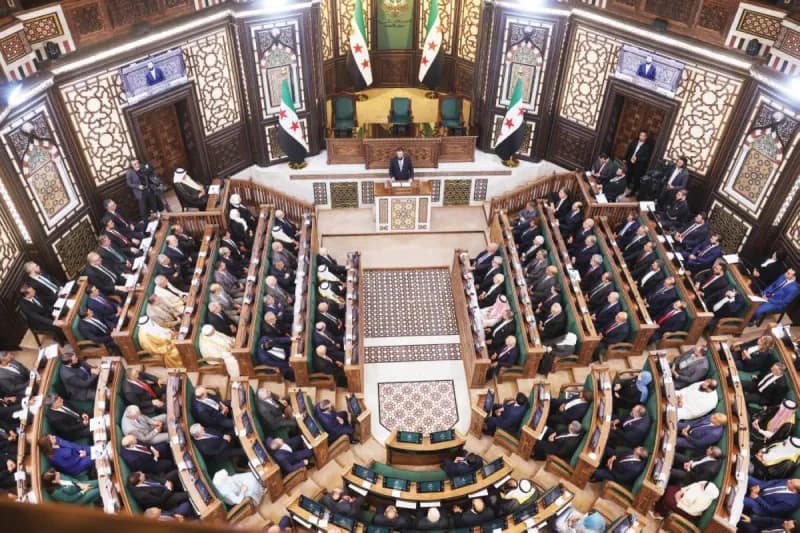
Syria took a new step in its history and in charting the contours of its future with the convening of the first session of the transitional People's Assembly, whose most prominent tasks will include forming a committee to draft a new constitution for the country and laying the groundwork for the transitional process.
The session opened with the swearing-in of 206 members present — excluding members from the Sweida governorate and one deceased deputy — in the presence of President Ahmad al-Sharaa and a number of ministers.
The deputies will elect the members of the Assembly's presidential bureau, with the oldest member presiding over the inaugural session. In a speech at the opening of the session, al-Sharaa called on deputies to serve as models of responsibility and competence, and to contribute to entrenching a culture of dialogue, the rule of law, and respect for institutions. Al-Sharaa said: "Humanity has continued since its inception to search for the optimal way to manage its interests; acceptance and consent are the means by which conflict is expelled."
Al-Sharaa added: "Syria is writing a glorious history that reflects its heroism. We face a responsibility to build the nation and the individual and to let responsibility prevail. We are partners in building that responsibility, and the Assembly today is a platform for truth and justice. Syria today is writing a new history that reflects its civilisation, its values, and its heritage. Let us together make the history of modern Syria."
For his part, the head of the Supreme Committee for People's Assembly Elections, Muhammad Taha al-Ahmad, described the session as historic, saying it represents the blood of the martyrs and a defining historic moment in which "we declare to the world that Syria has shaken off the dust of war."
He noted that true worth is not measured in words but in the magnitude of the sacrifices made by the Syrian people. Meanwhile, Osama al-Assaf, the oldest member of the People's Assembly, called on the members of the temporary legal committee to oversee the electoral process, count the votes, and establish the electoral regulations for the Assembly's presidential bureau.