
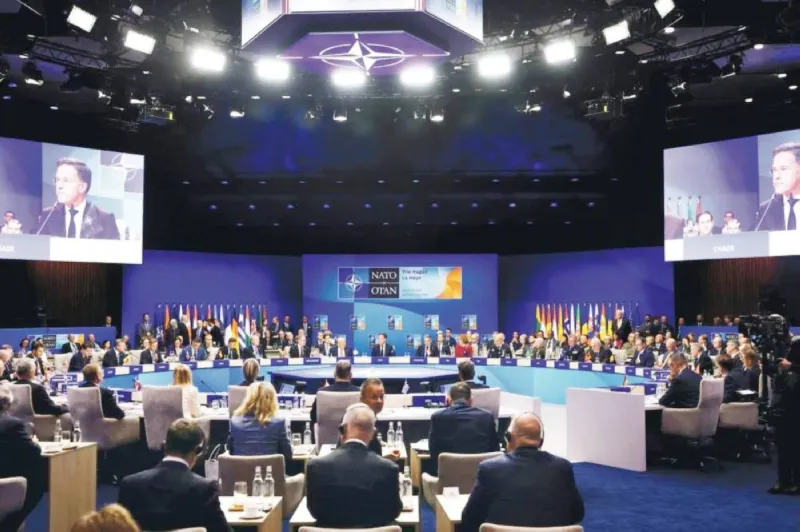
At what international observers describe as the most sensitive juncture in the alliance's history stretching back to 1949, the Turkish capital Ankara is preparing to host the 36th NATO leaders' summit. The summit, which convenes tomorrow and the day after, takes place amid rapidly shifting geopolitical variables, not least the rising tension across both sides of the Atlantic over burden-sharing in defence.
These include American demands for increased military spending, alongside the ramifications of regional conflicts extending from Ukraine to the Iran war crisis, and their effects on the security of maritime corridors.
Draft texts of the summit's closing statement indicate that the alliance is moving toward designating Russia a "long-term threat" to Euro-Atlantic security — a characterisation that reflects a fundamental shift in NATO's defence doctrine, from traditional deterrence policies toward a deliberate strategy of containing and exhausting Moscow.
Within this framework, the alliance is set to approve a military aid package for Ukraine worth 70 billion euros, covering 2026 and 2027, with guarantees of similar support levels thereafter.
Strategic analysts argue that this massive financial and logistical commitment goes beyond emergency military support, becoming a "strategic investment" aimed at constraining Russia's room for manoeuvre and prolonging the conflict in ways that drain Moscow's economic and military capabilities.
On the political front, this direction places the alliance before a dual test. On one hand, NATO Secretary-General Mark Rutte is seeking to maintain alliance cohesion and unify visions amid sharp criticism from US President Donald Trump over disparities in defence spending. On the other, experts believe that adopting an attrition strategy could narrow the prospects for a political settlement of the Ukrainian crisis, as the alliance has come to tie the security of the European continent to transforming Kyiv into an advanced line of defence against Russian dominance.
Yet the outcomes of the Ankara summit — which will bring together leaders of 32 countries — will not be confined to the Ukraine file alone. They will also seek to consolidate a security and defence network stretching from American territory to Turkey, as part of a re-engineering of regional balances.
As results are awaited, Europe appears to be entering a phase of permanent strategic mobilisation, in which security challenges — encompassing energy security, hybrid warfare, and coordination with partners in Asia and the Pacific — have become an inseparable part of the alliance's survival and its capacity to influence the contest of international wills.
Rami Zohdi, Deputy Chairman of the Arab Centre for Research and Strategic Studies, affirms that the trend emerging at the 36th NATO summit — toward entrenching the characterisation of Russia as a long-term threat, in parallel with the discussion of allocating approximately 70 billion euros to support Ukraine during 2026 and 2027 — reflects a strategic shift that goes beyond the concept of traditional deterrence toward building an extended policy of containment and attrition.
He adds that the alliance is no longer focused solely on preventing the expansion of military operations, but is working to extend Kyiv's capacity to hold out, thereby imposing on Moscow a mounting military, economic, and political cost.
He continues that this approach carries complex implications for European security. On one hand, it strengthens alliance cohesion and raises the defensive readiness of its member states; on the other, it entrenches a long-term confrontation with Russia, increasing the likelihood of arms races, deepening the geopolitical divisions of the continent, and delaying the prospects for building a stable European security architecture.
On the question of political settlement, Zohdi stresses that the continuation of massive financial and military flows may give Ukraine stronger negotiating leverage in the future, but at the same time it may push Moscow to harden its position and refuse to make concessions under the pressure of attrition.
The prospects for a political solution will therefore remain hostage to the ability of international parties to strike a balance between sustaining military support and opening a serious negotiating track that takes into account the security interests of all parties — for long wars rarely end in a purely military decision.
For his part, Dr. Dimitri Breج — professor of international relations and director of the Russian Studies Unit at the Centre for Arab-Eurasian Studies — believes that relations between Russia and the European Union are passing through an unprecedented phase of tension. He notes that Brussels has come to regard Moscow as a strategic adversary in the wake of the Ukrainian war and the growing disputes over European security files and the South Caucasus.
He says that Russia, in turn, is sending clear messages to European states signalling its readiness to deal with various escalation scenarios, particularly toward countries that have recently joined NATO, which Moscow considers part of the direct threats to its national security.
He explains that the Russian-European rivalry is no longer confined to the Ukrainian arena but has extended to the South Caucasus, where the European Union is seeking to expand its influence in Armenia — a trend manifested in its support for the Armenian government led by Nikol Pashinyan, as part of broader European efforts to strengthen its political and security presence in Russia's immediate neighbourhood.
Breج notes that the 36th NATO summit in Ankara will devote considerable attention to the file of collective European security, as well as examining Turkey's growing role within the alliance.
He affirms that Ankara has become a pivotal player by virtue of its relations with Moscow on one side and its active NATO membership on the other, in addition to its contribution to supporting Ukraine with weapons and advanced military technologies, including cooperation in the field of unmanned aerial vehicles.
He points out that the confrontation between Russia and the European Union is likely to continue for a long period, even in the event of partial understandings between Moscow and the administration of President Donald Trump regarding the Ukrainian crisis, noting that Russian-European differences are deeper and more complex, pertaining to accumulated security, strategic, and economic files.
He adds that any sustainable settlement of the Ukrainian crisis will remain contingent on the provision of mutual security guarantees between Russia and the European states, in addition to addressing outstanding issues — foremost among them the question of frozen Russian assets held by the West.
He also notes that the European Union is undergoing a gradual transformation from an economic and political bloc into an entity with an increasingly security and military character, driven by rising defence spending since 2022 — a development that sharpens the competition with Moscow and complicates the prospects for rapprochement in the foreseeable future.