
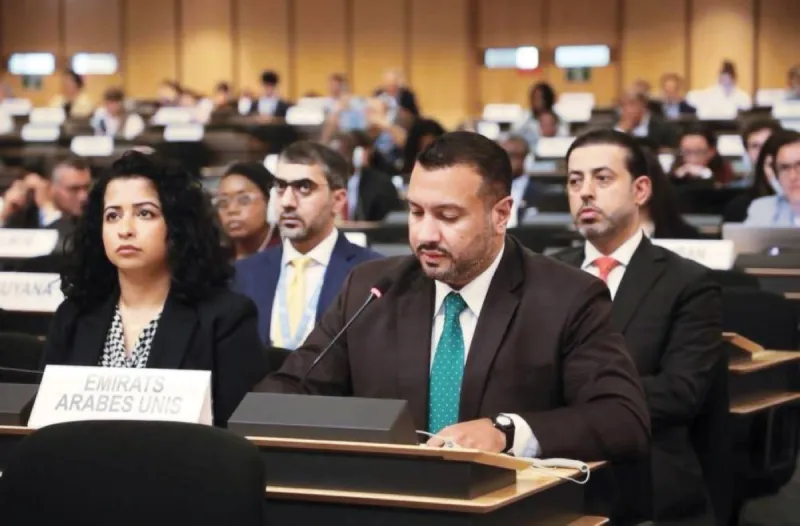
The United Arab Emirates has affirmed that the continuing escalation in the city of El Obeid and surrounding areas demonstrates that there is no military solution to the conflict in Sudan, renewing its call for an immediate and unconditional ceasefire and the reaching of an urgent humanitarian truce.
The statement came during the UAE's address at the emergency session convened by the United Nations Human Rights Council on the situation in the city of El Obeid.
The statement renewed the UAE's condemnation, in the strongest terms, of all violations of international law committed by both parties to the conflict across Sudan, including the targeting of civilians and civilian infrastructure.
It called for expanding the UN arms embargo to cover the entire territory of Sudan, describing this as a necessary measure to halt hostilities and ensure the protection of civilians, while stressing the importance of guaranteeing safe and unimpeded humanitarian access to all affected areas.
The UAE, in its capacity as a member of the Quad group on Sudan, welcomed the outcomes of the Berlin Conference and the opportunity it provided for Sudanese civilian actors, alongside the continued efforts of the Quint group to advance the civilian track.
In conclusion, the UAE affirmed that the primary objective of the international community must be to support an inclusive, civilian-led political process, independent of both warring parties and extremist groups, and one that reflects the aspirations of the Sudanese people.
Meanwhile, UN High Commissioner for Human Rights Volker Türk issued a strongly worded warning, telling the Human Rights Council in Geneva: "The indicators coming from El Obeid are clear and unambiguous," cautioning that "a new human rights catastrophe" was unfolding in the capital of North Kordofan state.
Türk stated that the Office of the High Commissioner had documented patterns of summary executions, abductions, torture, and sexual violence on routes used by displaced persons across Kordofan, calling on the international community to act to prevent a repeat of the atrocities witnessed in the city of Al Fashir last year.
He added that the UN Human Rights Office had documented 15 drone attacks on El Obeid and its surroundings between 6 and 28 June, resulting in the deaths of at least 45 civilians and the wounding of 41 others, with the actual toll likely to be higher.
He noted that drones belonging to both parties to the conflict had repeatedly targeted markets, schools, fuel stations, water facilities, and civilian vehicles in the Kordofan region.
Separately, the United Nations announced the destruction of a truck contracted by the UN Refugee Agency (UNHCR) that was transporting humanitarian aid to South Kordofan state.
According to the Office of the UN Secretary-General's Spokesperson, the truck was destroyed near the Tendelti area, resulting in the loss of 50 metric tonnes of relief materials, including food items, blankets, water containers, and household supplies that had been destined for those most affected by the conflict.
UN Secretary-General Spokesperson Stéphane Dujarric said the destruction of the convoy meant thousands of people would be deprived of urgently needed humanitarian assistance, expressing the UN's concern over the escalating violence and growing humanitarian needs. He renewed calls on the parties to the conflict to protect civilians and civilian infrastructure and to ensure aid access, as well as urging donor states to increase funding to meet rising needs.
While no statement was issued by the Sudanese army regarding the incident, media reports citing local sources and activists in Kordofan said the truck was struck by a drone belonging to the Sudanese army while en route to the town of Abu Jibeha in South Kordofan state.
The incident comes in the context of repeated warnings about the targeting of humanitarian infrastructure during the war.
The UN Office for the Coordination of Humanitarian Affairs had previously confirmed that attacks on roads, bridges, and civilian facilities were impeding the delivery of relief to affected areas, while the United States had condemned, in June, the bombing of the Ardamata bridge in West Darfur state — one of the most important aid supply routes to Darfur and Kordofan.
Washington considered the targeting of the bridge a threat to the delivery of humanitarian supplies to millions of Sudanese, and called on the parties to the conflict to accept a humanitarian truce to allow aid to reach those in need, affirming that there is no military solution to the war.
For its part, the United Kingdom called for urgent international action to prevent a deterioration of the situation in El Obeid.
British Foreign Secretary Yvette Cooper said: "The city cannot be the next senseless tragedy," warning against a repeat of what was witnessed in Al Fashir and arguing that the targeting of aid workers and civilians, and the obstruction of access to basic services, demands a unified international response.