
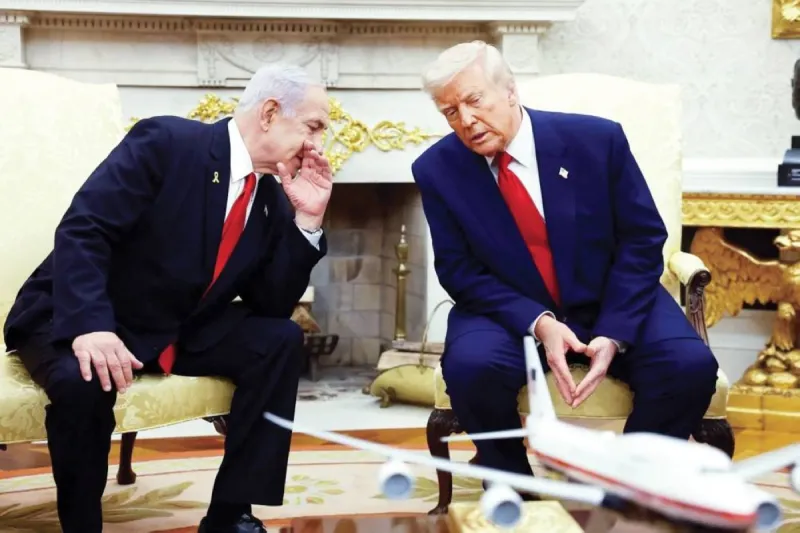
Israeli-American relations are currently experiencing an unprecedented state of public tension and discord, particularly between the US administration led by President Donald Trump and the government of Benjamin Netanyahu. This clash of interests centres on the management of regional files and diverging political and electoral priorities.
Roland Oliphant and David Blair wrote in The Telegraph under the questioning headline "Has the relationship between the United States and Israel changed forever?", noting that Trump's snubbing of his ally Netanyahu signals that a once rock-solid partnership has reached the point of collapse. The two authors argued that Netanyahu himself may be the architect of this rupture.
The writers say that Netanyahu presented himself as a leader capable of protecting Israel's security and dealing effectively with Trump — yet the US president appears to have adopted an entirely different view of Netanyahu's credentials. Trump stated earlier: "If it weren't for me, there would be no Israel."
This came just two days after a deal was struck with Iran that was concluded with conspicuous disregard for Israel. The authors consider this "extraordinary" statement the clearest indicator yet that an alliance stretching across decades, long regarded as unshakeable, can no longer be taken for granted.
This tension emerged at the close of a war both sides entered together — and, more significantly, the stronger of the two allies subsequently concluded a separate agreement with the "enemy" without consulting its battlefield partner, according to the article's framing.
The authors say that Trump's disregard for the most fundamental obligation of an ally — not to abandon a partner — raises an urgent question: has the special relationship between the two sides ultimately broken down? According to the two writers, what makes this situation different is not only Trump's moves, but also the sharpening of critical sentiment within American public opinion toward Israel, including within the Republican Party.
The analytical outlook on the future of the historic Washington–Tel Aviv alliance appears to have left the precincts of traditional optimism, settling instead in a grey zone governed by wariness and careful recalculation.
Observers believe that the current scene does not merely reflect a passing stumble between incompatible governments, but rather signals a deep shift within the American political environment. Younger generations and the base of the Democratic Party, too, no longer view support for Israel as a self-evident priority but rather as a strategic burden that conflicts with Washington's desire to reduce its military engagement in Middle East crises and redirect its weight toward other international conflicts.
This divergence in priorities becomes starkly apparent when the American desire for regional de-escalation collides with Israel's insistence on pursuing open, multi-front military confrontations — placing the US administration before complex political and moral dilemmas in the eyes of its own public.
Despite these visible cracks in the surface of the alliance, national security and intelligence experts discount the possibility of complete collapse or a total break, pointing to the deep institutional roots that bind both sides.
Intelligence coordination networks, joint technological and defence development programmes, and mutual dependence in arms sales continue to serve as a safety valve protecting the relationship from disintegration in times of crisis.
These analysts also recall the sharp historical turning points that witnessed stormy disagreements in past decades, all of which invariably ended in containment, because overriding strategic interests compel the preservation of this critical bond.
On the other side, Israel's internal debate reflects genuine anxiety about the contours of the coming period. Military and political leaders fear the loss of "bipartisan consensus" in Congress and the transformation of their country into a contentious issue in America's domestic polarisation — which could threaten the speed at which vital military supplies flow or weaken the diplomatic "veto" umbrella in international forums.
These various perspectives converge on the conviction that the alliance has already left the era of "American blank cheques" and entered a new phase in which relations are characterised by pragmatism and conditionality — where support is governed by the limits of supreme American interests rather than the unconditional commitment that prevailed for decades.