
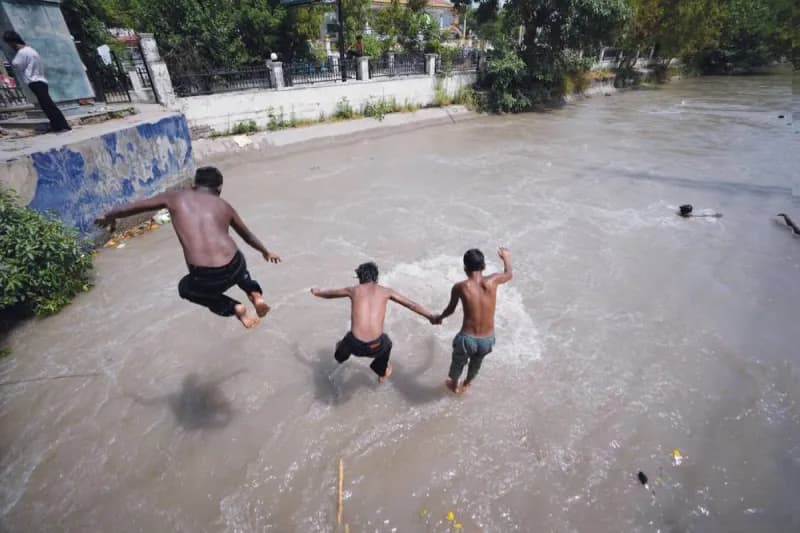
The United Nations Children's Fund (UNICEF) has warned that nearly every child in the world is exposed to at least one climate-related risk, with up to 1.8 billion children at risk from drought and 1.2 billion from extreme heat.
In a report published yesterday, the organisation said children are "disproportionately affected" by a range of escalating climate-related hazards. It said governments urgently need to invest in infrastructure, adaptation capacities, and disaster management to reduce children's exposure to these risks.
The report outlined a wide range of climate hazards facing children, in addition to the impact of air pollution and the risk of insect-borne diseases such as malaria.
It reviewed data on access to water, healthcare, and social services around the world, noting that up to 1.1 billion children globally have been exposed to at least 3 overlapping climate hazards.
The organisation warned of a "dangerous cascade of multiple, overlapping risks" that could overwhelm governments and social services.
UNICEF Executive Director Catherine Russell said: "Children's lives continue to be disrupted by the effects of heatwaves, wildfires, droughts, and floods. Half of the world's children now live under at least 3 overlapping climate threats that affect their daily lives."
According to the findings, drought, extreme heat, and heatwaves represent the most widespread group of climate hazards, with more than 296 million children living in areas exposed to all 3 of these risks simultaneously. The second most common combination is drought, extreme heat, and tropical storms, which affect more than 115 million children around the world.
Rohini Sampoornam Swaminathan, the organisation's Director of Statistics and one of the report's authors, said: "It is not just about children being exposed to individual hazards such as floods, drought, heatwaves, or extreme heat — it is about their exposure to multiple hazards."
Up to 662 million children are at risk from tropical storms, 337 million from river flooding, 33 million from coastal flooding, and 1 billion from malaria — the majority in Africa. The education of 242 million children in 85 countries was also disrupted by climate hazards in 2024.
UNICEF identified Somalia, Madagascar, Myanmar, Cambodia, and Pakistan as the most vulnerable countries, noting that the largest numbers of children exposed to drought live in agriculture-dependent economies such as Bangladesh, Indonesia, Nigeria, Pakistan, and Tanzania.
According to the report, children in landlocked countries face "disproportionate" risks from drought, desertification, heat stress, and flash floods, with water crises in countries such as Botswana and Burkina Faso expected to worsen.